
 Posted by
 Introduction
To fully understand the intricacies and nuances encompassing The Circuit of Culture, I chose the Dole/Kemp 96 campaign website for my final project. Although many remember the 1996 Presidential election for incumbent President Bill Clinton’s reelection, the first by a democratic President since 1944, I believe it is the impact the election had on internet campaigning that is far more interesting. The goal of any political campaign is simple, candidates spend money to reach more voters ideally earning their votes. The rise of the internet gave candidates another avenue to do this and ended up changing campaigning forever.
Representation
Representation is the form an object takes and the meanings encoded in that form (Curtin 2006). When Dole took his campaign online in 1995 representation followed. In the Dole/Kemp 96 campaign website, representation takes form in the particular image of the candidate, how they represent themself to various identities. According to Warner et al., “decades of communication research have demonstrated that political candidate images are important predictors of electoral success” (2016). The creation of Dole’s website employed representation by creating a more personal relationship with potential voters. When the website launched in August the Dole campaign claimed it was the first political website fully customizable to the user. This starts with user being given the ability to fully customize a “Dole Web Page” to their liking when they first enter the site. This includes the web page greeting the user by name and alerts to press releases the user hadn’t intereacted with yet. Users were even given a layout choice for the page in the footers at the bottom (Wheelwright 1996). Although these features are not longer usable since the website has been preserved they still provide context for how revolutionary and personable the website features were for the time. The interactive capabilities also show a clear effort from the Dole campaign to make Bob Dole look like more than just another “old guy” (Binder 2019). The websites effort to appeal to a younger audience by presenting Dole as a man in touch with the youth and technology gives a clear picture as to what his aim for representation was in the election.
Identity
The Circuit of Culture is a unique analysis tool because of the complex relationship between each of its components. Because of this, there is often overlap between areas and their deeper meanings. A key aspect of the Representation in the campaign website was its ability to personalize the campaign to voters creating a unique relationship with the electorate. Identity inside the Circuit of Culture is defined as meaning that accrues to all social networks, from nations to organizations to publics (Curtin 2006). Concerning the political campaign website, identity can be focused on the image the candidate puts out for the public to see. In Dole’s case, this included not only targeting an older more conservative voter population with his political views but also a clear effort to reach a younger generation through his website set up. When considering the identity of a political campaign, the candidate’s beliefs and agenda usually make up the forefront. Because of this, Dole’s website needed to promote the same message that voters were hearing from his T.V. ads and political speeches. If potential voters felt like there was a difference between traditional campaign avenues and the Internet campaign it could result in a loss of voter trust in Dole’s identity. A major way Dole and the website designers countered this possibility was through the implementation of a slogan on the front page of the website that embodied Dole’s ideal country if he were elected president.
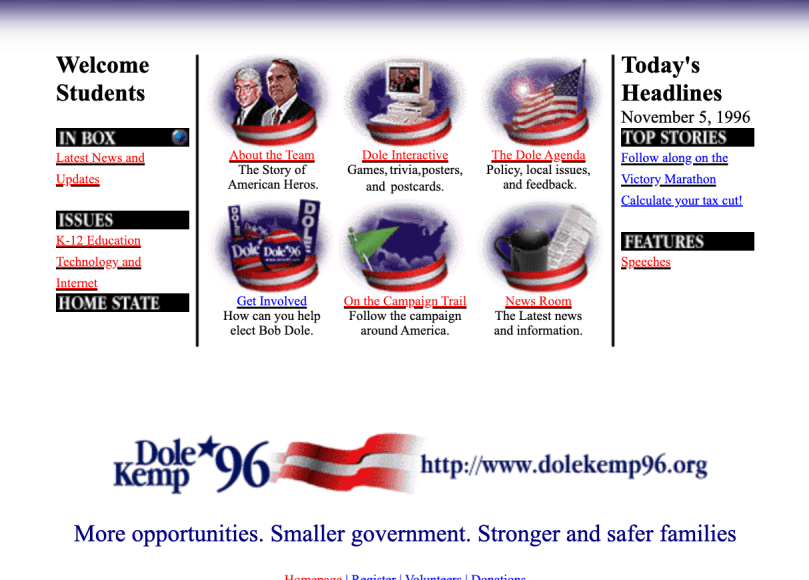
Image of Slogan Below:

The three statements that make up the slogan, “More opportunities. Smaller government. Stronger and safer families” (Dole and Kemp 1996) are central beliefs to a majority of conservatives. Two of the key components of Dole’s campaign included increasing job opportunities and decreasing the crime rate. Although the slogan doesn’t directly state these goals they are implied by the more general statements, “More opportunities” (Dole and Kemp 1996) and “Stronger and safer families” (Dole and Kemp 1996). The slogan is just one aspect that makes up the identity of the website and while it focuses more on Dole’s conservative image another identity is his effort to attract a more youthful voter audience. According to Elizabeth Weise, when Bob Dole urged young people to get involved with the campaign by interacting with his World Wide Web page, he believed he was tapping into an untouched pool of voters (1996). It wasn’t just the fact that Dole had launched the campaign online. The website’s features also evidence a clear effort to interact with younger voters. This is most noticeable on the Dole Interactive page inside the website.
Image of Dole Interactive Page Below:
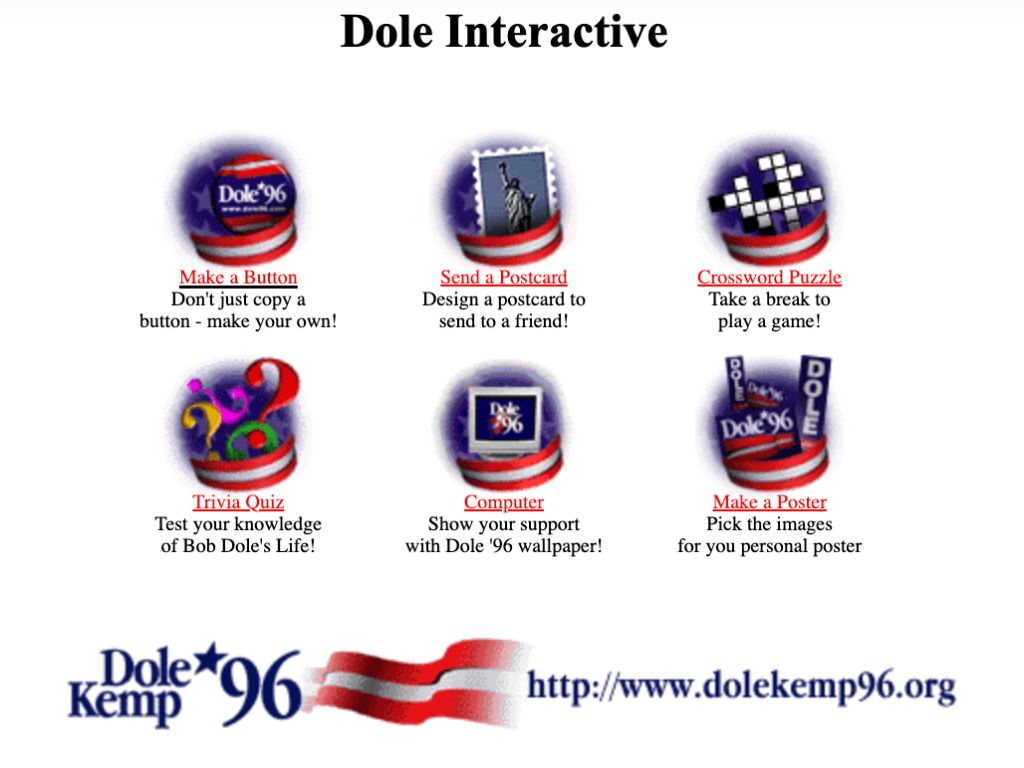
Here viewers can access several mini-games and creation features that personalize the experience to that specific viewer, increasing interaction and promoting a longer stay on the website. The creator of the website himself, Kubasko was even quoted concerning the interactive features saying how they were “incredibly innovative and had we known about patent law, would have patented the hell out of most of these technologies” (Binder 2019). This gives a glimpse into just how ahead of its time the website truly was and with the inclusion of mini-games and interactive features, the identity seems clearly targeted towards a younger tech-savvy audience that would find a connection to Dole through such interactive technologies. What makes this all even more interesting is the research Weise did concerning whether or not the effort from Dole to identify with the youth worked. Interestingly enough Weise found internet users to be older, more educated, and more likely to vote than the general population (1996). This is largely due to how expensive it was to be on the internet at the time. It seems cost was the biggest limitation as to why Dole wasn’t able to tap into the youthful population he originally believed possible. It’s important to remember that just because this aspect of the website identity didn’t produce the results the candidate was hoping for doesn’t mean it wasn’t still an important part of the website’s identity. Concerning identity, the Dole/Kemp 96 campaign website put forth an image of reliance on traditional conservatism combined with futuristic technologies in an effort to appeal to a wide range of voters.
Production
The Production of the Dole/Kemp 96 campaign website must be looked at with regard to who produced it, why they produced it, and where the money for production came from. Production outlines the process by which creators of cultural products imbue them with meaning (Curtin 2006). This means diving into who the web developers were and their backgrounds. There is no man or woman more central to the development of the campaign website than Rob Kubasko, the man hired to create Dole’s website. According to an article from, Matt Binder, Kubasko was working as a graphic designer at Arizona State University when he was able to connect to the campaign through a mutual connection (2019). Kubasko explains that “he had been interested in politics for some time” and discusses how “at that time, there weren’t a lot of experienced web developers out there” because this was still during the early days of the internet (Binder 2019). With Kubasko, Dole was not only getting a web designer with a passion for politics, but he was also getting someone at the forefront of the internet revolution who knew the ins and outs of what would make a website successful. Both aspects of who Kubasko was as a person, are deeply connected to why the design and capabilities of the website turned out so well. At the time websites were often cluttered and confusing. Kubasko however developed the website in a way that was extremely user friendly while also giving the viewer all the information necessary to understand the election. This included the columnized format of the website’s homepage which made it pretty blocky but also easy to understand.
Image of Homepage Below:
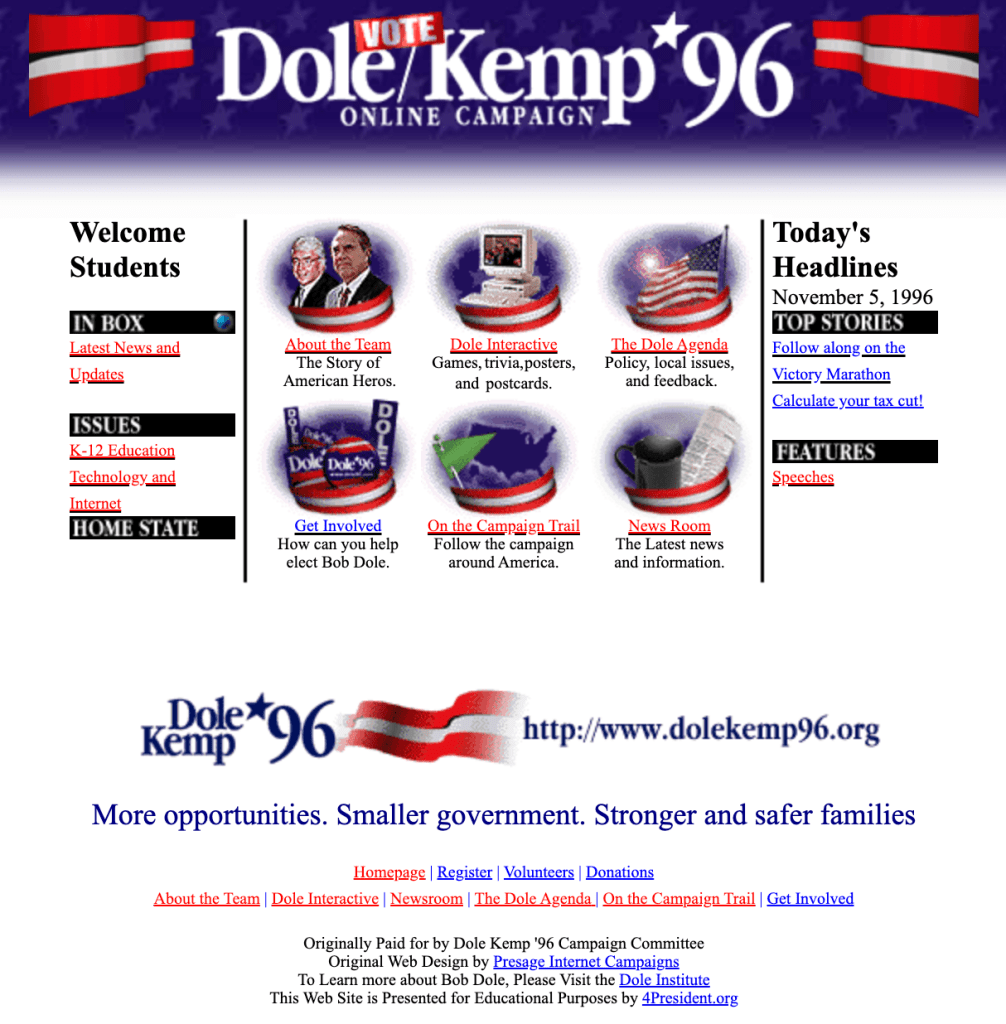
He simplified it further while also adding extra information through the use of links that took the user to an entirely new page of information where they then had another 6 options to choose from.
Example Link from the Homepage: The Dole Agenda
I believe that the vast amount of information the website provided the user is connected back to Production through Kubasko’s interest in politics and his desire to give every potential voter an experience he would deem worthy. Another aspect of Kubasko’s production is the unique moving images and interactive features discussed earlier.
Click Link To See Moving Coffee Steam: http://www.dolekemp96.org/main.htm
I believe his youthful creativity had a large role with respect to these features. He developed the website in line with what Dole would have asked for but further than that what he thought would generate the best reaction. Since it was one of his first major projects the future of his career would have also been riding high on the success of the site. Money is another major factor in Production so looking at where the money came from is important. According to Kubasko himself, the website was pretty costly even with the funding of a presidential candidate therefore it would have been crucial for him to please the PAC boosters who provided a majority of the money (PUBLIC CITIZEN 1997). In this situation, Kubasko’s commitment to the project did the job in itself. Information-wise it was pretty simple he just needed to include everything from Dole’s current campaign which he did in excess through the numerous pages about Dole and his politics. In reference to going above and beyond he added features that were revolutionary for the time period such as the customized electronic postcards sent via email. So this is to say, that Kubasko’s creativity and Dole’s politics are the biggest reasons why the website generated such a great response from voters.
Consumption
Consumption in relation to The Circuit of Culture is when messages are decoded by audiences (Curtin 2006). Consumption in relation to the Dole/Kemp 96 campaign website finds its value through how it influences the electorate’s vote. Political campaigns are defined as “means by which candidates and political parties prepare and present their ideas and positions on issues to the voters in the period preceding election day” (Open Election Data Initiative). The goal of the website campaign would have been no different besides adding another avenue for how people could consume political information. The website includes all the information that voters would typically consume. This includes background information on Dole and his family, a campaign slogan, and most of his political agenda.
Image for Reference Below:
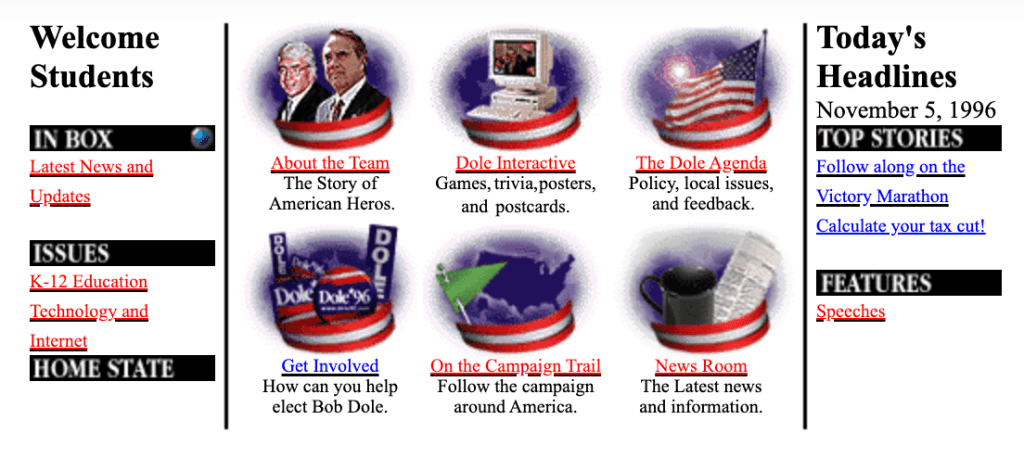
The website goes above and beyond concerning information so there isn’t much more that could have been added to affect voter consumption. Therefore it’s important to look at the greater effect on consumption in relation to political campaigns moving online. To analyze this further, we must first take a step backward to Clinton’s election in 1992 where he made “building an information superhighway” a key facet of his pro-tech campaign (Newstex 2020). His victory opened up the door to the commercialization of the public internet sector and with it the Web era. This leads into the election of 1996 where for the first time in history the internet played somewhat of a significant role (Rosenberg 2020). This is largely due to what is still considered one of the greatest internet namedrops ever by a politician. Towards the end of one of Dole’s campaign speeches, he decided to plug his website but missed the dot before org (THE WASHINGTON POST 1996).
Namedrop Video – Skip to 1 Hour 30 Minutes
Despite the mistake, the engagement was immense and the website would have a record-breaking day of over 2 million hits on the homepage (Binder 2019). Of those 2 million viewers the majority were an older voting population who was going online for the first time in order to check out a political campaign website (Weise 1996). The website was not just another avenue for political information it ended up integrating an entirely different generation of voters with the rise of the internet.
Regulation
In my research, the two biggest aspects of Regulation found within the Dole/Kemp 96 campaign website are content and financial regulations. Regulation comprises controls on cultural activity (Curtin 2006). Content wise the site was regulated by Dole’s own politics. While Dole Agenda might at times reference Clinton’s politics, it’s not gonna provide reasons as to the benefits of Clinton’s policies. Most of the time Dole references Clinton’s politics to show areas where he aims to improve or do something differently. For example, he mentions Clinton’s promise to balance the budget and immediately bashes him for doing the opposite the day he stepped into office. Content regulations in regard to political campaigns are fairly easy to understand. A republican candidate isn’t gonna promote information that would support his democratic opposition and this is true for both parties. Financial regulations regarding the campaign website are a little more involved. Because the website is another form of political campaigning it is also regulated by the Federal Election Commission or the FEC for short. The FEC regulates the financial side of campaigns as well as to some extent the content of campaigns (Mason and Abegg 1999). Financially the website was okay as long as the funds supporting it were coming from legitimate donors. What scared the FEC more was the vastness of the internet and its inability to regulate its expansion into the political world going forward. Concerning the 1996 election, however, the FEC played little to no role in regulating the website other than watching where the money came from that supported it. What ended up being the biggest regulation was the early stage of the Internet itself. Because the campaign website came at a time when the internet was brand new, running a site for millions of people was extremely expensive. So expensive in fact, Kubasko the website designer remembers one of the biggest regulations being the T1 line they used to host the site. According to him the line “would go down all the time and [they’d] have to reboot the system” (Binder 2019). He furthered this point by saying, “Literally, no joke, this was about as meager as you could imagine because there weren’t a lot of choices back then that weren’t way out of the budget for even a presidential campaign at the time” (Binder 2019). The early stages of the internet posed a major hurdle for Kubasko and his team in regard to financial regulations because of just how expensive it was to host a large website during the time.
Conclusion
The Circuit of Culture and its five aspects: representation, identity, production, consumption, and regulation offers an interesting way to culturally analyze a text or artifact. In relation to the Dole/Kemp 96 campaign website the combination of anaylis between the five different areas gave the website a clear culture. The websites aim was to provide voters with enough information to fully understand Dole and his campaign while also trying to reach into an untapped pool of younger voters through interactive features that were revolutionary for the time.
References
“1996 Federal Campaign Spending up 33% from 1992; Total Candidate and Major Party Disbursements Top $2 Billion.” Public Citizen, http://www.citizen.org/news/1996-federal-campaign-spending-up-33-from-1992-total-candidate-and-major-party-disbursements-top-2-billion/.
David Mason and John Abegg. “The Internet, the First Amendment, and Campaign Finance Regulation.” July 1, 1999. The Federalist Society, fedsoc.org/commentary/publications/the-internet-the-first-amendment-and-campaign-finance-regulation.
Elizabeth Weise Ap cyberspace writer. “PROFILE OF TYPICAL INTERNET USER MAY SURPRISE YOU”. Wisconsin State Journal (Madison, WI). October 16, 1996, Wednesday,. https://advance.lexis.com/api/document?collection=news&id=urn:contentItem:3SD5-F180-0094-33YH-00000-00&context=1516831.
Geof Wheelwright For The Financial Post. “U.S. ELECTION RACE SHIFTS TO CYBERSPACE: Major players promoting their campaign messages via the World Wide Web”. The Financial Post (Toronto, Canada). October 26, 1996, Saturday,. https://advance.lexis.com/api/document?collection=news&id=urn:contentItem:3S6T-4B60-00GC-P45M-00000-00&context=1516831.
“Global Network of Domestic Election Monitors.” Open Election Data Initiative, openelectiondata.net/en/guide/key-categories/election-campaigns/.
Matt Binder. “Yes, You Can Still Visit Bob Dole’s 1996 Campaign Website. Here Is Its Story.” Mashable, Mashable, 29 Oct. 2021, mashable.com/article/bob-dole-1996-website.
Patricia A. Curtin & T. Kenn Gaither (2006) Privileging Identity, Difference,
and Power: The Circuit of Culture As a Basis for Public Relations Theory, Journal of Public
Relations Research, 17:2, 91-115,10.1207/s1532754xjprr1702_3
Scott Rosenberg. “How the Internet Became Election Ground Zero”. Newstex Blogs Axios. November 4, 2020 Wednesday. https://advance.lexis.com/api/document?collection=news&id=urn:contentItem:6171-NVS1-JCMN-Y19V-00000-00&context=1516831.
THE WASHINGTON POST<. “Dole slip lures Net surfers to Clinton’s web”. The Ottawa Citizen. October 8, 1996, Tuesday, FINAL EDITION. https://advance.lexis.com/api/document?collection=news&id=urn:contentItem:3SR4-0YJ0-002F-0154-00000-00&context=1516831.
 Cultural History of the Internet