
 Posted by
 The Evolution of SpaceJam.com
Introduction
SpaceJam.com was established in December 1996 as a promotional tool for the popular live-action/animation film Space Jam. The website has remained culturally relevant across fan bases and generations, despite changes and redesigns, because it has continually adjusted to shifts in consumer digital engagement, intergenerational nostalgia, and commercial campaigns. By analyzing how SpaceJam.com has interacted with the five components of the circuit of culture model—representation, identity, production, consumption, and regulation—this essay will examine how the company has survived ongoing cultural, industrial, and technological advancements over time.
What is the Circuit of Culture?
Before getting into the thick of things, we must examine Space Jam’s past through the Circuit of Culture lens. The “Circuit of Culture,” which establishes five distinct but connected parts, highlights how every cultural artifact—whether it be a website, film, or brand—acquires meaning and value throughout time and among different cultures.

The first category is Representation, which looks at how the subject portrays itself in values, aesthetic, and how these factors influence consumer perception. It is important to take into account how basic representational decisions form meanings that come to be understood as truth by audiences, customers, and businesses. Similar to how Space Jam combined visual spectacles like Jordan 11s and Bugs Bunny tricks, early website designers combined the 90s content style with consumer feedback to establish a consistent atmosphere of fun.
The second key aspect of the circuit is Identity. Identity explores why certain images, symbols, discussions, or designs appeal to specific groups. Often those individuals sense a connection to their own perception of oneself. If websites are able to effectively resonate to lasting user bases in shifting environments they can expand their brand and user identity. Even momentary cultural products might develop enough influence over time with a careful cultivation of a distinct identity. However, in the same way that identities can influence how representations are interpreted, invested users’ identities can also be shaped by prolonged exposure to specific depictions. We will soon observe the reciprocal impact nostalgic affiliation had in maintaining SpaceJam.com’s life despite web design revolutions.
The third area of the circuit of culture is Production which refers to the systems, structures, and procedures involved in the development and distribution of a good or service. Production recognizes that company interests, economic factors, and the availability of content all affect the final product. Tracing the development of production on websites can reveal their adaptability when analyzed over a long period of time. For example, compared to the modern immersive experience of 2021, the original Space Jam site from 1996 was represented by entirely different company goals, design standards, and technology capabilities.
The fourth key aspect is Consumption, covering the ways in which viewers interact with and understand cultural objects such as the Space Jam.com. Consumption includes both user participation and creator visions to refine concepts through various perspectives by focusing on how users engage with the website in order to make their experience better. Examining, for instance, how users of the Space Jam website changed from being passive viewers of promotional film content in the late 1990s to active participants in the 21st century revised website. Following the evolution of SpaceJam.com’s interactive updates reveals a growing level of fan participation as technological and financial obstacles have changed over time.
The final category of the circuit of culture is Regulation which includes the laws, regulations, and systems that regulate the creation and consumption of a certain product. The basic concept of regulation is that corporate supervision closely monitors the site’s content to ensure compliance with legal regulations and social standards. Regulations pertain to SpaceJam.com in two main ways: first, they limit the use of copyrighted content through intellectual property restrictions, and second, they set criteria for what kind of content is appropriate for the website and its target audience.
Film Background

The 1996 Warner Brothers film, Space Jam, was an ambitious attempt to unite the biggest sports star in the world with Warner Brothers’ most popular animated franchise. In the live-action/animation production directed by Joe Pytka, basketball legend Michael Jordan starred alongside Bugs Bunny and the rest of the Looney Tunes squad. During the climax of the film, Jordan begrudgingly assists the Tune Squad in defeating the Monstars, a group of alien basketball players who steal the talent of five real-life NBA stars: Charles Barkley, Shawn Bradley, Patrick Ewing, Larry Johnson, and Muggsy Bogues. The movie released on November 15th, 1996 and made over $250 million at the box office, acting as the exemplary crossover between pop cultural nostalgia and sports celebrity fandom. Warner Brothers took advantage of this unprecedented collaboration by launching the film’s tandem promotional website SpaceJam.com on December 27, 1996. SpaceJam.com has shown exceptional resilience over the course of its 25-year lifespan by consistently adjusting to changes in technology and culture while maintaining links to its OG 1990s style influenced by the film it was designed to represent after.

Version 1 – December 27, 1996
By adopting a distinct web design style, SpaceJam.com’s first version in 1996 quickly set itself apart from many of its Hollywood counterparts. SpaceJam.com integrated interactive content, while a vast majority of early film sites only provided basic supplemental promotional resources like trailers, stills, or screening information. Despite the functional and visual limitations of the time, simple games, downloadable content, script notes, and merchandise sales demonstrated lucrative possibilities for utilizing the rapidly advancing world wide web. This distinction was beneficial to the franchise because SpaceJam.com’s style fit the studios aspirations to combine the fan bases of the NBA and cartoons. For a movie that combined multiple revenue sources, such as toys and product placements, priorities were mirrored in the site’s expanding features. The movie set a new standard for on-screen media partnerships and also laid the groundwork for future web design and film marketing strategies for years to come.
Regarding representation, the 1996 website sported a distinctive visual aesthetic that complemented the key concepts and vibes of the movie. Neon graphics, graffiti fonts, and bright color schemes all tapped into visual trends that would appeal to children and teenagers during this era. The deliberate use of this aesthetic purposefully contributed to appealing representations of the film as a colorful and high-energy suitable for wider family audiences. In order to increase impressions of playfulness, the creators carefully tapped into the vibrancy of 90s visual culture.

In terms of identity, the website created a highly focused experience that completely immersed users into the Space Jam universe. Fans’ connection and emotional engagement in this marketing tool was strengthened by the fact that it only included Looney Tunes characters, basketball content, and other thematic components. Unlike today’s film websites that cross-promote franchises, SpaceJam.com stays uniquely dedicated to its content.
Fans in the late 1990s were largely passive consumers of the merchandise and content that was on the site. Engagement was made possible by the games, downloads, merchandise, etc., but with limitations. 1996 consumption was more about viewing, playing, and purchasing, while co-creation in the franchise experience came later down the line. While this site is meant to provide additional information on the film, its main purpose was to make more money for Warner Brothers.


Version 2 – October 9th, 1997
Nearly a year after the film’s release the website saw its first change on October 9th, 1997. SpaceJam.com saw an update to its cover page with the original section of the site intact under an icon named “Feature Presentation”. Some of the new additions included active polls and video specials to encourage viewer engagement. New ads were also placed at the bottom of the website to endorse more ways consumers can interact with space jam products.
The addition of polls, video specials, and purchase options gave fans more ways to interact with the Space Jam universe. These additional features made users feel like they were a part of a larger group of people who had similar interests, in contrast to the 1996 website’s more isolated consumption experience.
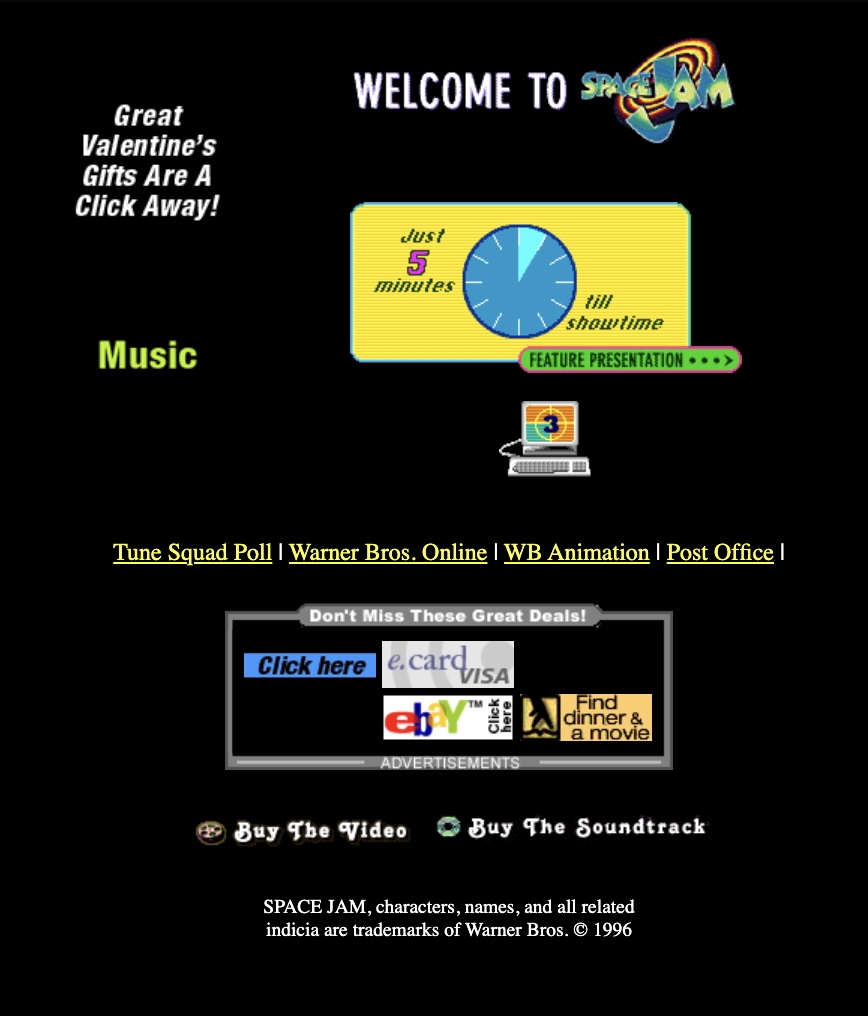
Undoubtedly, decisions about production were also influenced by the changes in consumer habits. During the late 1990s internet boom, fan expectations regarding digital participation increased and websites had to adapt to keep up. Expanding features offered new forms of connection for a growing audience of internet consumers. The inclusion of a “Buy the Video” and “Buy the Soundtrack” options are prime examples of developing production methods that reflect an industry focus on selling more copies of the movie.
Version 3 – December 10th, 2003
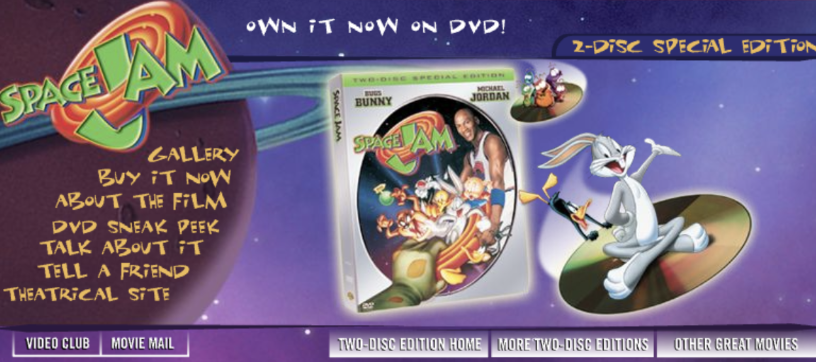
Six years after the release of Space Jam, Warner Brothers completely redesigns the website to reflect a new focus on DVD sales and distribution methods. This change was unveiled on December 10, 2003 where SpaceJam.com was relaunched to the public with a whole new look.
The main changes included a massive cover page advertising the 2-Disc Special Edition DVD, a gallery of movie stills, introduction of discussion boards, and sneak peeks into exclusive DVD content to entice consumers to buy a copy.
The introduction of discussion boards continually added onto the idea of expanding interactivity for SpaceJam.com users impacting both consumption and production. At this point, 6 years after the release, Space Jam probably doesn’t have too much social relevance so Warner Brothers hoped the relaunch would cause an increase in DVDs sold. Yet again, Warner Brothers displays examples of evolving marketing and production tactics in order to squeeze maximum profit out of their projects.
Fan interaction and posting on the website’s forums was made possible by this new interactive feature. Interconnectivity improved, but there was also an increase in the risk of inappropriate content. Uncensored conversations could result in damage to Space Jam’s reputation as a family-friendly film. Consequently, the 2003 version called for further oversight of the discussion boards. Warner Bros. had to navigate between allowing fan interaction and enforcing restrictions to ensure social and legal standards were upheld.
Version 4 – May 21, 2021
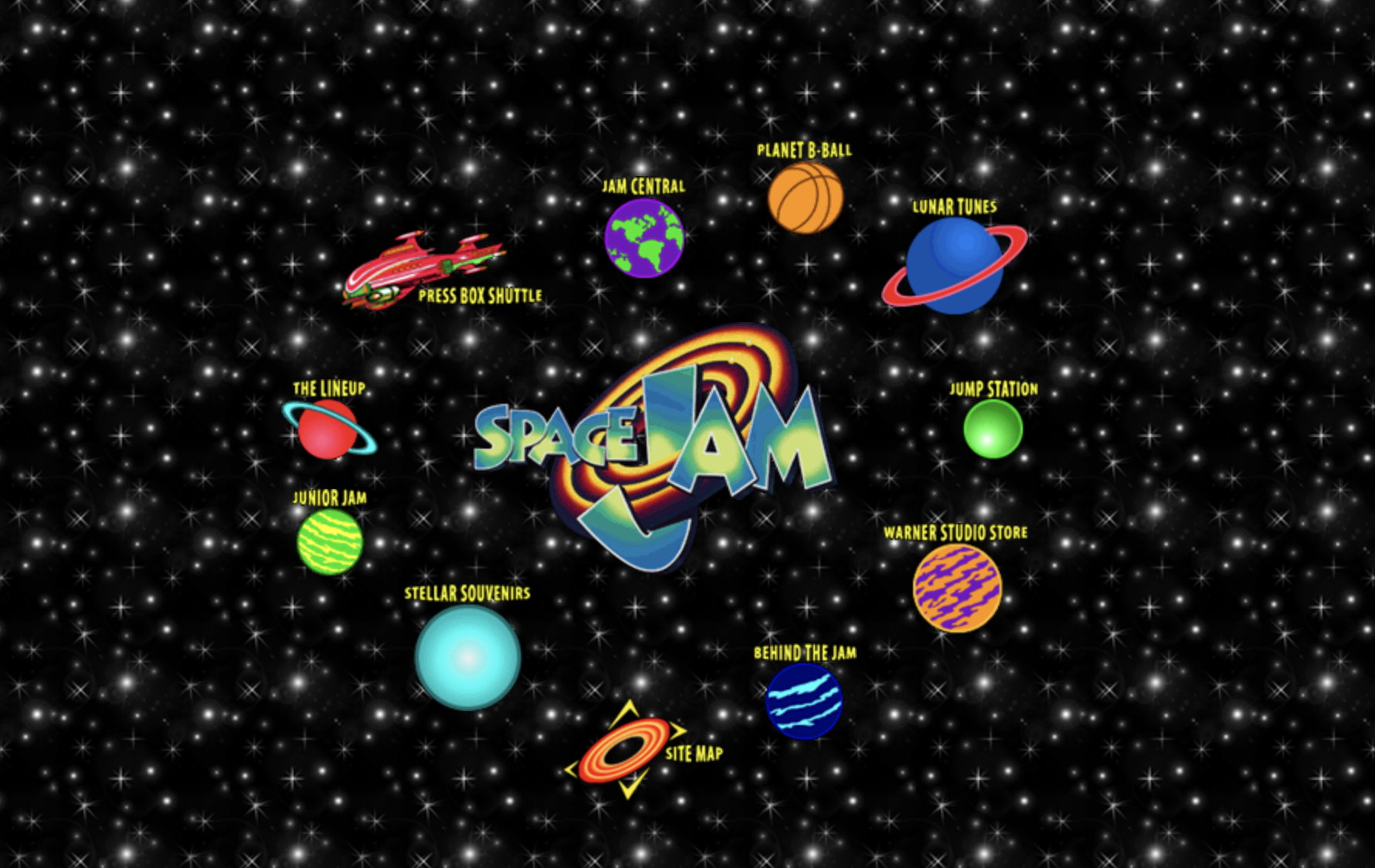

The most recent and final change to SpaceJam.com occurred on May 21, 2021 about 2 months before Space Jam 2’s release. The website was completely revamped for the newest iteration of the film franchise – Space Jam: A New Legacy starring LeBron James. The website design was meant to deliberately call back to the original 1996 layout and format, but the content is tailored to the 21st century consumer. Some of the key features to note about the 2021 version are medium of merchandise, the implementation of ads, and social media connectivity.
Compared to the posters and browser icons of the early internet, virtual backgrounds are a modern upgrade offered by the 2021 version of SpaceJam.com. The fun and activities section now has links to other games, like Candy Crush, outside of the Space Jam universe. Additionally, it is important to recognize that Spacejam.com is no longer a stand alone entity, it is now interconnected with other forms of social media advertisement for the sequel film including Instagram, Twitter, Facebook, etc. Looking at production, the changes of the 2021 website signified major investments into interactive film marketing during the modern era.

Final Takeaways
When examining the cross-generational relevance of SpaceJam.com, the website’s adaptability across the aspects of consumption, production, and identity stand out as the most vital in terms of the circuit of culture.
The site’s features progressed in parallel with the shift in consumer behaviors from passive to participatory web engagement. From the integration of games and merchandise in 1996, to discussion forums in 2003, and eventually reality experiences by 2021, the features reflect this development in technology. There are now more opportunities for fan connection thanks to these improvements in participatory consumption.
Similarly, production capabilities evolved throughout time. While maintaining the retro aesthetic SpaceJam.com was able to upgrade from guestbooks to DVD bonus content and VR areas. Space Jam.com effectively blends the familiar and the contemporary amidst cultural shifts.
In addition, SpaceJam.com maintains loyalty across age groups, from 90s kids to adults rediscovering nostalgia from their childhood. Maintaining aesthetic cohesion while incorporating new elements helps Space Jam foster a consistent fan identity.
SpaceJam.com has demonstrated amazing resilience in maintaining cross-generational appeal for more than 25 years. By repeatedly realigning core elements with changing consumer habits, production standards, and fan identities the website continues to win over new users and attract old ones by changing to meet audiences where they are.

Works Cited
Courtois, Noémie. “Digital Fossils, What the Heck.” Digital fossils, What the heck ? https://designblog.rietveldacademie.nl/wp-content/uploads/2017/01/Essays_NoemieCourtois_2016_reduced.pdf.
“Defend an American city from aliens and win prizes”. The Straits Times (Singapore). December 11, 1996. https://advance-lexis-com.proxy1.library.jhu.edu/api/document?collection=news&id=urn:contentItem:3SJD-NF00-0058-X0MB-00000-00&context=1516831.
Klein, Noami. “What’s up, doc? Just ask the marketers”. The Toronto Star. November 18, 1996, Monday, METRO EDITION. https://advance-lexis-com.proxy1.library.jhu.edu/api/document?collection=news&id=urn:contentItem:3VY3-0RK0-00H1-P0TN-00000-00&context=1516831.fd
Malinowski, Erik. “‘Space Jam’ Forever: The Website That Wouldn’t Die.” Rolling Stone, June 25, 2018. https://www.rollingstone.com/tv-movies/tv-movie-news/space-jam-forever-the-website-that-wouldnt-die-70507/.
Mekeel, David. “My 2 Cents: ‘Space Jam’ Website Feels Like Home.” McClatchy – Tribune Business News, Nov 21, 2013. https://proxy1.library.jhu.edu/login?url=https://www.proquest.com/wire-feeds/my-2-cents-space-jam-website-feels-like-home/docview/1459965000/se-2.
“Rip SpaceJam.Com, 1996-2021.” VICE, April 5, 2021. https://www.vice.com/en/article/dy8aea/rip-spacejamcom-1996-2021
Skinner, Greg. “Site seeing-using websites as marketing tools in the movie industry”. Kidscreen. November 01, 1996. https://advance-lexis-com.proxy1.library.jhu.edu/api/document?collection=news&id=urn:contentItem:3W94-TJG0-00JS-D0WR-00000-00&context=1516831.
Spacejam.com. Wayback Machine. (n.d.). https://web.archive.org/web/19960515000000*/http://www.spacejam.com
Suppa, Callie. Youth Culture 2000: A Webzine’s Critical Remembrance of the Y2K Era. Accessed November 18, 2023. https://youthculture2000.com/Callie%20Suppa%20Comm%20145%20Final%20Paper.pdf.
 Cultural History of the Internet