

 Posted by
 The Rise & Fall of LiveJournal.Com: A Circuit of Culture Analysis
Introduction

Brad Fitzpatrick, who was a student at the University of Washington at the time, launched LiveJournal in 1999 and it quickly grew into a world-renowned platform. LiveJournal was originally designed as a way for Fitzpatrick to stay in touch with his high school friends, as he used the site as more of a personal blog. However, it quickly rose to prominence as a social media pioneer, and ended up becoming a massive social networking platform that allows users to create personal journals, share thoughts, and engage in online communities. In 2005, the site hit its peak at 2.5 million active users, but that figure has been in a steady decline ever since. Author Kurt Lindemann (2006) wrote in “Live(s) Online: Narrative Performance, Presence, and Community in LiveJournal.com”, that LiveJournal was “arguably the most popular online posting site in the world” (Lindemann). The platform’s decentralized structure allowed for a wide array of stories, conversations, and creative projects—all of which were made possible at no cost to users as they evolved into both producers and consumers on the site. Over time, the interface has been modified with the goal of improving user-friendliness and creating a community that is not limited by geography. Nonetheless, it is imperative to look at LiveJournal’s history through the lens of its multiple ownership changes, with Six Apart, SUP Media, and Rambler Group all having a unique influence on the platform’s rules, user dynamics, and cultural resonance. It is these ownership changes that led to both the demise and remodeling of LiveJournal. Today, LiveJournal is one of the most popular sites in Russia, as both SUP Media & Rambler Group are both Russian-owned entities. The site’s popularity in the United States has completely diminished, as LiveJournal has distanced itself from the cultures and values it once stood for. This essay will analyze LiveJournal through the five aspects of the Circuit of Culture, which includes production, consumption, identity, representation, and regulation.
Production
In the context of the circuit of culture, “production” refers to the process of creating, advancing, and distributing goods or services within a particular society. Culture is produced through both tangible and intangible means. This may include literature, music, art, media content, and other creative expressions. This component is essential to the formation of a culture’s identities and values. In addition to the individual works that are produced, production also refers to the institutions that maintain/control “cultural goods”, affecting how societies consume and interpret them. Understanding the production component provides insights into the ever-changing processes that shape culture over long periods of time, reflecting the adaptive nature in which societies express their culture.
LiveJournal’s production aspect is best analyzed through the creative contributions of its users and the site’s ownership transitions. LiveJournal’s early decentralized structure let users take on the roles of producers and consumers, creating a dynamic community that produced a wide range of freely shared content, from personal blogs to topic conversations and communities. Even users with “little or no technological savvy” could construct their own narratives using text, personal photographs, images, etc. from popular culture (Lindemann 2006). LiveJournal actively modified its interface over time as the site grew, highlighting its dedication to improving usability. But when LiveJournal’s ownership changed, so did the site’s level of decentralization. LiveJournal was decentralized at first, but under Six Apart, SUP Media, and Rambler Group, it grew more centralized due to changes in its algorithms and popularity. The production dynamics of the platform were shaped by the introduction of new rules, limitations, and interface modifications with each changeover. For example, Although these changes were associated with a drop in the number of users, what constituted “production” on LiveJournal remained relatively the same, especially with regard to written material. The platform’s reputation as a venue for creative writing persisted even after ownership changes. After being bought by Russian companies, producers on LiveJournal were no longer able to produce content that was political (read: anti-Russian government), sexually explicit, or related to the LGBTQ+ community. LiveJournal has undergone significant changes, and these changes serve as evidence of the complex interactions that occur between platform architecture, ownership relationships, and user-generated material in the production phase of the cultural circuit.
Consumption
The consumption feature of the circuit of culture refers to how individuals interact with and interpret cultural goods/services in society. It deals with how people receive, understand, and make use of cultural artifacts. These artifacts, as aforementioned, may include media, symbols, and practices in addition to tangible objects. Consumption is the process by which individuals take in and give meaning to these, simultaneously shaping their identities and values. This extends beyond the act of just purchasing or using goods; it is more so about how users engage with what is being presented to them.
In order to analyze LiveJournal from the perspective of consumption, I believe it is necessary to understand how LiveJournal users interact with both each other, and with the content they encounter on the site. Each user had its own profile that acted as a personalized hub where people may interact with friends, review and update previous entries, and exchange personal information. Users were also able to add “friends” and join communities, which allowed them to share protected material with only those people or groups. There were no mutual relationships, as users could add friends without it being reciprocated. As the site grew more prominent, it began to include consumption features that users had to pay for. Within a few years of its creation, the site introduced 5 types of accounts, including basic (free), plus, early adopters, paid, & permanent. With each level of account, users gained greater access to some of the site’s paid features, such as SMS texting, “express lanes”, voice posts, and extra storage space. Around 2005, the site also introduced new features such as virtual gifts and polls, both of which are shown below. All of the various features mentioned above allowed LiveJournal to transcend its means of consumption beyond just passive reading to active participation, fostering a sense of community and individual expression.


Identity
The “identity” component in the circuit of culture involves how individuals and groups express their sense of self within a cultural context. It investigates how different races, genders, classes, etc. interact with one other to form individual and group identities. This aspect acknowledges that identity is dynamic and ever-changing, influenced by societal expectations from the outside as well as one’s own internal perceptions of themself. Identity constriction is a process that involves people using symbols, representations, and other cultural practices in order to effectively secure their place in the larger cultural environment. It is a continuous process that responds to societal changes, challenges stereotypes, and contributes to the ongoing evolution of cultural norms.
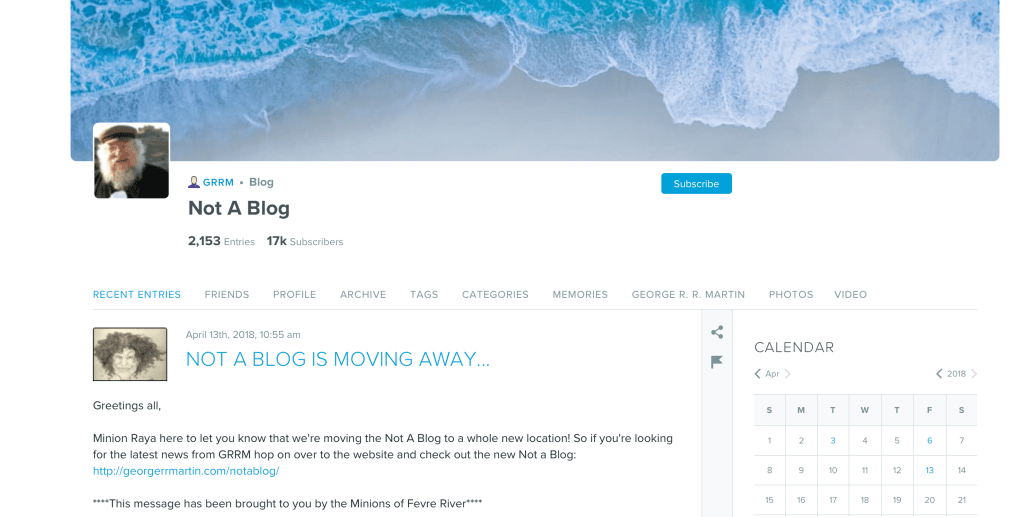
At the time of its creation, LiveJournal was one of the only websites on the internet that allowed users to freely express themselves, as the online diary allowed users to share their feelings, thoughts, life events, and other aspects of their own identity. In 2002, David Gallagher of the New York Times referred to LiveJournal as “a site to pour out emotions, and just about anything else” (Gallagher). As each user maintained their own individual profile, it was feasible for LiveJournalists to create their own online persona, and shape that identity in any way that they saw fit. For example, George RR. Martin (whose novels inspired the Game of Thrones TV series) was widely considered LiveJournal’s greatest content generator. The platform allowed Martin to not only bolster his identity as a respected novelist, but also to create a thriving online presence beyond just his literary works. Another way that LiveJournal enabled users to shape their identities was through its communities. These communities were based on one specific topic, and users would create entries that were related to it. Through the creation of communities, LiveJournal helped users to share a common identity with thousands of other people who they likely have never met before, nor ever will. This sense of connection or belongingness was very attractive for many users, as in the early days of the internet there were not many social networking platforms that supported this type of environment. LiveJournal’s most famous community, to this day, is titled “Oh No They Didn’t”. This community centers itself around celebrity/pop culture gossip, and is pictured below. In an era with limited social networking options, LiveJournal cemented itself as a place that could foster a sense of connection with others and in turn, a place where users could explore their own identity formations.

Representation
The “representation” feature of the circuit of culture explains how individuals, groups, and ideas are constructed (symbolically) within a cultural context. This is accomplished through images, texts, and symbols. Representation raises important questions about inclusion, exclusion, and the validation or rejection of stereotypes. It also delves into power dynamics, revealing who holds influence in shaping cultural narratives. In order to analyze representation, one must look at how various voices/perspectives are amplified or marginalized, and how this affects the formation of societal norms, values, and identities. Representation can be seen as understanding how the cultural artifacts we see and read contribute to the way we perceive the world around us. In general, it plays a pivotal role in shaping the diversity, inclusivity, and dynamics of our society.
LiveJournal’s representation can be characterized by how the site represented itself to the global online community, and also how users represented themselves on the site. When Fitzpatrick initially created the website, he positioned it as a decentralized and inclusive platform for sharing information among friends. This early representation aligns with the platform’s organic growth, allowing for a diverse array of communities, identities, and opinions to thrive daily. Users were not only consumers of content but active contributors, representing themselves creatively through customizable profiles. However, LiveJournal’s trajectory took a significant turn for the worse with the changes in ownership, altering the site’s representation from an open, engaging space to one marked by restrictions and controversy. This shift impacted how LiveJournal portrayed itself globally and how users perceived their representation within the platform. Users, who would “tend to be 15 to 21 and predominantly female” (Gallagher 2006), felt alienated by the restrictions and it was as if they had lost their individual representation. As aforementioned, these new owners banned LGBTQ+ communities, which silenced a major part of the website’s original core. Furthermore, in 2014, LiveJournal began displaying “Top Communities” and “Top Journals” of both that day and of all time. This marked yet another shift away from its decentralized platform, as some communities/individuals prospered while others were marginalized.
Regulation
“Regulation” in the circuit of culture refers to the rules and systems governing the creation, distribution, and consumption of cultural products. It involves legal frameworks and social norms shaping what’s acceptable in content. The fundamental idea behind regulation is that corporate oversight keeps a watchful eye on the content of the website to make sure it complies with societal norms and regulatory requirements. In some cases, the regulatory body will create laws/regulations that align with their own agendas. To analyze regulation, one must look at how different authorities, institutions, and the public interact with one another to create these restrictions.
In LiveJournal’s case, regulation is what led to its demise, and also why it is now a predominantly Russian-used website. In Gita Jackon’s 2023 article “How a Social Network Falls Apart”, and Yi Shu Ng’s 2017 article “People are Quitting LiveJournal in Droves…”, both authors explain why this played out the way it did. In 2005, LiveJournal was sold to Six Apart, an American based company. Six Apart did not introduce a ton of new regulatory requirements, but rather cluttered the site with advertisements and other paid features. It was in 2007 that “things started to change” (Jackson 2023). SUP Media, a Russian-owned company, purchased LiveJournal and began its regulatory crackdown. The company suspended blogs and placed limitations on all political and adult content. SUP Media claimed this was to “protect minors”, however the sites’ users viewed this as a “broader cleanup of anything that looked remotely edgy” (Jackson 2023). LiveJournal’s popularity continued to decline, and this was exacerbated when Rambler Group, a Russian state-owned company, took over in 2017. As Yi Shu Ng explains, this meant that LiveJournal was to ban anything “contradictory to the Russian Federation” (Shu Ng 2017). This meant that any post on LiveJournal had to be in compliance with Russian law, censoring & alienating thousands of its users/communities. These regulations led to a stark decline in user trust, leading thousands of LiveJournal users to migrate to sites such as Tumblr, Dreamwidth, and more.
LiveJournal’s Interface Throughout the Years


Conclusion/Takeaways
To summarize, looking at the development of LiveJournal through the Circuit of Culture helps show the dynamic interaction between all five aspects: identity, representation, production, and consumption. The platform as a whole underwent a major cultural transformation, from its decentralized beginnings to the detrimental modifications it experienced under several ownerships. Each aspect of the circuit of culture was affected by these changes, highlighting how intertwined the five components truly are. The regulatory changes caused shifts in identity, which resonated in altered representation, impacting the production dynamics, and finally, influencing patterns of consumption. LiveJournal’s demise, characterized by those regulatory restraints, can help teach a lesson for companies trying to find a balance between company regulations and user freedom of expression. The sudden emergence and collapse of the platform serve as a reminder of these larger issues influencing the digital cultural environment. By turning its back on those who popularized the website, LiveJournal forever tarnished its image, brand, and reputation.
Sources
Associated Press, “Ether Replaces Paper As Diaries Go Online,” Associated Press, August 28, 2003. https://advance.lexis.com/api/document?id=urn:contentItem:49DC-6DF0-00BT-N1FW-00000-00&idtype=PID&context=1516831
David F. Gallagher, “A Site to Pour Out Emotions, and Just About Anything Else – Correction Appended,” New York Times, September 5, 2002. https://advance-lexis-com.proxy1.library.jhu.edu/api/document?collection=news&id=urn:contentItem:46P2-9T00-01CN-H1WW-00000-00&context=1516831.
Dragileva, Olga. The Story of Livejournal: How Russians Started Blogging, Trepo, July 2009. https://trepo.tuni.fi/bitstream/handle/10024/81329/gradu04102.pdf?sequence=1&isAllowed=y
Jackson, Gita. “How a Social Network Falls Apart.” The Verge, 9 Mar. 2023. www.theverge.com/2023/3/9/23629372/twitter-tumblr-livejournal-social-network.
Kurt Lindemann, “Live(s) Online: Narrative Performance, Presence, and Community in LiveJournal.com,” Text and Performance Quarterly 25, no. 4 (2005): 354-372. https://doi.org/10.1080/10462930500362494
Ng, Yi Shu. “People Are Quitting LiveJournal in Droves after Russian Owners Ban Political, LGBTQ Talk.” Mashable, Mashable, 29 Oct. 2021. https://mashable.com/article/livejournal-russian-law
Phil Kloer, “AN OPEN BOOK: With online journals, people can bare their souls to the whole world,” The Atlanta Journal-Constitution, March 31, 2002.
Saket Sathe, “Rumor Spreading in LiveJournal,” Mini-Project Report, Dynamical Networks, July 4, 2008. https://citeseerx.ist.psu.edu/document?repid=rep1&type=pdf&doi=4aa151d654c72a2cde1d079410d120227a7ff36b
 Cultural History of the Internet