
 Posted by
 Blockbuster Circa 2003
Intro
At its peak in 2004, Blockbuster had upwards of 60,000 employees, over 9,000 physical sites, and millions of daily visitors around America. It was a significant player in the home video market for over two decades. However, after 2004, Blockbuster came crashing down, filing for bankruptcy in 2010 and shutting down all corporate-owned locations by 2013. One of my oldest childhood memories was my last time going into Blockbuster before it shut down. I rented “2012,” “10,000 BC,” and “Invincible.” The cashier let me keep the movies since the store was closing down, and I still have those Blu-Ray discs to this day. In this nostalgic webpage, I will walk through the rise and fall of Blockbuster, the evolution of its website and analyze a 2003 screenshot of Blockbuster’s website through the circuit of culture.
The Rise
Blockbuster became a household name in the late 1980s with the home video revolution and the VCR industry’s introduction of the VHS. When Blockbuster was founded in 1985, there were a lot of individual video rental stores, making the video rental market somewhat fragmented. Blockbuster entered the market and aggressively expanded through corporate-owned stores rather than franchisees. Blockbuster had a simple but aggressive business strategy. The company’s two driving factors in immediate expansion in the late 1980s were assembling a massive amount of movies/games as inventory for consumers to rent and carefully handpicking many convenient locations in communities across the United States.
Blockbuster offered extended rental periods, new releases, and an overall inventory of 10,000+ items per store to differentiate itself from competitors. In the 1990s, this led to a substantial increase in brand loyalty, even consumer fandom. The introduction of the DVD in 1997 brought even more popularity to Blockbuster. At its peak in the early 2000s, Blockbuster generated $6 billion in revenue annually from over 84 million active rental members (Olito 2023). The company accounted for 60% of the market share in the home video rental business.
The Fall
As most know, Blockbuster dominated brick-and-mortar video rentals but made the brutal mistake of missing the shift away from physical stores and toward the rise of streaming services such as Netflix and Hulu. The downfall happened in the late 2000s with the introduction of on-demand video streaming, which eliminated the need for retail locations and allowed people to instantaneously and affordably watch movies on their TVs and computers.

Redbox kiosks became increasingly popular across the country and started to upend Blockbuster’s success. Redbox used automated vending machines outside grocery stores and fast food restaurants to rent videos for $1 a day. Meanwhile, Netflix began investing heavily in online streaming, quickly becoming the preferred option as internet speeds grew in the late 2000s. In 2009, Blockbuster launched its digital platform called Blockbuster On Demand to compete with online streaming, but by 2010, millions of subscribers had already turned to rivals Netflix and Hulu.
Blockbuster filed for bankruptcy in 2010, with over $1 billion in debt, due to massive income declines in the renting business (Olito 2023). By 2013, all corporate-owned Blockbuster locations in the United States had closed after failing to adapt to industry advancements toward on-demand viewing and online streaming. Blockbuster’s traditional in-store service was now outdated. One store remains in Bend, Oregon, known as “The Last Blockbuster.”
Blockbuster’s Website Evolution


Blockbuster announced the launch of its website on October 19th, 1996. The announcement read that www.blockbuster.com would be launching in early November of the same year. To get traffic on the website, the entertainment company ran a promotion promising 2 CD samplers for the first 600 people to make a purchase on the website and 1 CD sampler for numbers 601 to 1000.

This December 24th, 1996, screen capture is the first look at Blockbuster’s original website. It appears that Blockbuster hired a graphic design company to create the layout for the website. The site’s interface says more about the visual design of the era than it does about Blockbuster’s identity. The animated aesthetic from 1996 is not what consumers think of when they hear Blockbuster. The retro movie theater background does not represent Blockbuster’s identity.


As of June 28th, 2001, consumers can access a website symbolic of what they are used to associating Blockbuster with. The famous blue and yellow Blockbuster colors compliment the overall aesthetic of the page with its color-coordinated rows and columns. On the left-hand side, users can access different subsections under Movies and Games as well as the top 5 lists for “New Releases,” “Top VHS Rentals,” “Top DVD Rentals,” “What’s Cool,” and “Coming Soon.” Visitors can find featured movies, games, and stories in the middle column. Finally, the third column features a variety of advertisements for Blockbuster partners. This website is still in the early stages of Blockbuster’s attempt at personalization with features such as “search my store,” “my account,” and “rental cart.”


The June 11th, 2003, edition of www.blockbuster.com is the site that I chose to focus closest on for this webpage. I aimed to find a screenshot of Blockbuster’s website as close as possible to the day I was born, interested in the popular movies and stories circulating twenty years ago. At first glance, the 2001 and 2003 sites look very similar. However, the closer one examines the two pages, the more differences they will find. Through the circuit of culture, I will highlight the additions to the 2003 website that foster an improved and well-rounded experience.
Circuit of Culture Overview
The circuit of culture is a five-dimensional framework for analyzing anything past and present. These five dimensions are representation, identity, production, consumption, and regulation. The five elements all feed off of one another and are all intertwined. Examining these five aspects while analyzing the Blockbuster website from 2003 offers complex insights into both the producer and consumers. The circuit of culture provides an in-depth framework for interpreting Blockbuster’s role in a cultural setting during 2003.
Representation
Representation looks at how the topic being analyzed conveys specific meanings and values through its functions, aesthetics, images, and other elements of design that influence cultural perceptions. Users can perceive and absorb these symbolic details in conscious and unconscious ways.
By 2003, Blockbuster’s website had undergone significant aesthetic improvements, featuring a sleeker, more modern visual style that complemented the company’s primary blue and yellow logo. A well-rounded online shopping experience was created by introducing enhanced e-commerce features with subtle indications like unifying fonts and logos. The website effectively established broader omnichannel options from segmented rental groups. There is now more that the Blockbuster experience has to offer within the website’s added capabilities. Easily accessible search functionality and rental promotions reflected information design that boosted rental activity in the early 2000s.
Icons such as the animated Blockbuster Kids’ Club serve as a link to fun, family-oriented weekend activities that are typically related to going to actual Blockbuster locations. For example, in September 2000 in Dallas, TX, Blockbuster offered free movie rentals to kids who earned a B average or higher on their report cards (PR Newswire 1996). Blockbuster ran rental promotions like these to appeal to the broadest audience of movie consumers possible.


New features and the layout improved earlier, more minimalist models to highlight Blockbuster’s unique capabilities, even though the visual elements still paid tribute to the classic Blockbuster in-store experience. The styling sought to maintain Blockbuster’s sense of cultural relevance in the face of rapidly changing technology affecting consumer entertainment tastes.
Identity
Identity is centered on consumers’ associations and perceptions around the subject being analyzed. This aspect of the circuit of culture asks how consumers can use the subject to connect with larger identities and develop their individual identities. Identity pertains to the producer and consumer and what these groups associate Blockbuster’s website with.
The website reinforces good memories for loyal Blockbuster customers browsing the 2003 version, merging nostalgia for favorite video store habits while welcoming new advantages that internet technology began to provide. Customers can dually appreciate strolling around the in-person store on a Friday night while enjoying a website browse from the comfort of their homes. Various consumer demographics formed lasting brand connections with this combined “nostalgia x forward-thinking” identity, allowing groups to identify in any way they chose, ranging from full adoption of the newest technology for rental improvements to the old-school attachment of picking up DVDs and VHS from the store.

Customers with a long relationship with Blockbuster may have naturally biased their dashboard settings toward real-store location features and in-person recommendations. On the other hand, younger customers valued features like the “My Blockbuster” user section that allowed customization and provided tailored rental recommendations. The feature lets users sign in, check out their rental cart/history, access rewards, e-newsletters, recommendations, and a store locator. The convenient e-commerce model in Blockbuster’s 2003 website catered to various consumer identities, while the timeless style pays homage to the company’s in-store legacy.
Production
Production is the creation and distribution of an item involving operations. Changes over time reflect shifting priorities, where companies may face the problem of having to balance technological advancements, expenses, executive decisions, and workforce capabilities.
It was necessary for Blockbuster to fundamentally change its manufacturing methods beyond purely physical stores to form the omnichannel capabilities that are displayed on its 2003 website. It is all in an attempt to create a combination bundle of digital and brick-and-mortar experiences. This required a significant level of connectivity between the internet and traditional retail systems that had previously been divided.

Consumers could “advance search” movies and games to locate if a specific video desired by the consumer was available based on local store proximity. This two-way integration between store inventory databases and point-of-sale software was critical for functionality where consumers expected rental availability transparency and transaction history. The 2003 Blockbuster website also saw a clean polish of the blue drop-down tabs on the left-hand column. Rather than taking up unnecessary space like the 2001 “top 5” version, the ‘03 model condenses the tabs into three sections: Movies, Games, and Specials with subsequent subsections.


Consumption
Consumption relates to the patterns and behaviors of usage that occur when consumers interact directly with the good/service. Forms of consumption include a website’s transactions, navigation choices, activity metrics, and engagement levels.

Blockbuster’s 2003 website allows the consumer to browse the website without feeling obligated to purchase anything. The site is interactive with easily accessible hyperlinks. In the bottom right corner of the page is a “Your Take” section where users can vote on a poll that appears to change bi-weekly/monthly. In the June 2003 screen capture, the question is “Father’s Day is coming soon. Who is your favorite movie dad?” Eddie Murphy from Daddy Day Care is selected over Albert Brooks (Finding Nemo), Michael Douglas, Jack Nicholson, and others in this picture. The website is a catalog to buy movies and a destination for movie fanatics to read up on trending topics and vote on polls that cultivate a larger community for Blockbuster.

Again, following the overarching theme of the website’s attempt to complement the brick-and-mortar store with a website companion, the site played a significant factor in consumption. Under the “New Releases” section, Blockbuster labels select movies as “Guaranteed in Stock” in red bolding and mentions how the visitor can “rent the latest new releases at your local Blockbuster store or buy online now.” It is evident on the 2003 site that Blockbuster is not trying to phase out physical stores for the website. Instead, the website serves as an extension of the store. Blockbuster.com allows visitors to browse the site and see what is in stock at in-store locations or on the site itself. The website is an additional avenue for Blockbuster visitors to consume media.
Regulation
Regulation includes both official rules and unwritten societal standards that specify acceptable behavior. It consists of the policies, laws, and procedures that control the production and use of a given good. These rules/regulations can be both explicit and implicit.
Blockbuster’s 2003 website’s governing policies highlighted necessary adjustments that come with new capabilities that connect virtual and physical stores. A visible Privacy Policy and Terms & Conditions stated that Blockbuster’s name and trademarks are fully reserved, that commercializing the site’s content for unrelated use is prohibited and that the legal terms allowing online rental reservations for in-store rentals are clearly stated.
With Blockbuster having to comply with evolving e-commerce rules, the company was granted exclusive authorization to use customer information to improve a customized experience on the website. Since digital and physical rental components contain interconnected data, laws evolved to permit specific customer information exchange while prohibiting unauthorized actions from compromising privacy. Blockbuster’s 2003 website regulations represented early adjustments that acknowledged shifting governance demands brought about by increasingly personalized technology.
Conclusion
The foremost idea behind Blockbuster’s move to create a website at the end of the 1990s was to adapt to changing times in an attempt to reach a wider audience through the brick-and-mortar store locations as well as with a website. The site served as a complement to the physical store; it was not meant to take away from in-store sales. This sentiment may have caused Blockbuster’s downfall. Its refusal to re-locate completely online through streaming and its inability to let go of the past ultimately led to Blockbuster declaring bankruptcy in 2010.
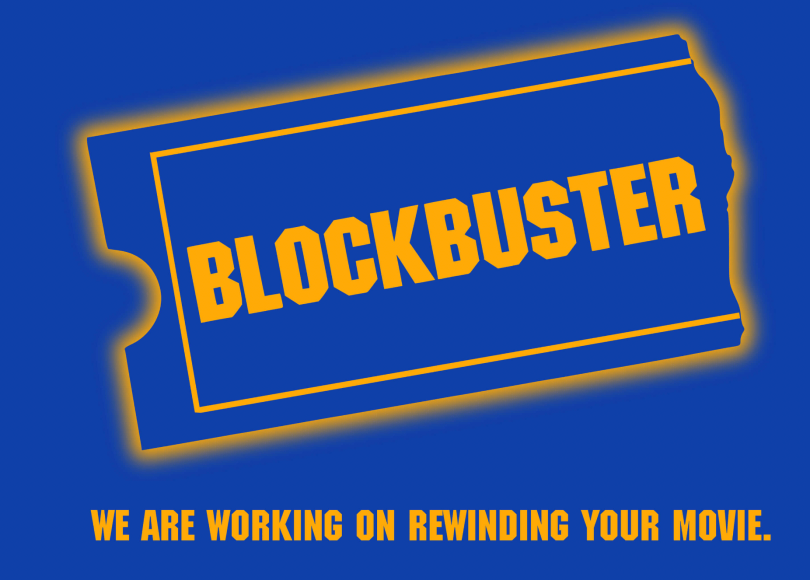
Unfortunately, this is what Blockbuster’s website looks like now. For some reason, though, Blockbuster still has excellent brand recognition, which is practically unheard of for a dead company. There’s even a Netflix sitcom that came out last year about the last-ever blockbuster store. Pretty ironic.
“We are working on rewinding your movie.” Who knows, maybe Blockbuster is prepping for a comeback.

Here is a link to the “Last Blockbuster” commercial that I showed during my presentation:
Works Cited
Chao, Chiang-nan, Niall Hegarty, and Ingrid Fray. “Impact of Movie Streaming over Traditional DVD Movie Rental—An Empirical Study.” Journal of Industrial and Intelligent Information Vol. 4, No. 2, March 2016, March 2016. http://www.jiii.org/uploadfile/2016/0215/20160215101852372.pdf.
CNNMoney. 2004. “Blockbuster Going after NetFlix.” CNNMoney.com. August 11, 2004. https://advance-lexis-com.proxy1.library.jhu.edu/api/document?collection=news&id=urn:contentItem:4D2S-YV20-01PR-23PP-00000-00&context=1516831.
Davis, Todd, and John Higgins. “A Blockbuster Failure: How an Outdated Business Model Destroyed a Giant.” Legal Scholarship Repository: A Service of the Joel A. Katz Law Library, March 2013. https://ir.law.utk.edu/utk_studlawbankruptcy/11/.
McKinnon, Tricia. “8 Reasons Why Blockbuster Failed & Filed For Bankruptcy.” Indigo9 Digital Inc., January 11, 2023. https://www.indigo9digital.com/blog/blockbusterfailure.
Olito, Frank, and Alex Bitter. “Blockbuster: The Rise and Fall of the Movie Rental Store, and What Happened to the Brand.” Business Insider, April 24, 2023. https://www.businessinsider.com/rise-and-fall-of-blockbuster.
PR Newswire. 1996. “Blockbuster’s 5,000th Store A Milestone In Ongoing Growth From Video Renter To Global Entertainment Retailer.” PR Newswire. November 8, 1996. https://advance-lexis-com.proxy1.library.jhu.edu/api/document?collection=news&id=urn:contentItem:3TD9-73W0-004Y-H54Y-00000-00&context=1516831.
PR Newswire. 2004. “Blockbuster Launches BLOCKBUSTER Online(TM) -The Movie Store at Your Door(TM).” PR Newswire. August 11, 2004. https://advance-lexis-com.proxy1.library.jhu.edu/api/document?collection=news&id=urn:contentItem:4D36-WF60-010D-R25P-00000-00&context=1516831.
PR Newswire. 2000. “Good Grades, Free Rentals at Blockbuster; Students Earn Free Rental for Academic Accomplishments.” PR Newswire. September 28, 2000. https://advance-lexis-com.proxy1.library.jhu.edu/api/document?collection=news&id=urn:contentItem:419G-59N0-00KH-74VR-00000-00&context=1516831.
The Canadian Press. 2005. “Blockbuster Says Online Venture Not Adding Customers as Fast as Expected.” The Canadian Press (CP). October 6, 2005. https://advance-lexis-com.proxy1.library.jhu.edu/api/document?collection=news&id=urn:contentItem:4H8K-54W0-01G6-9368-00000-00&context=1516831.
Links to all of the screenshots used:
First website: October 19th, 1996
https://web.archive.org/web/19961019173729/https://www.blockbuster.com/
December 24, 1996
https://web.archive.org/web/19961224035012/https://www.blockbuster.com/
June 28, 2001
https://web.archive.org/web/20010628172952/https://www.blockbuster.com/
June 11, 2003
https://web.archive.org/web/20030611042623/https://www.blockbuster.com/
April 12, 2008
https://web.archive.org/web/20080412205703/http://www.blockbuster.com/
Blockbuster today
 Cultural History of the Internet