
 Posted by
The claim to the title of ‘oldest social media platform in the world’ is a highly contested one, but Myspace is a worthy competitor. Though there have been other sites active before its launch (such as Six Degrees and Friendster) Myspace was the first platform of its kind that is reminiscent of social media of today- with its enormous capabilities for user modification on their personal pages, the site quickly gained traction online.
Launched on August 1st , 2003, the site (originally named ‘Sitegist’) was started as a college project by senior Chris DeWolfe during his last year at USC. Upon graduating, he began work at eUniverse, a mixed media company, along with fellow alumni Tom Anderson, where they together further developed the site into Myspace.

The site found quick appeal among the masses, due in no small part to the degree of independence Myspace users were given- personal pages were highly customizable, letting users edit nearly every aspect of their page, from the background color to the font to the music playing. By 2005, just two years after its launch, it surpassed its competition and became the most widely used social media platform of the time.

Representation & Identity
Myspace built its brand around being a site where users felt represented and seen, no matter their interests. Thanks to the high level of webpage modification available, users’ pages could depict whatever mattered to them most. This created a sense of community, somewhat similar to the one formed by sister pages on Geocities- Myspace users who built pages devoted to similar topics could reach out through a friend request.

‘Friends’ were a crucial factor in Myspace’s success, and something that set it apart from the other social media at the time. Users had the ability to keep in touch with those who mattered to them by adding them as a friend, making their posts appear in their feeds. Further, there was the option to add friends to the coveted ‘Best Friends’ – eight spots that appear right on a user’s home page, letting the world know who was important to you. The Best Friends rankings could be edited every day, generating higher site usage, as dedicated users would go on their pages daily to update their list and also view the lists on their friends’ pages. Community is an integral part of representation, and by being a social media that focused so closely on one’s friend circle, users felt seen.

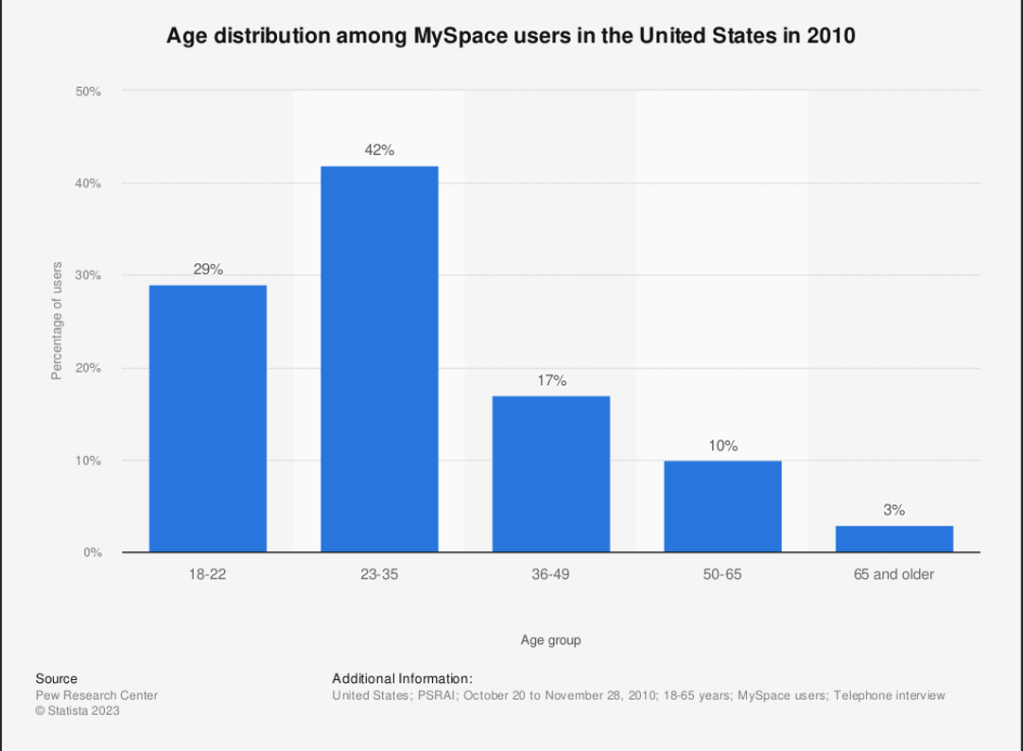
In 2005, when the site was at its peak, the average Myspace user was a white male in his early 20s of middle income. Though the fact wasn’t explicit in its advertising, Myspace was represented by young people- the vast clientele belonged in the age range of 16-35 years old. By having such high capabilities for page customization, the site could seem daunting to the older, less technologically advanced generation, who were just getting around to the very concept of the internet. The site definitely had a youthful vibe to it. Its most popular attributes- the Best Friends list, the emphasis on individuality and customization- were all features that directly appealed to a younger crowd.
Though Myspace became a social media that the user could take control of, shaping it to match their unique interests, the site always emphasized music. A shocking number of music artists- such as Adele, Panic! At the Disco, and Calvin Harris, just to name a few- all found fame through Myspace, by putting their music online for free. Users could add music to their page, allowing visitors to listen in on what appealed to them. Myspace also ran several dedicated radio channels, creating user consumption even when not directly accessing the site’s social media offerings. This focus on music was something no other social media site was doing, and it was something that would ultimately spell their doom.
Production & Consumption
Unlike most currently active forms of social media, Myspace had no form of user-paid features, and made its revenue entirely through advertisements. By monitoring site usage and using affiliated advertising networks, Myspace collected data about its users’ behaviors, selecting the ads users would see based on the information gathered. Third-party sites like RockYou and Slide.com collaborated with Myspace in the form of widgets on their site.
Around 2006, Facebook started to become a worthy contender in the battle for social media domination, and the numbers on Myspace started to dwindle. Panicking, investors demanded an increase in the amount of ads shown to users, just to stay afloat. And while this worked out for them temporarily, the site began to look overly cluttered and unattractive, especially compared to the sleeker Facebook. In their desperation to stay on top of the social media food chain, Myspace ultimately lost itself even more users, a move that wouldn’t be their last time doing.
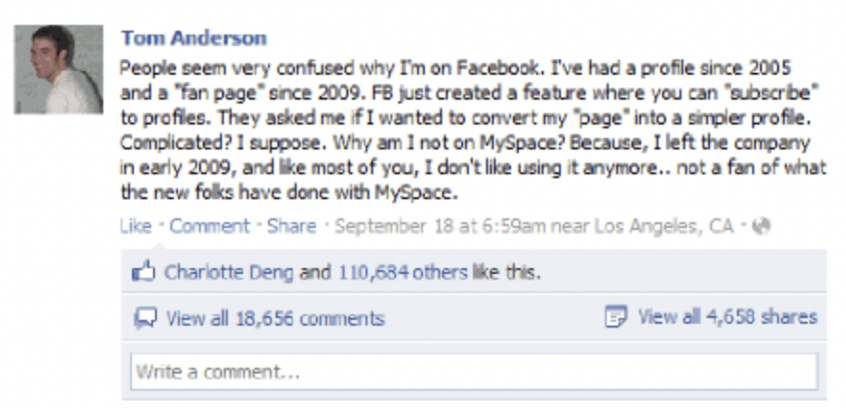
Each time Myspace took a large hit in user numbers the company was sold, ultimately trading hands four times during its 20-year run. Each change of ownership came with a change in management and a redesign of the site’s layout, further turning off users. Tom Anderson made headlines in 2010 for smearing Myspace (and doing it on Facebook, to really rub it in). After extensive changes to the site through multiple changes of ownership, the original Myspace- the college passion project birthed by two students- no longer existed.
By 2008, it was estimated that Myspace pumped out over 100 gigabits of data per second into the internet, only 10 gigabits of which were HTML content- the bulk of data was taken up by the much heftier picture and video packages. A gargantuan server infrastructure was created to accommodate the massive amounts of data being produced and shared every split second, comprised of over 4,500 web servers, 1,200 cache servers, and 500 database servers. A custom distributed file system was also created to ensure speed of data delivery.
Regulation & Controversies
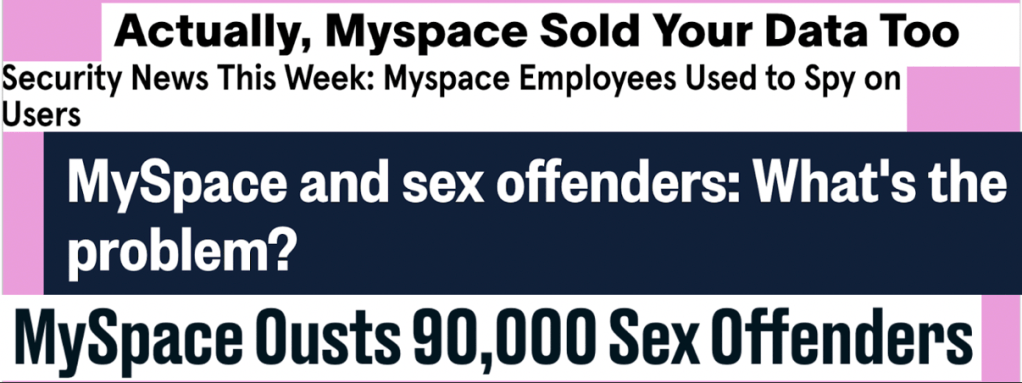
One of the initial draws of Myspace was the minimal regulation on the site- nearly anything besides hate speech and nudity was considered fair game, and it was a place where users felt comfortable to be themselves and voice their opinions. This level of freedom came at a price, however. As a space that was both heavily frequented by minors and was lightly moderated, the site became a breeding ground for sex predators. In 2007, Myspace announced that it was focused on removing all sex offenders from their sites, saying that they had accounted for 50,000 sex offenders on their pages. The clean-up effort took over two years, as a result of which over 90,000 sex offenders were removed from Myspace, more than 40,000 over their original estimate. In an effort to provide minors more safety, Myspace gave users who were 13-16 years old ‘hidden’ accounts, i.e. pages that could only be viewed by other minors. The drive to eliminate sex offenders off Myspace had been created in partnership with the FBI and background verification firm Sentinel Safe Tech Holdings Corp, resulting in enormous additions to the American sex offender database. The recorded conversations between sex offenders and their minor targets also provided the FBI with further data on the ways of their operation, especially in the relatively newer context of the internet.
Myspace is generally regarded as one of the ‘safer’ social media platforms, a place where user data is secure and privacy matters. However, just like its younger siblings who eventually overtook it in popularity, over the years the site has come under flack numerous times for selling user data. The parent company, Intermix, sold the site to Rupert Murdoch’s News Corp. in 2009 for $580 million, which (after draining all value out of it) was sold to media company Viant for the pittance of $35 million, and was finally sold one last time to Time for an undisclosed amount in 2011. Each time the site changed hands, users’ data was given over to these unknown third party companies, something users were not aware of and did not agree to while making their accounts. Myspace is no longer a valuable commodity to advertisers for their active users, but rather for the years of user data accumulated while it was still a highly trafficked site. Technically, targeted advertisements could be selected based on data mined from a user on a dead platform decades ago.
Taken directly from Myspace’s privacy policy, they have always been open about the fact that users’ data is being mined:
You may be served with targeted advertising on the Myspace Services and on websites, applications, and other platforms owned or controlled by third parties based on information about you collected both on and off the Myspace Services , including advertisements based on your location and/or Usage Information.
Viant’s privacy policy is even more open about the fact that they have been stalking you through Myspace:
We may receive information from our affiliates regarding your use of our services not covered by this Privacy Policy, such as information regarding the contents of your Myspace profile (such as your email address, IP address, age, gender, Myspace connections and location) . We may combine data from one service with information from our other services, and with information we receive from our affiliates and third parties.
Myspace, capitalizing on user blindness and knowing that the vast majority choose not to read the fine print of what they are agreeing to, willingly sold user data to ensure that their site could live on. All the while, users were leaving the site en masse to head for the younger, now more popular, competition.
Ultimately, what did Myspace in was its unwillingness to adapt to the times. Facebook, its biggest competitor (who would usurp Myspace as the social media with the highest web traffic in 2008) constantly stayed updated to stay relevant with the times, something Myspace did not attempt. As the main users of Myspace- the youth- started to age, what appealed to them when they were younger no longer had the same pull. The heavy customization available for user pages felt daunting to the less tech savvy, who preferred the ease of navigation on Facebook. Myspace was the perfect social media of the early 2000s because it was quintessential 2000s; by the time the 2010s rolled around, the site had started to feel outdated.
Myspace today
Most might think that Myspace no longer exists; that is not the case. On typing ‘myspace.com’ into a search bar, the once beloved social media does not pop up, what does is a music and entertainment news site. That is what Myspace has become; after its latest acquisition by Time, they made the shift from social media megastar to barely running music portal. In a Hail Mary attempt The front page has sections missing, the stories are updated irregularly, and there is no glimpse of all the personality and charisma that once made the site so beloved. As it fades unglamorously into the abyss, though, it lives eternal as it once was in the minds of those who had once held it so dear.

Bibliography
Academic Papers:
1. DeScioli, Peter, Kurzban, Robert, Koch, Elizabeth, and Liben-Nowell, David. “Best Friends: Alliances, Friend Ranking, and the MySpace Social Network.” Association for Psychological Science, 2011.
2. Jones, Steve, and Millermaier, Sarah. “Whose space is MySpace? A content analysis of MySpace profiles.” University of Illinois at Chicago, 2008.
3. Jones, Norah, Blackey, Hay, and Fitzgibbon, Karen. “Get out of Myspace!” University of Glamorgan, 2009.
Online Articles:
4. Mayberry, Carly. “Welcome to MySpace age.” The Hollywood Reporter, November 2, 2005. URL: https://advance-lexis-com.proxy1.library.jhu.edu/api/document?collection=news&id=urn:contentItem:4HHX-9BP0-TX2Y-F221-00000-00&context=1516831
5. “Myspace Exceeds 3 Million Members; Viral Marketing Continues to Power Myspace’s Membership Growth.” Business Wire, August 8, 2000. URL: https://advance-lexis-com.proxy1.library.jhu.edu/api/document?collection=news&id=urn:contentItem:40XK-P060-00RH-42YS-00000-00&context=1516831
6. Marlowe, Chris. “Online community MySpace connects musicians with fans.” The Hollywood Reporter, June 21, 2004. URL: https://advance-lexis-com.proxy1.library.jhu.edu/api/document?collection=news&id=urn:contentItem:4CNS-4GY0-006P-R0J3-00000-00&context=1516831
7. Kozlowski, Lori. “How MySpace Spawned A Start-Up Ecosystem.” Forbes, May 15, 2002. URL: https://www.forbes.com/sites/lorikozlowski/2012/05/15/how-myspace-spawned-a-startup-ecosystem/?sh=374c575540ba
8. Cruickshank, Lesley. “Why you all up in MySpace?” Charleston Gazette (West Virginia), November 17, 2005. URL: https://advance-lexis-com.proxy1.library.jhu.edu/api/document?collection=news&id=urn:contentItem:4HKJ-10D0-TX2T-P2SW-00000-00&context=1516831
 Cultural History of the Internet