
 Posted by
 Hello, all. For this presentation, I wanted to explore one of my favorite and most visited sites of the last couple of years: Last.fm. Admittedly, I am late to the Last.fm train with the site having a resurgence in popularity since a quiet time of its history in around mid 2010s. I only hopped on to the wave late last year after deciding I wanted motivation to listen to more music and increase my Spotify Wrapped stats. Nonetheless, my time with the app does not diminish my interest in it and my curiosity in how it works as a successful commodity in terms of the circuit of culture.
What is Last.fm?
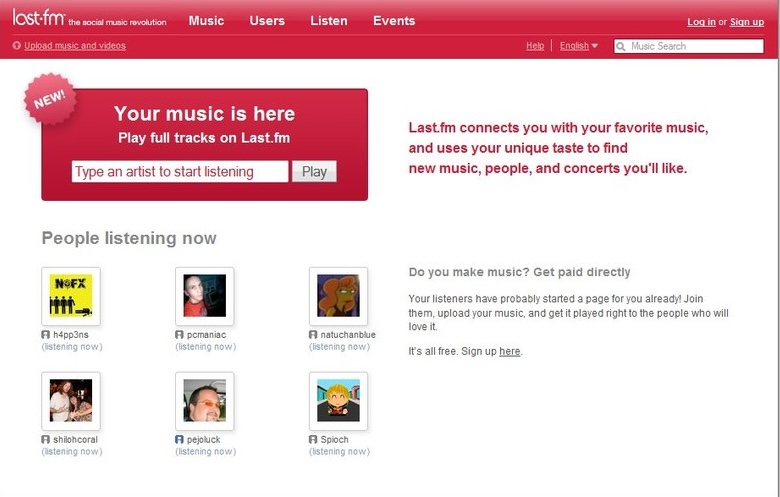
To begin, it is important that I provide some information on Last.fm: what exactly the site is, the features it includes, how it was created, etc. To start, let’s explore what exactly we see when we visit the website. Here is a screenshot of the homepage.
The first thing that pops out is the text right at the top, positioned like a title, but serving as more of a logline for the site as a whole: “Explore Top Music Powered by your Scrobbles”. If I am being honest… it does not roll off the tongue well. It also most likely leaves many of you with a few questions: most notably perhaps, ‘what is a scrobble?’ I will go deeper into this word and how it serves as the backbone for the site in a moment, but for now let’s treat it as the site does: by ignoring it and instead giving more information on the purpose of Last.fm as a whole.
The next line of this small text block is as follows: “We bring together your favourite music services and join up listening, watching and sharing to connect your musical world.” Other than the ‘u’ in favorite, this sentence is more accurate in terms of detailing what Last.fm is all about, most importantly the phrase “connect your musical world”. Unlike Spotify which is all about distributing songs to its consumers as solely a music listening site, Last.fm is more of a music compiling site. After making a profile, one is given their own personal page where, after linking the site to some other music listening application, like Spotify for example, they can begin tracking their music listening statistics. These statistics include everything from number of artists listened to, to a list of recent songs, to statistics about the user’s most-listened-to songs, albums and artists over varying timeframes. On this page, one can also create playlists, set songs as obsessions (which will be explored later) and even browse future events like concerts and festivals. The sheer amount of music-related content provided on the site really does show its desire to, as the homepage says “connect your musical world”.
It is here that we also learn the definition of the infamous scrobble, a statistic listed at the very top of your homepage that can be defined as simply being a ‘play’ of a song that originates from the site’s original name, audioscrobbler.com, which we will discuss more later. It is also important to note that while Last.fm is not primarily a music listening site, it can be used to listen to music. Jon Haupst, in his article “Last.fm: People-Powered Online Radio” explores the different ways that Last.fm allows one to listen to music from listening “to Last.fm Radio directly from the website or by using a stand-alone radio application free for download” to “sending data through a user’s choice of audio player” and listening to it on Last.fm to even being able to, as mentioned earlier, send data from a music listening site and have Last.fm track your listens in the background (Haupt 24). All in all, the functions Last.fm provides cast a wide net, touching all different aspects of the music listener’s experience and bringing it all together in one very dynamic website.
As we delve deeper into the creation and functions of Last.fm, we will begin viewing it in terms of how it accounts for all five aspects of Stuart Hall’s 1997 model of the circuit of culture (displayed below).
Identity
To begin, we will discuss the easiest and most prevalent aspect of Last.fm’s business model, the aspect of Hall’s circuit of culture that I believe to be most important and abundant in Last.fm: its identity. We have already begun to explore the website’s desire to “connect your musical world”, but it is the angle they take in doing this that separates them from their contemporaries. In the Haupt article mentioned earlier, he compares Last.fm to Pandora, one of Last.fm’s major competition during the late 2000’s. He says that while both “are primarily ‘Internet radio stations’ focused on finding music for the listener in a serendipitous fashion” (this was before Last.fm became used primarily as a music tracker in the background of another application), the method in which Pandora does it is much more based in “taxonomy” while Last.fm’s approach is more related to what Haupt calls “‘folksonomy,’or user-created organization” (Haupt 23). It is this focus on a more fluid, user-centric model that will become Last.fm’s identity, this desire to create a website that feels more like a community than a corporation. This can be seen with the homepage having a large graphic letting you know what artists are ‘spiking’ (or being played the most around the globe), to the ability to leave ‘shouts’ on your homepage for visitors to see, to the fact that Last.fm promotes the users who have similar taste to you as ‘neighbors’ and pushes that you follow them to develop your community further. Every decision they make is based on this idea of personalization and founding a community.
Even their method of giving each user their own personalized page helps bolster the community-based aspect of its identity. Take Spotify, for example. One of both Spotify’s and Last.fm’s largest features is their ability to recommend the user new music based on their prior listens. For Spotify, one way this is done is through a section on their homepage called ‘Discover picks for you’ which lists a few albums that Spotify thinks you would enjoy based on what you have been listening to recently.
Notably, though, this section is buried in the homepage, requiring a good bit of scrolling, past other sections like ‘Tis the season’ boasting Spotify created Christmas playlists and a whole section about popular podcasts (I have only listened to one Spotify podcast ever). With these two examples, it is clear to see how Spotify places its business (with both artists and podcasters being able to pay the corporation to promote their music higher on the homepage) over the user’s personal tastes. The fact that these sections are universal also takes away from the personalized aspect of it. Last.fm on the other hand promotes its recommendation feature right beneath your scrobble list. When one clicks on it, they are brought to a page that lists some artists, albums, songs they think the user will like. They even have a tab for ‘blasts from the past’ or music you used to listen to, but haven’t in a while. These recommendations, unlike Spotify, are not influenced by artist donations, instead being solely a way for music enjoyers to find more music to enjoy.
Finally, to cap off this section on identity, I turn to a study conducted by Luis Cabral, April Franco and Matthew Mitchell in April of 2021. They wanted to test the effect of Pitchfork magazine turned pitchfork.com’s ‘Best New Music’ tag, a tag they give to their favorite albums of the week, to see if the existence of this tag impacted the song or album’s popularity. In order to track this popularity, Cabral et al. decided to use Last.fm scrobbles. Not only does this show their trust in its representation of popularity, but they also acknowledge just how handy Last.fm was for this task, citing the site’s “convenient Application Programming Interface” and how it made it easy for them to “download demand statistics, both accumulated number of plays and accumulated number of listeners of a given album” (Cabral 6). This again shows the community-based aspect of the site that has become its primary identity.
Representation
The circuit of culture emphasizes the way that all five of its components must influence each other in order to create a successful product. For example, while Last.fm may have a strong identity, it requires a strong representation of this identity to build its brand. This representation can be viewed through a couple of magazine articles that were released towards the beginning of the site’s creation and how these articles work in tandem with Last.fm’s identity to represent the site in an accurate and effective way. One of these articles submitted by Bobbie Johnson to The Guardian in 2004 (2 years after Last.fm launched under its original name of audioscrobbler.com) praises the website and the Internet as a whole for being able to provide spaces like this. In this appraisal Johnson quotes the Audioscrobbler software creator, Richard Jones, as he discusses why he created this idea to begin with, citing how he wanted people to be able to find great new music without having “‘to read all the magazines, trawl record shops and listen to the radio all the time.’” (Johnson 15). This quote represents audioscrobbler.com’s (Last.fm’s) identity as being based in the music nerd community. It also represents the creator as existing in this space as well, giving the site much more legitimacy, but also relatability.
It is also important to note how this article cemented the personal aspect of Last.fm’s identity by pinning it against the corporate side of the music industry. “‘Services like Audioscrobbler are a boon for independent music, which traditionally has to fight in areas that are saturated by big marketing budgets’” says Sam Shentob, a worker in a small record label (Johnson 15). This quote shows how Last.fm is not skewed towards the big music corporations, but how every record label and every artist sits on an equal playing field. This, paired with the author detailing the self-made origins of the site, “‘when we started, I moved to London to work on the project. Two of us slept in tents on the terrace,’ says Mr Jones” gives the site a level of authenticity and personal connection that perfectly represents the image that the site wants as their identity.
Production
One aspect of the circuit of culture that has gone ignored up until this point is how a product is actually circulated by this site. Now, the method in which this occurs in Last.fm is not the typical buying and selling of tangible goods that one might immediately associate with production, but there is still something that is being produced by the site. This comes in the form of the services that the site provides. From providing the data on your listening habits, to creating recommendations to the concert feature mentioned earlier, Last.fm works by producing information to its users. They have different techniques in obtaining this information but much of it is bolstered by their algorithms which, just like every other aspect of the site, allow for them to recommend songs to users based on the activity of other users. When a user tags a song (one of Last.fm’s many features) it places that song in a category with other songs with that tag. They also view the data of the music other user’s like and use that to recommend some artists that may be missing from another user’s rotation. Just like everything else, the production is user-generated as well.
It is also important to note that currently Last.fm also has a Last.fm Pro feature for $3 a month which gives the user even more features such as being able to track their monthly stats (as opposed to just weekly, yearly and all time) and more. This is important to consider in terms of production as the idea of profit is just as important in understanding an object’s culture as the ideas themselves are.
Consumption
As for the consumption of these produced ideas, a user is able to take in the information provided by Last.fm, which is one very valid way of consumption, but the site itself also gives many outlets for the data they provide to be utilized. From the ability to create playlists to set obsessions (or your favorite song of the moment) a user is able to utilize the data produced by the site to create a representation of themselves for their followers or other Last.fm users who stumble on their page to see. This again solidifies the idea that the site is all about the user as these features are all about defining one’s taste and displaying it to the rest of the user base.
Regulation
To finish off this analysis of Last.fm in terms of the circuit of culture, we must look at how all of the four aspects we have discussed so far are regulated, to ensure that the site does what is intended to do and not service any other unexpected activities. Surprisingly, for a site as user-focused as this one is, the rules on the site are quite quick.
Looking at the list here, it is clear that really the only aspect that needs regulation are the different chat features that Last.fm provides to allow you to connect to different music listeners. Even then, all of the regulations are very standard and can be seen on pretty much any website or application that has a chat component. The major unique rule listed here is that regarding copyrighted material and commercials being banned. This makes sense as both provide possible worries with Last.fm having to pay fines for breaking copyright law.
The truth is, the fact that these regulations are so slight is a testament to a lot of things. First, it shows just how effective and well-maintained the site is from the creator’s side. It limits the amount of things you can do in a universal sense, but still provides the user with enough content to be entertaining and worthwhile. The things it chooses to produce are, not only easy for the user base to consume, but also cannot be manipulated to serve other unexpected purposes. However, not all the credit can be given to Last.fm themselves, this small amount of regulation is also a testament to the user base themselves. Last.fm has created it’s identity around the music nerd, a small subset of the population that care about music so much that they want their whole listening world connected, as the tagline stated. By centering this identity to something so specific it limits the amount of people who will be there just to troll, or ruin other’s experiences. Instead, it turns the site into a real community. Even the regulation shows just how user-focused and communal Last.fm is.
 Cultural History of the Internet