
 Posted by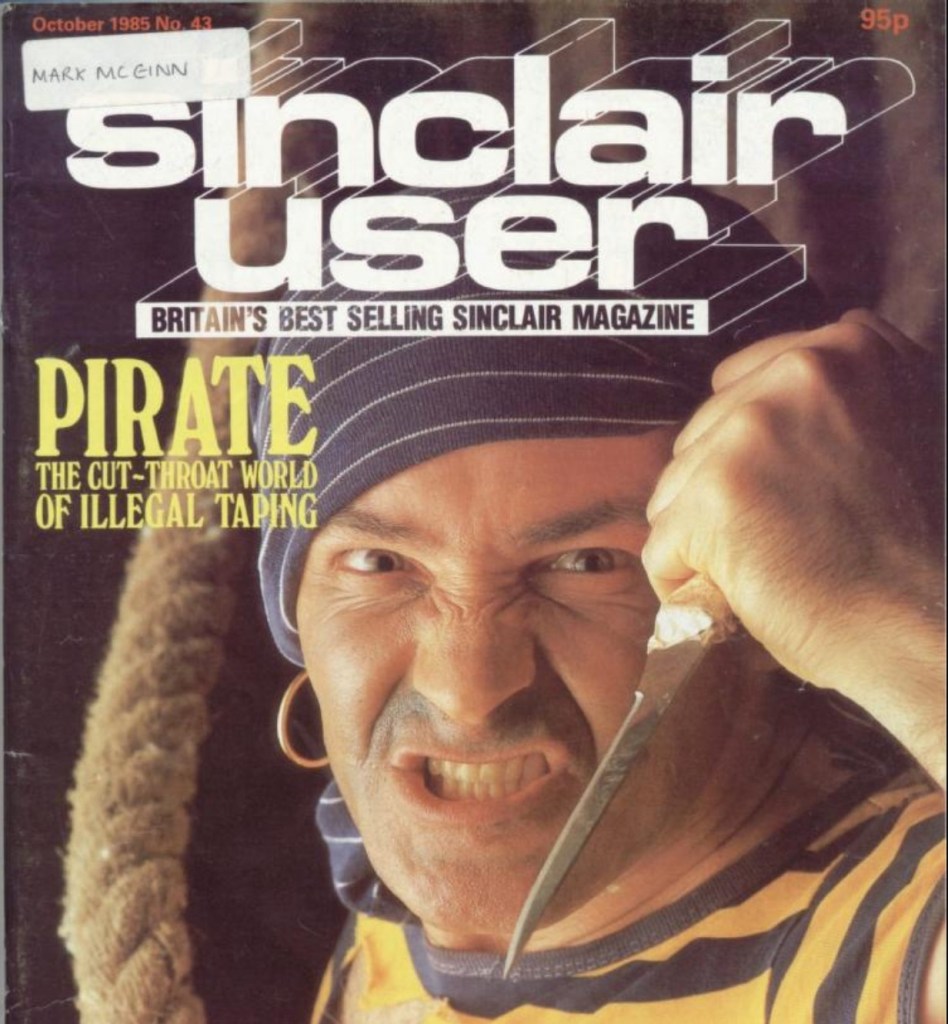
The Sinclair User magazine, once heralding itself as ‘Britain’s best-selling Sinclair magazine,’ is a now-defunct technological magazine from the United Kingdom that centered its content around Sinclair Research LTD’s line of home computers (Wikipedia 2024.) The magazine catered towards a more casual audience of early internet users, with its articles containing content related to technological news and video game-centric content like reviews and demos.
The cover of the 43rd issue of the Sinclair User magazine from October 1985 stands out among the rest. Relative to the circuit of culture model’s ideas about representation, this feature sets itself apart from the whimsical and optimistic graphics featured on the front of the magazine’s other issues. Rather than demonstrating home computers’ exciting features or prowess at the time, this feature indicates early technological fears–in personal computer users and brands alike.

The figure at the forefront of the magazine cover is a fearsome one: a stereotypical swashbuckler provides a stark contrast against the dark background. Donning a fierce expression and tattered clothing, the knife-brandishing pirate evokes a sense of unease in readers, begging the question: “How big of an issue is digital piracy?”
This, in combination with the cover story’s bold yellow caption, “PIRATE: the cut-throat world of illegal taping,” emphasizes the severe nature of the article within. Although the pirate figure on the cover is dramatized for a comedic and eye-catching effect, negatively connotated phrases like ‘cut-throat’ illustrate the consequences associated with digital piracy, or, as the Sinclair User describes it, ‘illegal taping.’ The cover notably does not contain much text outside of brief descriptions of the articles within in an effort to entice readers to peruse the content within.
To understand the concern around digital piracy that the magazine cover aims to convey, one must first familiarize oneself with digital piracy’s nuanced background. A Computerworld article from 1984 defines software piracy as “the reproduction of copyrighted software for redistribution regardless of whether it is for resale.” (Computerworld 1984.) Before becoming an established activity in its own regard, digital piracy began as an offshoot of hacking in the mid-1970s. Computer hobbyists began to create unauthorized copies of digital software and games, with some even distributing their duplicates to others. (The Encyclopedia of Criminology and Criminal Justice 2013.)
In an era when digital piracy was expanding at such a rate that tech giants like Samsung must make efforts to curb the practice (The Associated Press, 1986), it became essential to inform the everyday internet user on the topic–serving mostly as a cautionary tale for casual computer users who may be unknowingly engaging in online crime.
The article that the magazine cover represents isn’t black and white. Featuring the points of view of digital pirates and digital law enforcement (Guild of Software Houses and Federation Against Software Theft, respectively), readers can gain insight into both sides of the argument. (Sinclair User Magazine Issue 043, 1985.) This unjudgemental approach to the debate makes the article accessible to a more general audience of computer hobbyists. Rather than outwardly supporting or opposing piracy, the author–Wendie Pearson–presents the practice’s perceived dangers and merits.
Pearson’s narrative elucidates a lesser-known side of personal computer usage in the mid-80s and propounds an interesting fact: not only traditional counterfeiters were considered to be pirates. The article prompts hobbyists to put their actions into perspective because even those copying software to share with friends or using copies as a rental system were criminals in the eyes of the law.
Although the Sinclair User’s 43rd edition cover appears cartoonish and exaggerated at first glance, the information in the article it advertises highlights a digital issue that was just beginning to crop up amongst personal computer users at the time it was published.
Feature Image: Sinclair User Magazine Issue 043, 1985
References:
The Associated Press. Combo Video Recorder Raises Movie Pirating Concerns. (June 3, 1986, Tuesday, AM cycle). https://advance-lexis-com.proxy1.library.jhu.edu/api/document?collection=news&id=urn%3acontentItem%3a3SJD-K2T0-0011-8200-00000-00&context=1519360&identityprofileid=QW3CVQ54612.
Ingram, J. R. (2013). Digital piracy. The Encyclopedia of Criminology and Criminal Justice, 1–5. https://doi.org/10.1002/9781118517383.wbeccj116
Sinclair User Magazine Issue 043 : Free download, Borrow, and streaming : Internet Archive. (1985, October 1). Internet Archive. https://archive.org/details/sinclair-user-magazine-043
Sinclair User 1-95 + Annuals : Free download, borrow, and streaming : Internet Archive. (2014, December 21). Internet Archive. https://archive.org/details/SinclairUser033Dec84/SinclairUser/SinclairUser003-Jun82/
THOMAS W. MADRON. (February 20, 1984). Software piracy: How serious is it?. Computerworld. https://advance-lexis-com.proxy1.library.jhu.edu/api/document?collection=news&id=urn%3acontentItem%3a3S8G-G5J0-000C-T530-00000-00&context=1519360&identityprofileid=QW3CVQ54612.Wikipedia contributors. (2024, August 18). Sinclair user. Wikipedia. https://en.wikipedia.org/wiki/Sinclair_User
 Cultural History of the Internet