
 Posted by
 Long before computers as we know them today were established, excited innovators were working to connect people through various, developing technological means. As Kevin Driscoll writes in The Modem World, enthusiastic hobbyists started out with ham radios, expanding their reach and interconnectivity before household “computers” were a thing. After years of working together and sharing ideas regarding these radios, the hobbyists later turned their attention to the development of computers with microprocessors and modems that connected these computers, Using the technical skills they had developed in their free time, these hobbyists utilized the new technology at their fingertips to create the first Computerized Bulletin Board Systems (CBBS), a new method of widespread communication and cooperation. As a way to cover the new developments and advertise new microcomputer products of interest, Driscoll also notes the publication of Byte as instrumental to the emerging modern world.
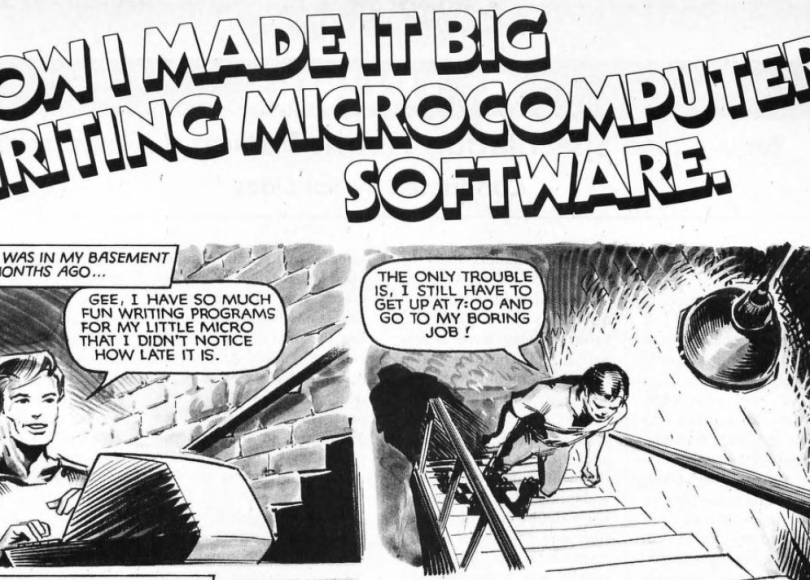
While this is all happening across the country, a small company out of California is also looking for ways to capitalize on the growing culture of consumer innovation to expand its product offerings. As Michael Doan described in his 1981 news article “A New— and Bigger– Computer Explosion”, Microstar, a software company, found momentary success because of the launch of a word processing software called Wordstar. According to Wikipedia, this software was the best on the market upon release, but when faced with competition from other companies, it started to lose its popularity. In the face of this software’s decline in popularity, MicroPro needed new products to market to their users, and so they sought to utilize the general public’s budding knowledge of microcomputers and programming to find new software offerings in a program called “Software Search”, which asks people to submit their own programs to the company in return for compensation of some form. In the last Byte issue of 1981, this cartoonish advertisement for Software Search was published by MicroPro International.

A picture of the advertisement taken straight from Byte Magazine
The advertisement immediately stands out to the reader because of its plentiful imagery and newspaper-esque cartoon style of illustration. At first glance, your eye can’t help but move between the basement, kitchen, and yacht scenes. It almost gives the impression of a superhero emerging from their disguise, switching from their day job and their heroic alter-ego, except in this case, the alter-ego is just them as a wealthy yacht owner. Though there are countless advertisements for games, computer parts, websites, etc., throughout this issue of the magazine, almost all of those focused on conveying as much information as possible in the little space they were given, so MicroPro’s advertisement stood out in contrast. As Byte’s main goal is to cover developments in microcomputer technology accurately, this is expected, but MicroPro’s comic therefore stands out in contrast. The one-page advert contains a roughly fifty-fifty split of text and images, with very informal and blatant language used throughout (except the fine print in the bottom right of the advertisement). From a representation standpoint in the Circuit of Culture, it seems that MicroPro is trying to remove the technical and professional stigma from microcomputers in an attempt to broaden the base of users who may feel interested in or qualified to submit their work to MicroPro. It is worth mentioning that at this time, the primary use of commuting was still business applications. Although there had been some ventures into entertainment and social uses of computing, such as the pong game, in the late 1970s and early 1980s computing was still characterized by a primary focus on how to improve efficiency in the workplace. Additionally, because the focus was primarily still on business applications, consumer usage of personal computers was still limited to being primarily hobbyists. It is likely for this reason that MicroPro chose to publish their advertisement in Byte. They wanted to reach out to the previously untapped innovative source that was the hobbyists and utilize the innovations they made in their spare time as the base for new products they could monetize, and so the identity of the advertisement lies in how they view the hobbyists they intend to recruit.
MicroPro’s stylistic choices in recruiting these hobbyists reflect their perception of the potential users of Software Search and reinforce the above ideas of online experience at the time. The man being followed in the advertisement goes from being in plain clothes, having fun coding his basement, to having coffee with his wife before heading to work, and it is only after he sends his programs into MicroPro that he reaps the benefits of being on a yacht off the shore of Greece. Without any sort of background knowledge, one can clearly see that MicroPro is attempting to create as stereotypical of a computer hobbyist as possible and show that hobbyists find success with Software Search in an attempt to get readers to believe they have that same kind of hobby. What this means, however, is that in the eyes of a corporation such as MicroPro, the most prominent users at the time were part-time hobbyists. If computers were more widespread, the advertisement would have focused on trying to get families who already had computers to pick up coding as a means to make extra money on the side, or if computer science were a more established career, MicroPro would have simply made a job listing instead of asking amateurs for their ideas. Their choice to ask hobbyists for new pieces of hardware displays that the online experience was beyond the point of only being used in computational and research realms, but not yet at the level of being synonymous with everyday life.
While the advertisement promises financial rewards to those who send in programs, the one thing that stood out to me as strange was the lack of any definite financial figures in the advertisement. The representation of the yacht as a byproduct of submitting your programs to MicroPro is certainly a powerful image regarding the economic opportunity of Software Search. However, there is no statistical basis that says how much profit the typical consumer can expect to make when submitting their programs. They say they may offer royalties or a one-time payment on a case-by-case basis, but there is no reference for what those figures may be. It is also worth noting that neither the Wikipedia page on MicroPro nor any Google search returns any further information on Software Search, indicating that the program never really reached any noteworthy level of success. In my mind, this means that fundamentally there was something wrong with the concept or execution. It may have been there was very little profit to be made, and having to share it between the consumer and MicroPro themselves was financially inviable, or maybe Software Search never got enough submissions to offset the costs of advertising. Whatever the reasoning, the lack of clarity in the advertisement regarding the consumer’s profit is indicative of a lack of sureness in the product on MicroPro’s behalf. Had they expected it to do well, they could have advertised a flat royalty rate, but instead they wanted to sucker people in with the false promises of yachts and luxury, only to, I’m assuming, milk the little money they could make from each new piece of software and then payout as little of a sum as possible to the person that sent it in.
In conclusion, MicroPro recognized that there was a previously unused market of raw potential in terms of creating new products in the form of microcomputer hobbyists. Through the comic-like deception of the typical amateur computer enthusiast, MicroPro effectively targets these hobbyists, conveying feelings of excitement and previously unheard-of financial opportunity in order to expand their product lines. Although ultimately unsuccessful, MicroPro’s Software Search recognized the evolution of the online experience as computers became increasingly common in homes and for personal use. Their advertisement not only reflects what they imagine their target audience of hobbyists’ use of online services to look like but also offers up a new vision for future cooperation in the development of computers, supporting a vision of what is essentially a part-time computer scientist.
Works Cited:
Doan, Michael. “A New– and Bigger– Computer Explosion.” U.S. News and World Report, 20 Apr. 1981, p. 62, advance.lexis.com/document/?pdmfid=1519360&crid=f86aac8e-90d7-484f-8352-70bc5858f0df&pddocfullpath=%2Fshared%2Fdocument%2Fnews%2Furn%3AcontentItem%3A3SJ4-FGT0-000C-D0YY-00000-00&pdcontentcomponentid=8065&pdteaserkey=sr0&pditab=allpods&ecomp=hc-yk&earg=sr0&prid=26f23849-e0a1-430d-a64a-289ea780f291. Accessed 20 Sept. 2024.
Driscoll, Kevin. The Modem World: A Prehistory of Social Media. New Haven, Yale University Press, 2022.
MicroPro International. “How I Made It Big Writing Computer Software.” Byte, vol. 06, no. 12, Dec. 1981, p. 314. Accessed 19 Sept. 2024.
Wikipedia Contributors. “MicroPro International.” Wikipedia, Wikimedia Foundation, 3 Nov. 2023, en.wikipedia.org/wiki/MicroPro_International. Accessed 24 Sept. 2024.
 Cultural History of the Internet