
 Posted by
 Before the 1970s, the connotation of computers was one associated with blocky, room-sized main frames. Universities, research firms, and government contractors were the hubs for mainframe computers, and “accessing the system required a terminal, modem, and phone line—a tall order for all but the hardcore hobbyist in 1978.”[1] The Altair 8800 was the first personal computer, and despite its difficult user-interface, it was crucial toward the development of our modern-day personal computers, and eventually the creation of the Apple PowerBook G4, which transformed the capabilities of personal computing through its utility, portability, and user-interface.
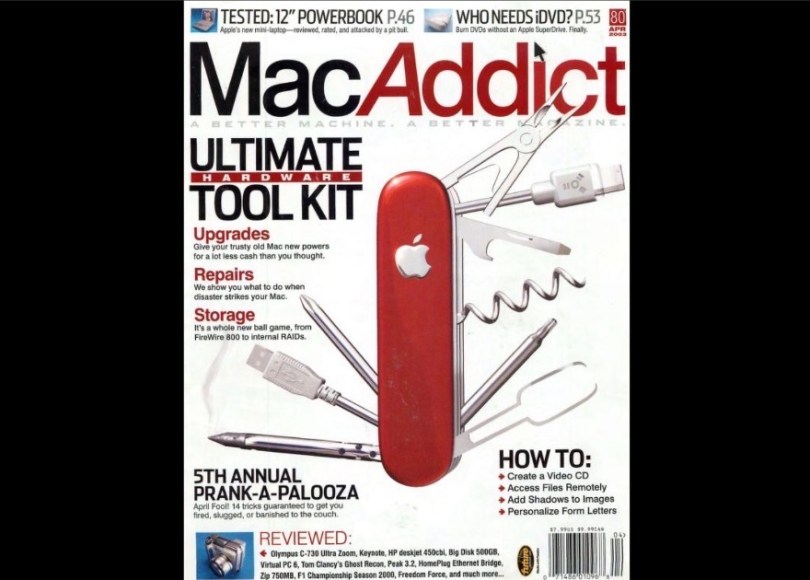
Regarding computer advertisements, I have chosen to analyze Mac Addict’s 80th edition.[2] This 2003 release features an ad for the Apple PowerBook G4 in the corner, and more importantly, a centerpiece of a red, Apple logo embossed, Swiss army knife that sports various computer-modifying tools. This visual metaphor conveys the utility of Apple products in a manner that popular audiences are able to understand. When viewing this ad, one does not need to be an Apple product aficionado or a computer scientist to understand that the representation of the Apple brand as a Swiss army knife conveys a tone of utility and efficiency surrounding their devices, and more specifically, the PowerBook G4 shown on page 46. The tools shown within the Apple Swiss army knife are screwdrivers, scissors, a bottle opener, a corkscrew, a micro-USB, and a sim card tray remover. This combination of both conventional Swiss army knife tools, as well as computer specific tools results in the synthesis of the Apple brand as one that incorporates traditional as well as innovative features into its products. Additionally, the red of the knife’s casing draws the viewer’s eye toward the centered apple logo, and the outstretched, sleek and silver tools give off a futuristic look. The magazine cover headings of “Upgrades, Repairs, and Storage” are written in red text to match the knife, and this cohesion of color progresses the idea that Apple products are ones that are simple to modify and fix. As to how the PowerBook G4 plays into this utility, “take the new miniature G4 PowerBook … for $1,799. Looks to die for. Sleek aluminum casing. Powerful chip. NVidia graphics to drive a screen that’s delicious to look at. Ports everywhere. I’d sleep with one under my pillow if it was a little bit softer.”[3] This perception of the G4 showcases how revolutionary of a device it was, and that Apple’s focus on implementing utility into its products was appreciated by consumers.
Portability is the second aspect that is highly conveyed in this ad, and the pocket-sized nature of the Swiss army knife makes the viewer associate Apple products as ones that can be used in all sorts of settings such as at home, at work, while traveling, or in the field. This association results in the PowerBook G4 contrasting against the confinement of the desk top microcomputers of the 1970s and 1980s. Times Newspapers commends this device “with its sleek looks and space-age design, the G4 Powerbook is the latest in portable multimedia.”[4] The text in the lefthand corner of the ad says “Tested: 12” Powerbook,” and this specific inclusion of the computer dimensions being 12 inches aids in persuading consumers to buy it since this device will be able to fit in their backpacks, purses, or briefcases.[5] Apple’s combination of conveying utility and portability within its marketing draws the viewer in, but the PowerBook’s user-interface is what makes them stay around to buy the product.
While the image of the PowerBook in the lefthand corner is quite small, the viewer is still able to see that this personal computer has a display screen, a keyboard, and a mouse trackpad. When compared to the Altair 8800’s “bright- blue case and blinking red LEDs,” Apple’s PowerBook flaunts its streamlined user-interface, and the viewer is left with the perception that Apple’s devices are able to be used by the common man, but without sacrificing the presence of necessary features.[6] Stephen Williams writes, “of course, Apple remembered to put in more useful stuff than it forgot. A DVD-ROM/CD-RW combo drive comes standard (you can opt for a CD-RW/DVD-R burner for $200), as do stereo speakers and a S-video out for hookup to a TV monitor. And then there’s the whole aluminum-touch PowerBook thing, to satisfy a soul who’s been left out in the cold by Compaq or Dell.”[7] This inclusion of drives, speakers, and monitor ports characterizes Apple as a tech brand that is welcoming to varying consumer skillsets.
Computer development has come a long way since its takeoff in the 1970s, and the modern-day connotation of computers is now one of knowledge and portability, rather than mystery and confinement. The mainframes of the 20th century no longer rule above everyday consumers, and the onset of computer advertising, specifically Apple’s PowerBook G4 ad in this case, emphasizes that computer advancement is not defined to universities, institutions or government agencies. Apple’s PowerBook G4 was a computer for everyone, and this ad’s use of metaphor through the Apple Swiss army knife showcases how this brand combined utility, portability, and user-interface to create the device of the future.
[1] Kevin Driscoll, The Modem World: A Prehistory of Social Media, Yale University Press, 2022, https://doi.org/10.2307/j.ctv2c3k1ww.
[2] Internet Archive, 2003, “MacAddict 080: Free Download, Borrow, and Streaming : Internet Archive,” April 1, 2003, Accessed September 27, 2024, https://archive.org/details/MacAddict-080-200304/mode/2up.
[3] Stephen Williams, “Apple’s Mini PowerBook Is Big on Amenities: [ALL EDITIONS],” Newsday, March 11, 2003, https://proxy1.library.jhu.edu/login?url=https://www.proquest.com/newspapers/apples-mini-powerbook-is-big-on-amenities/docview/279627524/se-2.
[4] “Apple Titanium Powerbook,” Times, June 26, 2002, 9[S], The Times Digital Archive (accessed September 27, 2024), https://link.gale.com/apps/doc/IF0501117384/GDCS?u=balt85423&sid=bookmark-GDCS&xid=7fb061f4.
[5] Internet Archive, “MacAddict 080.”
[6] Driscoll, The Modem World, 53.
[7] Williams, “Apple’s Mini PowerBook Is Big on Amenities.”
Bibliography
“Apple Titanium Powerbook.” Times, June 26, 2002, 9[S]. The Times Digital Archive (accessed September 27, 2024). https://link.gale.com/apps/doc/IF0501117384/GDCS?u=balt85423&sid=bookmark-GDCS&xid=7fb061f4.
Driscoll, Kevin. The Modem World: A Prehistory of Social Media. Yale University Press, 2022. https://doi.org/10.2307/j.ctv2c3k1ww.
Internet Archive. 2003. “MacAddict 080 : Free Download, Borrow, and Streaming : Internet Archive,” April 1, 2003. Accessed September 27, 2024. https://archive.org/details/MacAddict-080-200304/mode/2up.
Williams, Stephen. “Apple’s Mini PowerBook Is Big on Amenities: [ALL EDITIONS].” Newsday, March 11, 2003. https://proxy1.library.jhu.edu/login?url=https://www.proquest.com/newspapers/apples-mini-powerbook-is-big-on-amenities/docview/279627524/se-2.
 Cultural History of the Internet