
 Posted by
Source: https://dn790004.ca.archive.org/0/items/USER_04/USER_04.pdf
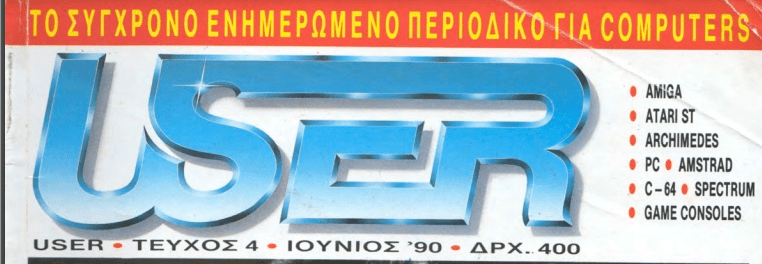
This is a screenshot of a printer advertisement from the Computer User 04 Magazine in Greece published in 1990.
Translation:
“The first thing you buy when you are satisfied with the capabilities of your computer is a printer. The ability to print texts, images or data on paper that are either lost or hidden on some floppy disks when we switch off our computer is still a necessary asset. And the goal set by many visionaries, that is, to live in a paperless world, does not seem to be realized in the very near future.
Whether we want it or not, at some point we need a printer. Besides, you, the readers of this magazine, have shown through the questionnaires you sent us that a printer is probably the peripheral you would prefer. Thus, in response to your request, we are presenting in this issue two printers that have appeared relatively recently on the Greek market: the 1.O-10 II from 8TAP and the VNIRT 9 from OITIZEN. These two models have several things in common: They are both single-axis, have a full-length, high-clearance, low-weight, and low-maintenance.
They both have a 9-colour printing quality and their price indicates that they are aimed at (and affordable to) the average user. But, of course, apart from these, there are also the elements that constitute the telling difference. So let us see what each printer has to offer.”
The dimensions and weight are about the same, so the two machines occupy the same space on your desk. The VNIRT 9 is more impressive with its modern shape, while the design of the 1.O-10 II is simple and traditional. Besides, the VNIRT has often been distinguished for its design. In the final analysis, of course, it is a matter of preference.
The VNIRT has twice the capacity of the 1.0-10 II, which allows you to get on with your work more quickly, especially if it has 2 built-in LEDs (apart from the usual ones, of course), and the possibility of an optional OOLIG KI seems quite interesting. On the other hand, the is armed with a lower price. It is also less noisy than its competitor (which, it should be noted, is equipped with a siwi piowave). In terms of handling, which is also a very important factor, the two models seem to be equivalent, since they have an easy-to-use opti-handle that incorporates several functions. However, both manuals are very detailed. It should be noted that the companies that import these printers into our country are known for their support, impeccable VNIRT and consistency.
It is difficult to distinguish which text comes from one printer or the other as the quality of the print is almost identical (if some samples appear lighter in the photographs, this is due to the condition of the ink ribbon and is not related to the performance of the printers). Perhaps the 1.0-10 II has softer graphics, but as mentioned, with little difference. It should be said here that an AATARI 1040 8T was used in the test (not that it plays any role in quality!) and I did not encounter any problems at all.
You are in for a truly impressive experience with the VNIRT to go to the appropriate ION and press RILE. Here with the peephole-like option you can see the level and your position on a map whose sharpness is increased by picking up the right objects.
The OAMERIY therefore seems to be a lot cheaper – it’s almost a classic – but about 11000 USD less. On the other hand, if speed plays an important role for you, you will undoubtedly prefer the VNIRT. If you are one of the users whose only final criterion is price, then the I.O-10 II will be your choice, since it costs about 11,000 USD less. On the other hand, if speed plays an important role for you, you will undoubtedly prefer the VNIRT.
We would like to thank INROAIEDT (representative of DTAB) and AMY OMRITERD (representative of OICIEN) for providing the machines for the test.”
Analysis:
The July 1990 issue of Greek Computer User Magazine #4, or ΤΕΎΧΟΣ #4 as it was in Greek, features an advertisement and short article about two printers. By the late 1970s, computer technology had made relatively little impact on sectors of Greek society that had limited engagement with electronics such as TV, video, and fax. However, in the early to mid-1980s, a culture of software use and openness developed within the home computing scene in Greece. Catered towards new computer users in Greece in the 1990s, this September 1990 advertisement insists that printers, which were solely an office accessory, were now a necessity in the home. Each printer is represented very differently in the context of the novel luxury of home printing. One printer is represented to be more traditional, whereas the other is represented as more modern and advanced. These different representations of the printers cater to different audiences, giving this advertisement a unique edge in the printer market.
This advertisement attempts to persuade people that they need a printer, and goes on to compare and contrast two different printers. In Greece, as in other European countries, home computers began to gain popularity in the 1980s and reached a wider audience, adapting to the nation’s unique social, economic, and cultural characteristics. Therefore, this advertisement starts out by highlighting one of the main issues faced by computer users. With a persuasive tone, it acknowledges a common customer problem of lost or hidden data, and goes on to glorify the capabilities of a printer as a solution. It explains the necessity of printed paper in the world, and consequently the necessity of printers, and retains a pessimistic tone when addressing “visionary dreams of a paperless world.” The article also attempts to be customer-centric, as it explains that its two new printer offerings are a response to user requests on a questionnaire. Its target audience is therefore computer-owners. The first few paragraphs, which are written in large blue font to catch the eye of the reader, have an intended purpose of convincing hesitant computer users that they need a printer. The latter part of the advertisement is text-heavy and caters to those who are deciding which printer to get by laying out facts about each. Since the advertisement is found in a computer user magazine, it acknowledges that readers may not be comfortable with heavy technical terms, so while the language is formal, it is not overly technical so that its popular audience can understand it. Furthermore, the advertisement attempts to make consumer problems are seen and offers the printer as a solution, evoking positive feelings towards, and even an apparent need for, one of the printers. It represents printers for computer-owners as a necessity. It evokes feelings of falling behind or being left out if one doesn’t have a printer. However, it also represents the two printers it markets differently, and each representation appeals to a different audience.
The first of the printers is represented as simplistic, traditional, and economically friendly. Its main selling point is its lower price, so there’s not much representation beyond that. The printer is meant for people “whose only criterion is price,” highlighting that the printer doesn’t offer anything particularly special beyond its low price. The use of the word “only” ties together the way the printer is represented and the identity of the people who appeal to this representation. The printer is represented as something with a sole financial benefit and its specific features aren’t considered much. However, it’s important to note that because this is an advertisement aimed at convincing people to purchase this printer, the word choice used is very persuasive. The words “classic” and “traditional” are used many times to describe this printer. This gives the printer a more “old-timey, vintage representation. The printer is associated with simpler tasks and there are pictures of the printer in a house. The advertisement explains that the printer is not fast and has relatively low space capacity, indicating that it is meant for simple, discernible tasks.
On the other hand, the other printer is represented to be high-tech, designer, and “has often been distinguished for its design.” Since it’s much more expensive, this printer is not represented through the lens of price, but rather it is represented as a very novel, high-quality technology. The article explains that when you purchase this printer, “you are in for a truly impressive experience.” This printer is also represented as being fast, so it targets people who may have a lot on their plate and care about the speed that their work gets done. Although the printers are the same size and weight, this printer is described to be “more impressive with its modern shape.” This gives the printer a higher-end, chic designer identity.
Fundamentally, the representation of printers along with the growing traction and popularity of home computers in Greece during the 1980s is incredibly complex and fascinating. Targeting new computer users in the 1990s, the issue of the Greek USer Magazine’s advertisement emphasized that printers—once seen as purely office tools—had become essential household items. The ad presented two printers in contrasting ways: one depicted as traditional and the other as modern and cutting-edge. These were some of the first representations of printers in Greece, paving the way for a long and innovating technological future for the country.
Work Cited
Greek User Magazine 04. September, 1990. https://dn790004.ca.archive.org/0/items/USER_04/USER_04.pdf
Lekkas, T. (2014). Legal Pirates Ltd: Home Computing Cultures in Early 1980s Greece. In: Alberts, G., Oldenziel, R. (eds) Hacking Europe. History of Computing. Springer, London. https://doi.org/10.1007/978-1-4471-5493-8_4
Lekkas, Theodore, and Aristotle Tympas. 2020. ”Global Machines and Local Magazines in 1980s Greece: The Exemplary Case of the Pixel Magazine”. WiderScreen 23 (2-3). http://widerscreen.fi/numerot/2020-2-3/global-machines-and-local-magazines-in-1980s-greece-the-exemplary-case-of-the-pixel-magazine/
 Cultural History of the Internet