
 Posted by
 While browsing the internet today, it is hard to miss the obvious signs of censorship, regulation, and restriction placed on many of the sites you visit every day. You may have noticed how YouTube will demonetize content with foul language, how Reddit will place a blur over spoilers, and how Instagram will delete any content it deems inappropriate for violent or sexual reasons. These regulations are so automatic and commonplace that you might forget that previously content had to be moderated by actual individuals.
If you go way back to 1985, roughly five years before peak Usenet usage in the early 1990s, you will find one of the earliest examples of an internationally accessed, moderated Usenet discussion channel in the form of mod.recipes. Carrying the mod classification in the title of the newsgroup is the first indicator of heavy regulation of content that can be posted to the newsgroup. For those unfamiliar, any newsgroup whose name starts with “.mod” is classified as moderated, meaning that there is a strict protocol in place that restricts the messages to official group business, and also indicates that there is at least one person with administrative access to enforce the rules and etiquette of the newsgroup and remove any posts they deem off-topic. As a result of this classification, only those interested in a focused discussion or uniform forum even accessed these newsgroups, which means beyond having a moderator regulating the discussion, the “mod.” tag itself regulates out those looking to troll, or otherwise distract, others because they are aware their comments will be swiftly deleted by moderators. In this sense, those interested in the content of the newsgroup benefitted from the classification placed in its name.
In the case of mod.recipes, the sole moderator of the forum was also the creator, Brian Reid. He was a food enthusiast who envisioned a collectively-created, printable cookbook that sourced dishes from around the globe. As a result, he did not want to limit access to the forum and potentially seclude those with great recipes, so the forum was accessible to all Usenet users. However, any non-recipe posts would ruin the vision of the forum being a cookbook one could scroll through like an actual book, so he created strict rules and posted them as the first few messages to the forum. These messages would then be continuously reposted (every 28 days domestically and every three months internationally) to make sure new members were made aware of the rules immediately upon entering the forum. In terms of further regulation on the site, these rules would serve as the basis of how Reid moderated content, and how eventually the users began to self-moderate their own content. The most prominent of these rules is the one regarding how new posts are created, which can be seen here:
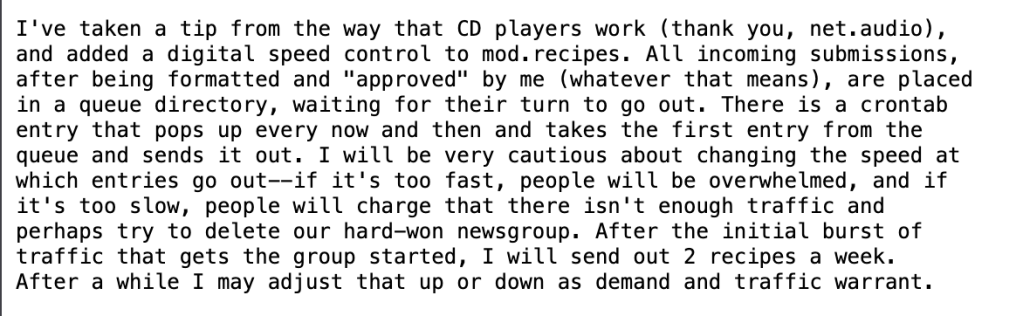
(Screenshot taken from mod.recipes newsgroup)
In utilizing this method for new posts, Reid is ensuring that content is continuously flowing out into the newsgroup, keeping users happy, and therefore less likely to break any of the rules. What it is also doing, however, is certifying that every post people want to make gets the stamp of approval from Reid. In terms of executing his vision for the newsgroup, this means that every recipe will have the same format, so once users adapt to it, they will be able to read all of them with ease, and can more efficiently go through vast quantities of recipes to find ones that fit their dietary needs. This would suggest that this type of regulation on content benefited the forum and the users. Unfortunately, however, the rigid nature of such restrictions seems to have had the opposite effect. Although he edited every post to fit the desired format, Reid requested that all posts be submitted to either his email (reid@decwrl) or his alternate account (recipes@decwrl) in the same format that was outlined in his initial rule postings. Since all posts have to go through Reid, and all posts are supposed to be in the same format, people are unlikely to even try to comment on or appreciate other’s recipes (and even if they did the moderator likely did or would, shoot it down). What you get when you scroll through mod.recipes is exactly what you would expect, a cookbook, but what you don’t get is a community. There isn’t any way to receive feedback for your recipes or even thank someone for informing you of one of your new favorite food items. Maybe this was desired not only by the moderator but by a majority of the community, but it also may have been a contributor to the eventual dying out of the community in 1987.
To that end, this sole-moderator regulation appeared to be unsustainable in the long run. Despite being deeply invested in his creation, Reid had other, more important ways to spend his time, and could not always actively moderate and maintain the level of posts each day, as can be seen through one of the only non-recipe messages he posts:

(Screenshot taken from mod.recipes newsgroup)
If there were a large group of moderators or even a small team of those with administrative access, then this issue could have been avoided, yet because of Reid’s choice to keep full control over the posting to maintain his vision of the cookbook, the quality of the posts started to vary over time.
As the moderation became less consistent and frequent, the members of the newsgroup, new and old, to maintain its activity, started posting on their own with what can only be described as a high degree of self-moderation. Even though posts never stopped coming from reid@decwrl and recipes@decwrl, posts started popping up in late 1986 from other users simply sharing their recipes by themselves, which Reid either endorsed or never objected to. Additionally, around this time, they also started posting a cleartext, or easy-to-read, version of their recipes that made reading off of a computer more intuitive but did not have the same practical applications for printing or sharing the recipes across different software. Despite their new control, the users maintained the etiquette of not commenting on other’s posts, posting in the standard format, and staying focused on only sharing recipes, leading to the conclusion that after a certain point, the social convention of the newsgroup served to regulate what content was posted. Either out of anxiety over the backlash of disrupting the norm, or respect for the strict precedence, no one ever broke any of the rules that were initially laid out, at least not to the extent that the moderator, in his lackluster management, wasn’t able to moderate. The addition of the clear text, which initially came from a user, not the moderator, also displays that with less strict regulation, the newsgroup actually became more enjoyable to use, and overall, the shift away from strict, one-person moderation, may have yielded a nice reinvigoration of the forum.
The mod.recipes newsgroup may not have been the most interactive community as far as Usenet goes, but it was still an international meeting ground for cooking enthusiasts to share their recipes with their peers. Although the forum started as a closely moderated community, maintained solely by its creator to execute his vision, it eventually grew into a self-moderated community where anyone could post. The fact that the people of mod.recipes newsgroup remained focused on the original cookbook vision displays not only the effectiveness of the moderator in executing his vision but also the power of social convention in continuing to allow for the self-moderation of the community and the power of the “mod.” classification in keeping those who would disrupt this convention away. Without the strict regulation laid out by Reid when he created the forum, it is unlikely this newsgroup would have ever stayed active for as long as it had and never would have become a site where people today can still access, download, print, and be left with a wonderful new set of cooking adventures at their fingertips.
Works Cited
My Recipe Book. Canva. Accessed October 10, 2024. https://www.google.com/imgres?q=online%20recipe%20book%20graphic&imgurl=https%3A%2F%2Fmarketplace.canva.com%2FEAFeaUjq_fA%2F1%2F0%2F1003w%2Fcanva-beige-simple-sketch-illustration-recipe-book-cover-KGMSotYMFUo.jpg&imgrefurl=https%3A%2F%2Fwww.canva.com%2Ftemplates%2Fs%2Fcookbook%2F&docid=1UPRSjixqECV-M&tbnid=UdCm5cqC64_XOM&vet=12ahUKEwi0uLzSwoWJAxXDFVkFHRP4DJ4QM3oECE0QAA..i&w=1003&h=1600&hcb=2&ved=2ahUKEwi0uLzSwoWJAxXDFVkFHRP4DJ4QM3oECE0QAA.
Reid, Brian. “mod.recipes.mbox.” Usenet Historical Collection. Accessed October 2, 2024. https://www.usenetarchives.com.
 Cultural History of the Internet
