
 Posted by
Aliens exist and they are here. On December 6, 1999, a newsgroup was created to post this theory, and for the past 25 years, thousands of different voices have had something to say in response. Thus, the newsgroup, “alt.aliens.they-are-here,” originated. Newsgroups are discussion forums on usenet dedicated to specific topics, ranging anywhere from movies to politics. As a biologist myself, fascinated by the limitless possibilities of space, I wanted to hear what others had to say about the idea of extraterrestrial life. The existence of aliens is a particularly fascinating topic for a newsgroup because people tend to hold very one-sided, insistent opinions: aliens exist or they don’t. This one-sidedness places many restrictions on what people say in different chats within the newsgroup. In fact, the name of the newsgroup itself, “alt.aliens.they-are-here,” not only categorizes it, but already poses a pretty clear restriction on who interacts with it. It suggests that this newsgroup is a place for people who have different theories on the existence of aliens, particularly those who do believe in their existence. A lot of the time, these restrictions are quite subtle or indeliberate. People, often due to unintentional confirmation bias, tend to read and contribute to the conversations that align with their beliefs and interests. Therefore, a lot of the conversations within this newsgroup include people agreeing with each other or sharing similar thoughts. This analysis will highlight the ways this newsgroup intentionally or unintentionally places restrictions on the topics of conversation, and what these restrictions mean in terms of who interacts with the newsgroup and the implications of the theories, stories, and science shared within it.
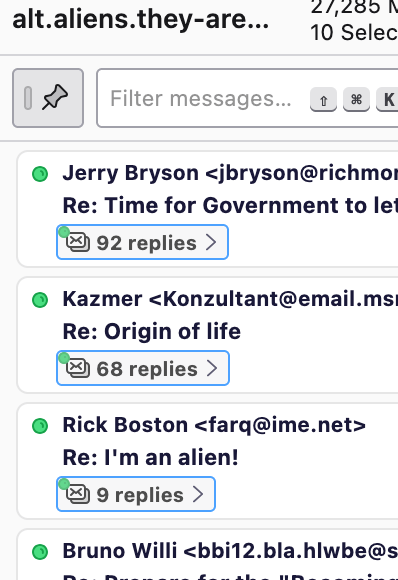
The most explicit form of restriction within this newsgroup is the subject lines for each conversation. Some subject lines state an opinion, others ask questions, and others link to sources. As aforementioned, the actual name of the usenet group, “alt.aliens.they-are-here,” places a restriction on the people who contribute to the group, as it suggests that aliens do in fact exist and opens up conversations for people to discuss their experiences with sightings or other forms of alien interaction. The same goes for the subject lines. Oftentimes, the subject lines connect like-minded people who share opinions, have the same questions, or want to share their own stories of alien encounters. Some subject lines are looking for advice in terms of protection from aliens: “best guns to defend against aliens.” This is a unique case because the subject line already establishes the fact that this conversation is meant for people who believe in aliens. This is an indirect restriction on who interacts with this conversation. One of the subject lines is “A Survey on Aliens, MIBs, and UFOs.”, which immediately places a restriction on the conversation because the answers are in a very specific format that the author of the subject line has prepared (multiple choice and short answer). The restrictions placed by subject lines can be both beneficial and malevolent. On one hand, they allow users to quickly identify conversations within the newsgroup that appeal to their interests or questions. This way, they connect like-minded people and spark interesting conversations. On the other hand, if someone has a very specific or niche interest, they may not be able to get it across because they feel restricted based on the subject lines. They may feel as though their idea doesn’t fall under the subject, which could stop them from contributing their thoughts to the conversation.
The second major way that this newsgroup places restrictions on content is through the validity and credibility of the conversations within it, which is often an unintentional restriction. Some conversations are structured around intentions to objectively study the science behind alien existence and leave out any subjective opinions. An example of this conversation is titled “Some Science News: Motions in Our Solar System.” This conversation is restricted to science-centric topics, which have changed a lot over time with new scientific discoveries. This discussion is particularly interesting because it is one of the longest-running ones. It was started in 2000 and people continue to update it today, rather than starting a new conversation chain with more recent science news. This highlights how there is no restriction on time. This conversation appears to be more timeless, which shows that the content itself takes priority over time when it comes to placing restrictions. While credibility and citations to science news sources are one way to restrict content, a lack thereof is another way that restrictions play into this newsgroup. For example, many conversations are about “the truth,” which adds an element of ambiguity. This ambiguity lessens the restrictions placed because it allows for a variety of opinions to be shared. While this can spark complex and intriguing conversations, it can also lead to strong emotions and arguments. This ties in the concept of the importance and impact of restrictions. Restrictions can bring together like-minded people; for example, when there are citations and intentions to converse about strictly scientific topics, it can bring scientific people together who all look at the idea of alien existence through the same objective lens. On the contrary, they bring together people who want to engage in back-and-forth subjective dialogue about the existence of aliens. This back-and-forth is due in part to restrictions being placed that categorize the conversation, while also being a result of a lack of restrictions within the conversation.
Alien existence is a compelling subject for a forum like usenet because it tends to inspire strong, polarized opinions: either people believe in aliens, or they don’t. This binary perspective often limits the scope of discussions. These limitations can be subtle or even unintentional. People often engage in discussions that confirm their existing beliefs due to confirmation bias, which means many conversations in the group tend to feature like-minded individuals agreeing or building on each other’s thoughts. This is one of the benefits of restrictions, because it allows people with similar interests, stories, and questions, to connect with each other in unique ways. However, at the same time, restrictions can lead to ambiguity and result in harmful and ill-intended dialogue. Overall, this usenet group highlights the positives and negatives of restrictions on these unique newsgroup online communities and their greater audiences.
 Cultural History of the Internet