
 Posted by
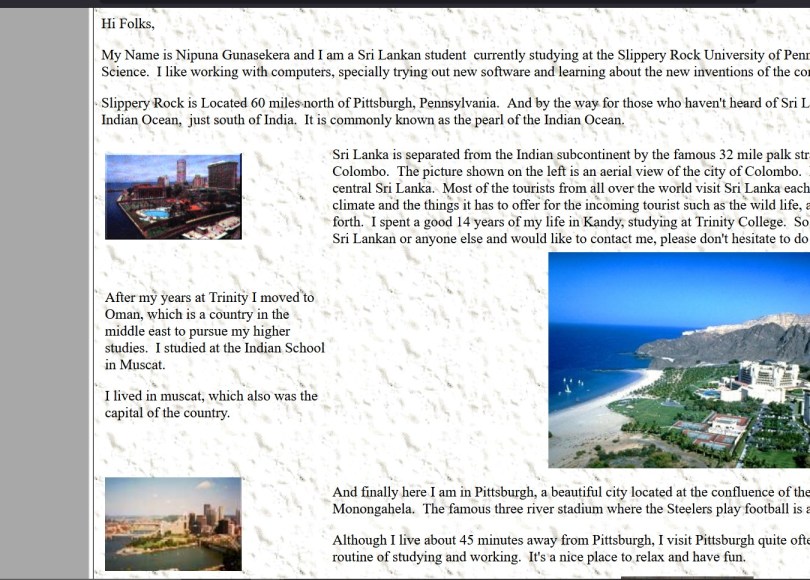
 Back in 1998, a Sri Lankan student called Nipuna Gunasekera made his last update to his GeoCities website simply titled “You are about to enter Nipuna’s Domain.” Through the information available on his website, we can take a peek at his identity and the properties of those who would view his website, thus giving insight into GeoCities and GeoCities’ users as a whole.
Nipuna was a computer science student studying abroad at the Slippery Rock University of Pennsylvania. Perhaps because of this his website is easy to read and formatted simply and clearly. On the left hand side, is a sidebar with navigation buttons to important side pages with titles such as “resume,” “Srilanka,” “SRU,” and “Comments.” This sidebar tells the viewer Nipuna’s main identities and details on viewer engagement.
It is self-evident that Nipuna loves Sri Lanka. He introduces the reader to his home country in the homepage and has an entire sub page dedicated to Sri Lanka. In fact, upon clicking into the Sri Lanka subpage, the viewer will hear a sped-up instrumental of the Sri Lankan national anthem. Inside the Sri Lanka subpage, Nipuna introduces the viewer to Sri Lanka through a collection of photos and short descriptions of Sri Lankan flora, fauna, historical sights and culture. Clearly Nipuna has put much effort into creating these pages with the goal of introducing the viewer to Sri Lanka. Considering the website is all in English, and that Nipuna uses his university email as his form of contact, this website is presumably for curious classmates, friends and netizens in America to learn about him and Sri Lanka.
One particularly interesting detail I noticed is that while most of the photos are taken by an assortment of different people and credited as such, all of the descriptions are written by one Siri Ekanayake. The very bottom of the Srilanka sub page says this page is designed and maintained by Siri and another author called Muditha Abhayagunawardhana. Perhaps Siri and Muditha are friends of Nipuna from back home?
A quick google search leads me to a website called “Sri Lankans on the Web.” This website is a collection of 697 hyperlinks of Sri Lankans that takes me to their websites. While Siri’s website is inaccessible, Nipuna’s website link is the same link as the one I’m using. Muditha’s website is also inaccessible, but the link includes an “.edu” portion that clues me in on Muditha’s identity. He seems to be a student from Bowling Green State University from Ohio. I may be making assumptions, but it’s likely that all three of them are Sri Lankan students studying in America. Nipuna wanted to make a website and asked Siri and Muditha to help out with the Sri Lankan sub page.
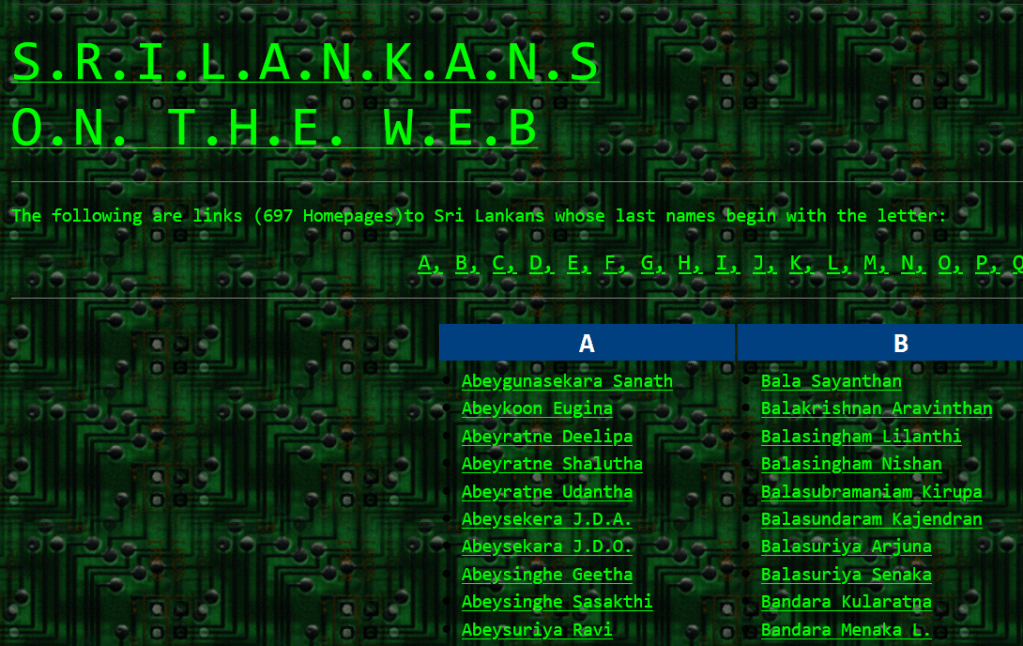
This was an unexpected discovery for me. It’s comforting to see people connect with each other and help each other out online. It also shows that while geocities were separate web pages that may require the viewer to enter the correct address to find a specific page, the creators made amalgamate websites for connection with each other and easy access for viewers.
The rest of the website is not as detailed. Under “resume” is his real resume, complete with his phone number and address. This would be unheard of currently, as people are much more weary about putting private information online due to fear of doxing, harassment, spam and targeted fraud. We can see that back then, viewers and creators had different opinions on the safety of the internet. They openly invited strangers to view private information. Perhaps this is because the internet did not have the same reach and accessibility as today, thus limiting the number of people who could use it. Another reason could be that back then, people’s lives were much less influenced by the internet. Meanwhile in the present, the internet holds so much more power over us, for example, it allows us to access our banking, credit information and medical and academic records.
In the last sub page, Nipuna thanks the viewer for “dropping by” and asks if they would like to leave a comment. I briefly considered leaving one but felt nervous about entering that much information (it asked for your address). In the end I tried it with a spam email. When I clicked send, it just took me to my own email with the information I entered and Nipuna’s email in the address. I’m unsure if this is also how this function worked back then, but presumably, Nipuna would receive these messages and maybe even reply from his own email. This would be one method of engagement the viewer could use. Another button in the sidebar says “chat” but is unfortunately blocked on the Hopkins’ internet and categorized as malware so I won’t test my luck with it. Presumably, the chat is a chatroom where viewers can see messages in real time and speak with others who are in the same chatroom. Both methods of engagement are still used today widely, but in the form of emails, direct messaging and live chats.
From Nipuna’s website, we can see that while GeoCities exist as discrete sites, they can and are interconnected with each other through the same bonds we are still connected by, whether it’s by nationality, by academic affiliation, or common interest. This webpage, like many others GeoCities, depicts a kinder and friendlier version of the internet where strangers can post their private information online and message each other directly with little fear. While we can see people from many different places, not everyone has access to the internet. GeoCities’ user demographics seem to lean younger with more English-speaking users from developed countries who have the infrastructure to support it.
https://geocities.restorativland.org/CollegePark/1027/hp1.html
 Cultural History of the Internet