

 Posted by
 Table of Contents:
Introduction
Production
Identity
Consumption
Regulation
Representation
Bibliography
Introduction
It may not surprise you to find out that just 30 years ago, it would have been impossible to come home after school and open YouTube, TikTok, or Instagram and scroll through a mixture of uploaded and live content as you unwind today. Most people know that these apps have only been around for a couple years or decades at most, but what they fail to realize is that internet streaming in general is actually a relatively recent technology. In fact, the first internet broadcast was actually the American garage rock band Severe Tire Damage testing the Xerox Palo Alto Research Center’s MBone (multicast backbone) in 1993 (Volle 2024). Unfortunately, the technology at the time was still very basic and could not handle more than 200 different connections to the stream at a given time. However, this all changed when, in 1995, a new company came online that we now know as Broadcast.com.
Broadcast.com is a since discontinued online audio and eventually video streaming service that became popular in the mid-1990s. Capitalizing on the lack of a developed streaming industry and the novelty of the internet at the time, Mark Cuban, along with Todd Wagner and Christopher Jaeb, launched AudioNet.com (the former name of Broadcast.com). Cuban himself has said that people thought he was an idiot because no one else was investing in developing online streaming at the time (Huddleston 2023). In the following clip, Cuban himself talks about how crazy the idea of investing in the internet broadcast industry was at the time, but also reaffirms how strongly he felt about the concept:
(Starting Greatness. “Takeaways from Broadcast.Com — Mark Cuban on Starting Greatness.” YouTube, March 22, 2021. https://youtu.be/vkzmh2dQJ04?si=9Shc__gSUCS63dQj&. )
(The relevant portion of the video ends at the 1:20 mark)
In hindsight, this decision to ignore the naysayers was ingenious, because not only did the three partners go on to make incredibly large sums of money off Broadcast.com, but they pioneered internet streaming as we know it today. Throughout this analysis, you will get a chronological look at how Broadcast.com started with nothing, grew into a streaming monstrosity, and then disappeared, leaving only its legacy behind.
Production:
To go back to the beginning of Broadcast.com is to actually go back to the beginning of AudioNet, which was the name and brand of Broadcast.com from 1995 up until 1998. As the story goes, Cuban and Wagner were both University of Indiana alumni who were living in Texas. This meant that they were nearly a thousand miles away from the game’s local radio and television broadcasts, and to listen to the games live, they had to call friends still living on or near the campus and have them put the phone next to the radio while the game was going on. As already promising businessmen, the two searched for a project that they could invest in and solve this problem, and after finding Christopher Jaeb and his idea for internet streaming, they founded Broadcast.com (Bottomley 2020). As discussed above, internet streaming was barely more than an idea at this point and no real commercial sites or services had yet to make a substantial impact on the market, so the trio quickly took to producing the next big thing. What is important to note though, is that from a technological standpoint, AudioNet and its creators made nothing new. They simply took existing technologies and configured them in such a way that they had created a service that could handle thousands of different users at once, download and stream media, and was accessible online. For example, the crucial software that allowed for audio streaming, which was the only streaming AudioNet had, was RealAudio, which was made by RealPlayer. Their servers were hosted by Microsoft and they used pre-existing satellite delivery technologies (Li 2013). As it turns out, this combination was both hard to reproduce and took immense financial investment, which gave them an edge over their competition. Almost ironically though, the entire company initially ran out of Cuban’s house and even went offline at one point because Wagner tripped on a cord en route to the bathroom (Bottomley 2020), an image that stands in contrast to the company’s high-tech product. In the end, it seems that the creation and production of Broadcast.com is the lackluster, but fortuitous combination of Jaeb’s ingenuity, Cuban’s investment, and a little help from the technological geniuses who had no idea that their ideas would one day be used to create the site you see below:

(Screenshot of Archived Version of AudioNet.com, The Wayback Machine)
Identity:
One consequence of Broadcast.com not being an original idea or technology is that it had no inherent identity. There was nothing tangible or intangible that you could single out of the production of Broadcast.com and confidently say reflected the values and ideals of the service and its staff. As a result, it is the choices that staff made in terms of what content they streamed on the site as well as the consumers of that content that defined the company. From its inception, the site primarily streamed sports games and sports broadcasting content, partially because Wagner and Cuban were still invested in listening to their alma mater play. However, a huge part of it is because the three founders saw the demographic of internet users as primarily male and believed that on the weekends, thousands of these men would tune in to listen to their team (Adelson 1996, Lexis Nexus Archives). What this means is that from its inception, the culture and vibe of the site was very sporty. Much like a GeoCities site, it was a place for like-minded individuals to gather, and while they couldn’t interact with each other, they could take comfort in knowing that thousands of others were currently sharing the same experience. Unfortunately, as a profit-driven business, Broadcast.com started to adopt new content and forms of revenue, and it had a detrimental effect on its core identity. The business model that Cuban laid out for broadcast.com was one where the goal was to aggregate as much content as possible (Sherman 1998, Lexis Nexus). In fact, making agreements with various entertainment companies and event producers was viewed as a way to lock up internet traffic and prevent competition (DiOrio 1989, Lexis Nexus). As time passed and the company continued to grow, both in the amount of content it offered, the number of consumers it had, the size of its staff, and the increased prevalence of advertisements and other paid services it offered, they slowly detached from their sporty origins. No longer could they be viewed as a novel internet sports radio broadcaster, but instead were much more of a corporate behemoth. consumers were no longer limited to just male sports fans, and while in the short term, this resulted in great expansion for the company, the decrease in identifiability that an individual consumer could have with the site may have been a contributing factor in the company’s eventual decline. That decline did not come for several years, however, and in fact, after the company started expanding its content offerings, and went public in July of 1998, it finally rebranded as Broadcast.com and saw tremendous growth.
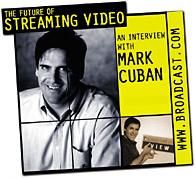
(Image Taken From Interview with Mark Cuban. Videomaker. “Six Streaming Video Questions with Mark Cuban of Broadcast.Com.” Videomaker, 1 Nov. 1999, www.videomaker.com/article/c9/7386-six-streaming-video-questions-with-mark-cuban-of-broadcastcom/. )
Consumption:
That growth was largely due to a period in the technology sector known as the Dotcom Bubble. Although this term refers specifically to the near 600% increase in the NASDAQ Composite Index that occurred from 1995 to 200 (though most of it came in the latter half of that time frame), the Dotcom Bubble has come to be characterized by the emergence of new uses for the internet, including shopping, new, communication, and of course streaming, all of which had the “.com” suffix (CFI Team 2023). What this meant for Broadcast.com is that they saw a rapid expansion in their consumer base, and at their peak were handling hundreds of thousands of users daily. As previously touched upon, the original demographic of their site was primarily male sport-enthusiasts, but right when they went public is when Broadcast.com really ventured into video streaming and a wider range of content offerings which can be seen in this picture of the archived version of the site through the variety of content in the tabs to the left and in the daily features section:

(Screenshot of Archived Version of Broadcast.com, The Wayback Machine)
Another result of the Dotcom Bubble for Broadcast.com was a massive influx of cash that came along as a result of the over-speculation in the stock market. On the first day alone, Broadcast.com saw a $45 increase in share price that resulted in roughly $45 million raised for the company (Bicknell 1998). That money was then spent on upgrading the hardware and software that supported Broadcast.com, allowing them to handle the increases in traffic and consumption. Additionally, the number of internet users almost tripled throughout the 1990s, and the demographic shifted from primarily male to females, grandparents, and kids alike. The lack of a limitation to accessing Broadcast.com as well as the ease at which the site could be navigated allowed the newest users of the internet to use the service with little trouble, aiding in its rise to the top of the streaming industry.
Users did not make up the totality of Broadcast.com’s consumption either. As their service grew, so did the desire of other companies to advertise on the site and streams. Throughout the boom period of the Dotcom Bubble, the site had more companies utilize their advertising as well as the newer forms of revenue, such as pay-per-view content or corporate services.
The consumption of Broadcast.com, while originally being a male-sporty demographic, underwent a rapid change throughout the Dotcom Bubble, and in contrast to the regression in identity, the business saw a drastic increase in its consumption as a result of its new content offerings, and the greater enticement of the services it offered to other businesses.
Regulation:
Unfortunately, like all bubbles, the Dotcom Bubble eventually popped in 2002, and the immense over-speculation that had occurred in the years prior resulted in massive layoffs through the tech industry as well as drove the value of many internet companies way down (CFI Team 2023). As owners of one of these companies, Cuban, Wagner, and Jaeb only escaped the crash by selling Broadcast.com to Yahoo for a staggering $5.7 billion in what became one of the worst deals in internet history (Kopytoff 2015). What this event highlighted in particular for Broadcast.com was how susceptible it was to regulatory pressures out of its control, and in fact, throughout its history, Broadcast.com had relatively little control over its fate. For starters, by design, Broadcast.com had to constantly pay other companies for their software and hardware needs, and over time those costs increased. Additionally, their lack of original content meant that they constantly had to shell out increasing sums of money for the rights and licenses to stream content. As the market and therefore the competition grew, these licenses, which were once very cheap or even free, became much pricier and harder to profit from. Consequently, these rising prices regulated how well Broadcast.com could deal with the Dotcom Bubble crash and ultimately their inability to do so. Additionally, although Broadcast.com reaped the benefits of being the first big player in the streaming market, they also had to deal with the fact that without established legal regulations, there were fewer barriers to entry into the industry, and they therefore had to to deal with the constant emergence of new competition. While many, including companies/organizations such as RealPlayer and the NBA, relished in the deals and laws that kept money flowing from Broadcast.com into their pockets, these regulatory pressures served as a huger damper to Broadcast.com’s profits, and in the wake of Yahoo’s purchase and the bursting of the Dotcom Bubble, lead to its decline.
Representation:
In 2002, Yahoo discontinued Broadcast.com and shut down most of its services, but that does not mean the story of the site ends there. Although its success was no longer measurable in traffic or earnings, even a decade later, the shockwaves of Broadcast.com’s time atop the streaming industry could still be felt. In hindsight, it is now clear that Broadcast.com represents a shift in the way the general population consumes media. In fact, in 2003 alone, there was a 104 percent growth in streaming media in the U.S. alone (Krikke 2004). Although Yahoo’s purchase was ultimately a failure, it opened the eyes of other investors in the industry to the potential of investing in user engagement rather than the product itself. Google’s purchase of YouTube in 2006, for example, can be viewed as a major corporation investing in an idea and consumers rather than buying an already profitable business. That is not to say, however, that Broadcast.com’s biggest impact is not that they essentially pioneered internet streaming as it is known today. This is not to say that every time someone sits down to watch the news or live sports they owe it all to Broadcast.com, because again, Cuban, Wagner, and Jaeb did not invent internet streaming, but without the path they carved, this process would likely have taken years longer and who knows how many great media moments would have been missed. It is hard to place Broadcast.com in any singular genre category because it basically created its own. Instead, this fortuitous configuration of years of technological development has come to represent a cultural shift in the way media is shared and consumed.

(Bing Image Creator, Accessed December 1, 2024. https://www.bing.com/images/create)
Conclusion:
If you were to ask strangers under the age of 30 today what they thought about Broadcast.com, they would likely give you a quizzical look and ask you what that is. Broadcast.com has not left a legacy of reverence or nostalgia, and it is unlikely you will even come across the name again in the foreseeable future. However, when viewed through the circuit of culture, it is clear that Broadcast.com is, without a doubt, critical to the history and development of internet broadcasting and deserves more recognition for the role it plays in the way we consume media today.
Bibliography:
Adelson, Andrea. “Remaking Radio as Internet Voice.” The New York Times. September 23, 1996, Late Edition edition, sec. D. https://advance.lexis.com/document/?pdmfid=1519360&crid=f8e46094-3cfd-4ad6-96cf-f39658adf096&pddocfullpath=%2Fshared%2Fdocument%2Fnews%2Furn%3AcontentItem%3A3S89-3M70-0005-G1N9-00000-00&pdcontentcomponentid=6742&pdteaserkey=sr6&pditab=allpods&ecomp=hc-yk&earg=sr6&prid=d1dd903e-ddd1-4294-b3be-fb84f5e6a845
Bottomley, Andrew. Sound Streams: A Cultural History of Radio-Internet Convergence. University of Michigan Press, 2020. https://www.google.com/books/edition/Sound_Streams/f9fkDwAAQBAJ?hl=en&gbpv=1&dq=history+of+%22audionet%22&pg=PA66&printsec=frontcover
Bicknell, Craig. “Broadcast.Com Wows Wall Street.” Wired, July 17, 1998. https://www.wired.com/1998/07/broadcast-com-wows-wall-street/.
CFI Team. “Dotcom Bubble.” Corporate Finance Institute, December 7, 2023. https://corporatefinanceinstitute.com/resources/career-map/sell-side/capital-markets/dotcom-bubble/.
DiOrio, Carl. “Broadcast.Com Chief: First Strike Crucial.” The Hollywood Reporter, April 19, 1999. https://advance.lexis.com/document/?pdmfid=1519360&crid=7c5a440c-324a-4b38-bf0f-42323487b473&pddocfullpath=%2Fshared%2Fdocument%2Fnews%2Furn%3AcontentItem%3A3W8P-XDG0-006P-R30V-00000-00&pdcontentcomponentid=12015&pdteaserkey=sr19&pditab=allpods&ecomp=hc-yk&earg=sr19&prid=17442c6f-4688-4373-af1d-43
Huddleston, Tom. “Mark Cuban: ‘People Thought I Was an Idiot’ for Launching the Company I Sold for Billions.” CNBC, January 15, 2023. https://www.cnbc.com/2023/01/15/mark-cuban-on-broadcastcom-streaming-people-thought-i-was-an-idiot.html.
Kopytoff, Verne. “5 Worst Internet Acquisitions of All Time.” Fortune, May 12, 2015. https://fortune.com/2013/05/21/5-worst-internet-acquisitions-of-all-time/.
Krikke, Jan. “Streaming Video Transforms the Media Industry.” IEEE Computer Graphics and Applications 24, no. 4 (August 31, 2004): 6–12. https://ieeexplore.ieee.org/stamp/stamp.jsp?tp=&arnumber=1310204
Li, Baochun, Zhi Wang, Wenwu ZHu, and Jianchuan Zhu. “Two Decades of Internet Video Streaming: A Retrospective View.” ACM Transactions on Multimedia Computing, Communications, and Applications 9, no. 1 (October 17, 2013): 1–20. https://dl.acm.org/doi/10.1145/2505805
Sherman, Jay. “If You Build It, They Will Listen, Cyber Exec Says.” The Hollywood Reporter, November 3, 1998. https://advance.lexis.com/document/?pdmfid=1519360&crid=bdb5db9f-c82c-4433-8f7e-354e0ee3b93c&pddocfullpath=%2Fshared%2Fdocument%2Fnews%2Furn%3AcontentItem%3A3V13-T9N0-006P-R1FK-00000-00&pdcontentcomponentid=12015&pdteaserkey=sr34&pditab=allpods&ecomp=hc-yk&earg=sr34&prid=aca45f28-496d-478d-abcc-6c28715fcdbb
Volle, Adam. “Streaming Media.” Encyclopædia Britannica, October 24, 2024. https://www.britannica.com/technology/streaming-media.
 Cultural History of the Internet