
 Posted by
 Introduction
Humans, it seems, are naturally inclined to keep a written record of their personal lives. The first instances of identifiable diaries come from ancient Mesopotamia, where Sumerians kept property records written in cuneiform on hard-baked clay tablets. 1Diaries became more personalized and less resource-oriented around the 17th and 18th centuries as literacy rates improved and paper proliferated–people were free to chronicle any aspect of their lives that they saw fit, not just the conventionally ‘important’ parts.
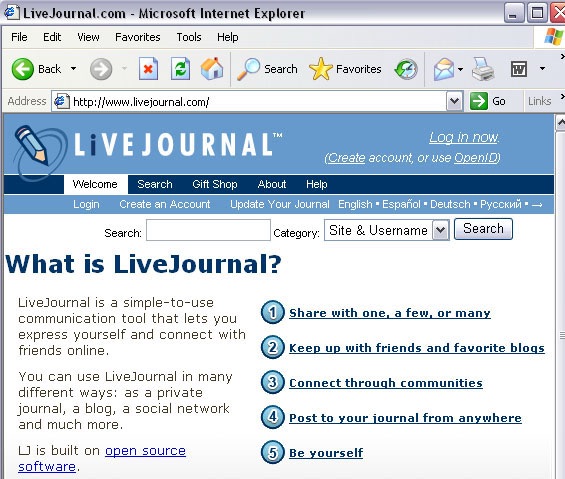
This desire to record written information retained prevalence into the late 1990s following the widespread promulgation of the internet. Just as primitive societies evolved their recordkeeping practices, teens coming of age in the early 2000s demonstrated a shift from pen-and-paper diaries to digital blogging–a phenomenon best exemplified by the advent of LiveJournal, a site that the Pittsburgh Post-Gazette aptly calls a personal “cyberdiary.”2

LiveJournal was founded in 1999 by Brad Fitzpatrick, a senior at the University of Washington. After getting the latest version of Microsoft Developer Studio for Christmas in 1998, Fitzpatrick yearned to create a more accessible approach to journaling. The earliest iterations of LiveJournal were “bradlog” and “News of Brad,” exclusive websites available only for Fitzpatrick to post. 3However, upon discovering Fitzpatrick’s pet project, other students at his school requested that the website be accessible. Not knowing the social networking potential it would later reach, Fitzpatrick adjusted his original vision for the site and turned LiveJournal into a platform where he could keep up with high school friends and dormmates alike. Just months after its original development, Fitzpatrick officially registered LiveJournal’s Domain–and, in March of the year 2000, LiveJournal would formally open its digital doors to the public.
Representation and Identity
LiveJournal’s founder, Brad Fitzpatrick, heralded the site as a place to “Let the world know the story of your life, as it happens! Whether they want to or not…” 4LiveJournal, as per its name, was a website designed to keep an up-to-date register of your life on the internet.
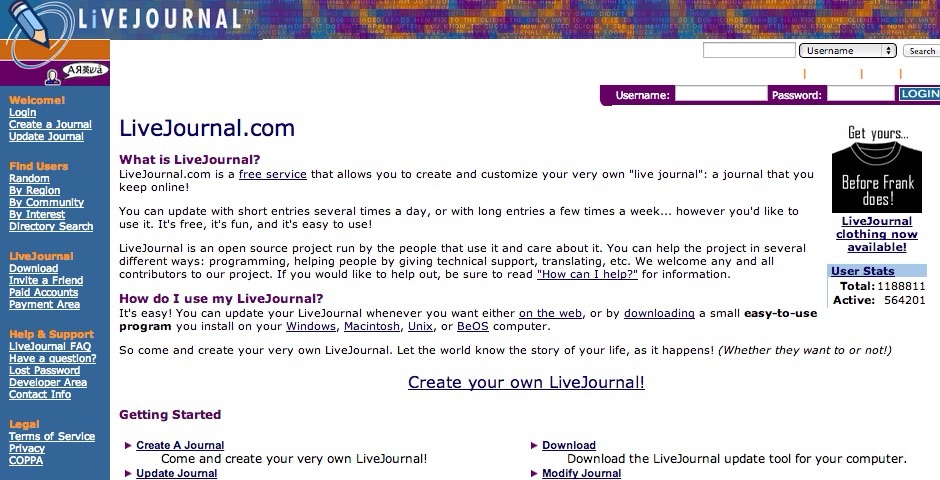
In 2003, near the peak of the website’s popularity, LiveJournal’s homepage read: “a free service that allows you to create and customize your very own “live journal” a journal that you keep online!”5 The website emphasizes the spontaneous as-you-see-fit nature of the blog posts by saying, “You can update with short entries several times a day, or with long entries a few times a week…however you’d like to use it! It’s free, it’s fun, and it’s easy to use!” 6
Before LiveJournal, most people tended to approach the internet with skepticism towards sharing personal information. It was practically unheard of to sign up for a website using one’s real name and image, let alone share details of one’s life–but that was exactly the point of LiveJournal. The website blurred the lines between privacy and publicity–between blogging and social networking–as teens across the globe penned out their most intimate experiences for their friends (and strangers) to read.
Through its marketing, LiveJournal gave its users an impression of the site’s identity: an inexpensive and highly accessible approach to online blogging. LiveJournal cast a wide net in regards to its user base. It didn’t target any specific type of person–LiveJournal was an application for anyone who could write. LiveJournal’s identity did not come from the people who used its interface but rather from the way it changed the preexisting technology of journaling.
Production and Consumption
Once Livejournal.com went public, the website quickly exploded as blogging became a mainstream internet staple. The sheer variety of different ways to use the website allowed it to flourish across a plethora of demographics–through individual blogs and interconnected communities, it was easy to find new friends and participate in online subcultures.
Simply put, there was something on LiveJournal for everyone. Whether you meant to use the website as a way to keep in touch with old friends as Fitzpatrick originally intended or stayed on the website to follow your favorite niche microcelebrity, LiveJournal always had new content to browse. Journals came in the form of short, even sentence-long posts, longer essays, creative works, and even debates or discussions in the comments section.
At its peak, LiveJournal boasted a community of 6.5 million users, with over 860,000 people updating their journals every week. 7The vast majority of these users were younger, predominantly in their teens and early twenties.
When asked about the website in 2004, 19-year-old active LiveJournal user Crystal Hughes told the Spokesman Review that she began blogging “because, well, it gave me something to do…I do it because it gives me a chance to spill my guts, and I like getting little comments.” Later, Hughes reveals: “I like people. I like getting to know them, and what better way to get to know someone than to be invited to read their personal journal?” Although some teens preferred to reserve their journals for a select group of friends, the majority of LiveJournal users posted for a community; they wanted the public attention.
However, not everyone using the site was a run-of-the-mill teenager. In the early 2000s, celebrities used LiveJournal as a method of keeping up with their followers in a more intimate setting. LiveJournal allowed fans to foster a sense of closeness with their favorite stars, as their journals revealed a glimpse of a more personal side.
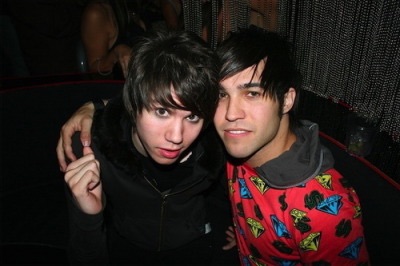
Two examples of this phenomenon are Pete Wentz and Ryan Ross, the bassist of Fall Out Boy and guitarist of Panic! At The Disco, respectively. The two pop punk icons were both early adopters of LiveJournal and used their journals to share snippets of their lives, work-in-progress song lyrics, and behind-the-scenes content from their bands:
Sunday, June 25, 2006: “Today I saw cancer, cigarettes, and shortness of breath. This is why I walk to the ocean. Swim with the sharks and jellyfish. I may never get this chance again. This is why if you want to kiss, you should kiss. If you want to cry, you should cry. And if you live, you should live. You don’t have to love me. You already did. At least enough to keep me smiling from South Carolina to Virginia. It’s for lovers (or just friends.) -Ry.”8
Tuesday, June 28, 2005: “Amazing New Mexico sunset. I’m hanging on a bridge with my friend Mikey Way from [My Chemical Romance.] It’s all orange and pink above us. We went to another waterpark again. I love high fives again. Totally back in love. Saw the most amazing movie. I think it’s called Spirited Away. Watch it. -Peterpan.”9
Wentz and Ross’s stream-of-consciousness way of posting gives an accurate representation of the disjointed but personalized nature of updating one’s LiveJournal blog; all of the sporadic thoughts strung together into one entry. The casual nature of the posts themselves and subsequent fan interactions in the journals’ comments are reminiscent of how a modern celebrity might use X (formerly known as Twitter) today.
Besides keeping up with celebrities one-on-one, the collaborative nature of LiveJournal fostered a vibrant hub of fandoms, alternative subcultures, and niche interests. LiveJournal’s “Communities” tab further redefined what it meant to blog, as instead of solitary journaling, blogging became a communal experience. Community members could engage in this dynamic group environment by posting their own content (like fanfiction or fan art) to a group blog, starting discussions/debates, or commenting on other users’ submissions.
Regulation
As the production aspect of the website began to boom, LiveJournal struggled to keep up with moderation. At its conception, the site was highly exclusive, only available to those bestowed a copy of the code by Fitzpatrick himself. However, even upon its widespread launch, LiveJournal maintained its nature of exclusivity. To create an account on the website, one had to have an invite code from someone who was already a LiveJournal member.
“Basic use of LiveJournal is free, but joining requires an invitation from a member. Paid memberships, which run about $2 a month, give users access to faster servers for faster updates, customized icons and graphics and the ability to send text messages to other subscribers through mobile phones.”10
This temporary invite-only feature made it easier to regulate the website’s traffic and control who could access it until the system was eventually abolished in 2003, when the site’s infrastructure had significantly improved to accommodate more users.
Once servers could feasibly host more users and invites were no longer necessary to create your own journal, the site saw more and more users. Fitzpatrick noticed that as people were flooding their journals with new posts, up to thirty-some each day, it was becoming exceedingly difficult to engage with the content that you wanted to see–the people you were friends with–so he created a new tab on the website: the Friends View. In the Friends View tab, you would only see the most recent content from your friends in a more digestible, easy-to-read format.11
In tandem with the addition of the Friends View, LiveJournal allowed its users to apply new visibility features to their posts. Users could keep their journals private or public or reveal them to only a selected group of friends.
With this update also came the inception of ‘Userpics,’ an early type of profile picture distinguishing each user from one another. Although this update was helpful at first, Fitzpatrick later was forced to implement a database that could flag inappropriate userpics after members began posting lewd images of female genitalia.12
In its early stages, LiveJournal faced more instances of spam, copyright infringement, and harassment than the website’s small team could handle–offensive posts were popping up faster than they could be deleted. In response to this issue, LiveJournal delegated a group of moderators to take on this task, later called the ‘Abuse Prevention Team.’ Outside of the aforementioned policy violations, the Abuse Prevention Team expanded to remove journal entries including transgressions such as posting adult content, explicit imagery of minors, mentions of self-harm or suicidal ideation, and impersonation.13
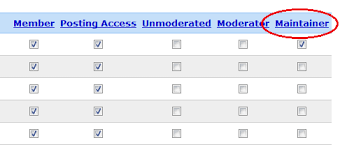
Site regulation was not just enforced by LiveJournal’s Abuse Prevention Team, but also by a host of unofficial community moderators. Communities on LiveJournal could be public or private; in private settings, moderators could choose who had access to view and share content within the groups. Community moderators’ responsibilities also included flagging and removing content that was deemed inappropriate, either for the group setting or in general.
LiveJournal Today
So, where does LiveJournal fit into today’s cultural zeitgeist? In the mid-2000s, as fandoms and subcultures expanded and flourished on the platform, a different cultural group began to take root on the website. By chance, Slavic literature professor Roman Leibov became LiveJournal’s first Russian blogger–purely because he thought it would be “funny” to do so. 14
“Russia’s more beloved blogging platforms, such as LiveJournal [have] features more unique to the Russian version of the platform: the predominance of literary and political tweets, what she calls “lamentations and gloomy predictions” (…particularly about the state and fate of Mother Russia), verbal aggression, stiob, and satire.”15
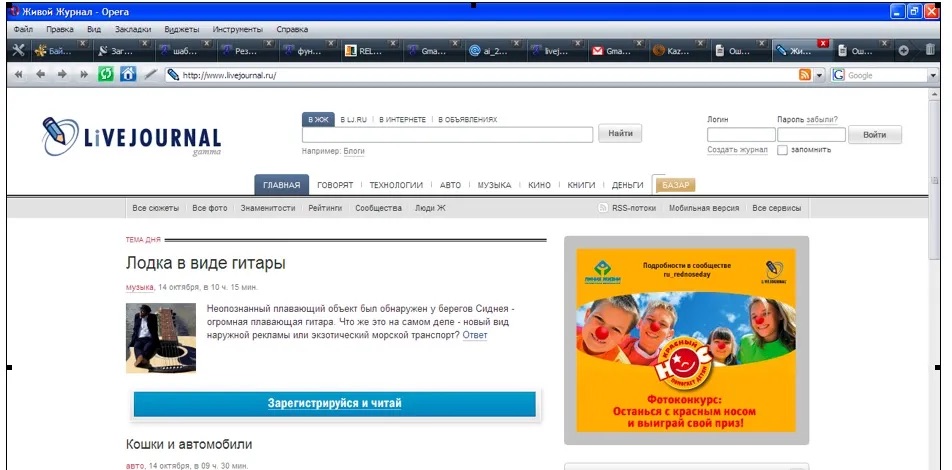
Leibov may have been the first Russian to adopt the platform, but he would not be the last. LiveJournal was the perfect breeding ground for unfiltered Russian content–it supported blogging across multiple languages, and its servers were hosted in California, where the Kremlin’s harsh censorship could not reach. The mass appeal of LiveJournal was not lost on the Russians, and the site eventually became so popular that SUP Media, a Russian company, paid $30 million to purchase the domain and relocate its servers to Moscow.16 Although LiveJournal’s (now known as “ЖЖ” or “ZheZhe” in Russia) popularity has plummeted in the United States, it consistently remains one of Russia’s most popular websites. BBC News’s Robert Greenall describes the bizarre shift of the site’s demographic: “Russians have made LiveJournal their own, turning what is in the West a relatively obscure and nowadays rather dated platform into a huge, seething mass of political anger, colourful prose and clever repartee.”17
The LiveJournal seen online today is a far cry from what it once was when Brad Fitzpatrick created it in the early 2000s. But when analyzing our cultural history of the internet, it is important to include LiveJournal–one of the earliest and most popular blogging platforms–in the conversation.
Bibliography
Scholarly Sources:
Michael Gorham. Slavic Review 72, no. 4 (2013): 924–25. https://doi.org/10.5612/slavicreview.72.4.0924.
Kate Raynes–Goldie. “Pulling sense out of today’s informational chaos: LiveJournal as a site of knowledge creation and sharing.” First Monday. Volume 9, Number 12 – 6 December 2004. https://doi.org/10.5210/fm.v9i12.1194
News Sources:
“DEAR CYBERDIARY; LOCKED, HIDDEN PAPER DIARIES? NOW THEY’RE ONLINE AND WRITERS WANT REACTIONS”. Pittsburgh Post-Gazette (Pennsylvania). August 29, 2003 Friday. https://advance-lexis-com.proxy1.library.jhu.edu/api/document?collection=news&id=urn%3acontentItem%3a49DG-36X0-0094-5081-00000-00&context=1519360&identityprofileid=QW3CVQ54612.
Dan Webster Staff writer. “Live journals, blogs offer glimpses into teens’ private, parallel universe”. Spokesman Review (Spokane, WA). December 19, 2004 Sunday. https://advance-lexis-com.proxy1.library.jhu.edu/api/document?collection=news&id=urn%3acontentItem%3a4F2T-2DB0-TWSR-V2JK-00000-00&context=1519360&identityprofileid=QW3CVQ54612.
“Weblogging Software Leader Six Apart Acquires LiveJournal “. Business Wire. January 6, 2005 Thursday. https://advance.lexis.com/api/document?collection=news&id=urn%3acontentItem%3a4F65-GRX0-TW8C-J1WT-00000-00&context=1519360&identityprofileid=QW3CVQ54612.
Other Online Sources:
Caitlin Dewey. “Whatever happened to Livejournal, anyway?” The Washington Post. June 10, 2014. https://www.washingtonpost.com/news/the-intersect/wp/2014/06/10/whatever-happened-to-livejournal-anyway/
Brad Fitzpatrick. “The Story of LiveJournal: How I accidentally started a Community, Business, and Open Source Project.” University of Washington. (n.d.) https://bradfitz.com/misc/bct/
Khan Academy. “READ: Recordkeeping and History–How We Chronicle the Past.” Khan Academy. (n.d.) https://www.khanacademy.org/humanities/big-history-project/agriculture-civilization/first-cities-appear/a/recordkeeping-and-history#:~:text=History%20Based%20on%20Written%20Records&text=The%20first%20written%20records%20date,which%20was%20then%20baked%20hard
LiveJournal Abuse Prevention Team. “Abuse Prevention Team Policies and Procedures.” LiveJournal. (n.d.) https://www.livejournal.com/abuse/policy-en.bml.
Ryan Ross. “I May Never Get This Chance Again.” LiveJournal. 2006. https://weresoryro.livejournal.com/Pete Wentz. “If you wanna go down in history.” LiveJournal. November 21, 2010. https://petewentz.livejournal.com/
- “Recordkeeping and History: How We Chronicle the Past.” David Christian. (Khan Academy, n.d.) Accessed December 1, 2024.
↩︎ - “DEAR CYBERDIARY; LOCKED, HIDDEN PAPER DIARIES? NOW THEY’RE ONLINE AND WRITERS WANT REACTIONS.” Jante Pak, The Associated Press. (Pittsburgh Post-Gazette (Pennsylvania), 2003.) ↩︎
- “The Story of LiveJournal: How I accidentally started a Community, Business, and Open Source Project.” Brad Fitzpatrick. (University of Washington, n.d.) Accessed December 1, 2024. ↩︎
- “LiveJournal.com: Nominee–Websites and Mobile Sites Community 2003” The Webby Awards. (The Webby Awards, 2003.)
↩︎ - The Webby Awards, 2003. ↩︎
- The Webby Awards, 2003. ↩︎
- “Weblogging Software Leader Six Apart Acquires LiveJournal.” Business Wire. (Business Wire, 2005.)
↩︎ - “I May Never Get This Chance Again.” Ryan Ross. (LiveJournal, 2006.)
↩︎ - “If You Wanna Go Down In History.” Pete Wentz. (LiveJournal, 2005.) ↩︎
- Pak, 2003. ↩︎
- Fitzpatrick, n.d. ↩︎
- Fitzpatrick, n.d. ↩︎
- “Abuse Prevention Team Policies and Procedures.” Abuse Prevention Team Staff. (LiveJournal, 2017.)
↩︎ - “Whatever happened to LiveJournal, anyway?” Caitlin Dewey. (The Washington Post, 2014.)
↩︎ - Review: Setevye razgovory: Kul’turnye kommunikatsii v Runete by Vera Zvereva.” Michael Gorham. (Slavic Review Volume 72, 2013.)
↩︎ - Dewey, 2014.
↩︎ - “LiveJournal: Russia’s unlikely internet giant.” Robert Greenall. (BBC News, 2012.)
↩︎
 Cultural History of the Internet