
Final Circuit of Culture Project
Circuit of Culture for a Website or Application launched between 1992 and 2005
Topic due October 18 on course spreadsheet (link on Canvas)
Annotated Bibliography due Nov 15
Presentations, Nov 18 and Dec 2
Final webpage due Dec 6 by 5:00 p.m. with link on Canvas
Topic
For the final project, you will be asked to create a WordPress page to analyze a website or app launched between 1992 and 2005, using all aspects of the circuit of culture: production, consumption, representation, identity, and regulation. Because even the smallest websites and apps have a lot to consider, you are encouraged to narrow your focus to an event, feature, use case, or failure that can drive your discussion. This should not prevent you from considering the full range of issues and concerns surrounding the website, but it can help you discuss them in a pointed way.
Stylistically, while it would make sense to create separate sections to address each of the aspects of the circuit of culture, it might be best to discuss the website holistically and bring up the interrelated areas of culture as they become relevant to your overall analysis. To this end, I’ve created pages to explain each area of the circuit of culture (available in the side menu), which you can link to as a way to highlight the topic and check off that you have met the assignment criteria for addressing each one.
A helpful resource for finding a topic is the Yahoo! What’s New page, as made available on Archive.org: https://web.archive.org/web/20240000000000*/http://www.yahoo.com/r/wn.
Annotated Bibliography
Annotated bibliographies serve a number of research purposes, from exhaustively documenting a field of study to roughly mapping the early stages of a project. In this case, we’ll use the annotated bibliography as a preliminary resource to help you refine your topic and find the most relevant story for analyzing your site or app through the circuit of culture. In the best case, all the research you include in your annotations will be directly used in your final project, but you should feel no need to include everything from this early effort nor feel constrained to just the papers you find in this first round of work. You are welcome and even encouraged to continue researching up until the final project is due.
Your annotated bibliography should meet the following criteria:
- Eight sources in total.
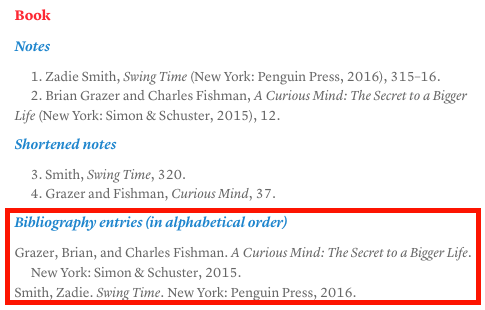
- Adhere to the Chicago Manual of Style’s notes and bibliography style citation, using bibliography-style references (the style with periods rather than commas—an example can be found in the selected area in the image below).
- At least two peer-reviewed scholarly articles or books. I recommend using Google Scholar and adding the library link to the JHU Library (instructions here).
- At least three newspaper or magazine articles published between 1992 and 2005, ideally contemporary with the aspect of your website or application that you’re focusing on. This category is considered broadly, but the idea is that you’re finding journalistic coverage of your topic from reputable news sources, whatever their platform or political persuasion. LexisNexis is a great resource for finding historical articles. You might also consider the collection of computer magazines that we used for the assignment on personal computers. Consider checking out the SPJ Code from the Society of Professional Journalists for a stance on what constitutes ethical journalism.
- And the remaining articles can be other peer-reviewed research, journalistic sources, or any number of web resources relevant to your topic, including blogs, website terms of service, press releases, user content, etc.
A sample bibliography can be viewed here.
Presentations
On November 27 and December 4, we will hold presentations for your final projects. Presentations will ideally give an overview of your selected website and a brief exploration of your analysis of it through the circuit of culture, touching on each aspect with an example. You can use either your webpage itself or a custom-made slide show as a visual aid for your presentation. Feel free to do whatever is best for your work process.
Time slots will be 15 minutes apiece, allowing for 10–12 minutes of speaking and 3–5 minutes of Q&A . See Canvas for the complete schedule.
Final Webpage
The final webpage should be around 2,000–2,500 words and include multimedia, such as images, sounds, and videos. Your analysis should engage with each aspect of the circuit of culture. It is up to you how you’d like to organize your page, but I thought one way to create flexibility would be to have explainer pages for each area of production, consumption, identity, representation, and regulation. This way, when you introduce a concept, you can link to the more in-depth explainer, and the link can serve as a way to highlight that you’ve covered that topic. If you choose this approach, you only need to create a link for the first use of the term. Another way to organize your page would be to use headers and have different sections for each circuit-of-culture area. Whatever way you choose to organize your page, it will be important to summarize the approach of the circuit of culture and provide a short definition for each aspect. The more you can integrate this information into your discussion of the app or website, the better.
The weekly schedule for the course provides a basic overview of the different types of content you can build using WordPress’s block editor (example here). If you’d like to venture beyond those constraints (which I’ll admit are real on WordPress outside of a commercial account), I suggest starting a free site on Weebly or another free website builder and host.
Here are a few standout pieces of multimedia journalism that show what’s possible. Although you won’t likely be able to create something so involved, they might still provide some inspiration.
- Anika Burgess, “The Shifting City: Shadows of New York,” New York Times, September 5, 2019.
- Ewen MacAskill and Gabriel Dance, “NSA Files Decoded,” Guardian, November 1, 2013.
- Simon Parkin, “‘Politicians Fear This Like Fire’: The Rise of the Deepfake and the Threat to Democracy,” Guardian, June 22, 2019.
- James Hill, “Riding the New Silk Road,” New York Times, July 21, 2013.
References
Citation for the final project will follow the Chicago author-date system. References in the text will include the author’s last name and the year of publication and can take one of two forms. If you discuss the author in your sentence, you can simply include the year in parentheses after the name:
As John Markoff (1988) reported in the New York Times, a computer virus forced the Pentagon to isolate the military network from the corporate and academic networks it had long shared connections with.
You’ll notice that I have included a hyperlink to the newspaper article because in this case, the article has a stable URL. If you’re using Lexis Nexis or another database behind a proxy, then you’ll want to include identifying information and omit the hyperlink.
If you do not include the author’s name in your sentence, then you can simply use a parenthetical citation at the end:
A computer virus around the same time forced the Pentagon to isolate the military network from the corporate and academic networks it had long shared connections with (Markoff 1988).
Again, you’ll notice that I’ve included a hyperlink because the article has a stable URL.
A full reference should be provided at the end of your document:
Markoff, John. 1988. “Pentagon Severs Computer Linkup.” New York Times, December 1, 1988. https://www.nytimes.com/1988/12/01/business/pentagon-severs-computer-linkup.html.
The reference list should be in alphabetical order by last name.
Attribution
All images should be attributed to a source, unless specified in an image database as requiring no attribution. (Sites such as Pixabay and Shutterstock specify attribution requirements for all images.) Anytime an image requires attribution, include a citation in the image caption, preferably using a hyperlink as well as identifying information. For our purposes, in an educational course and as scholarly research, screen captures from The Wayback Machine, oldweb.today, and other archived sites should fall under fair use. We’ll want to include a link to these important tools though.
Web Design
Here’s a list of links to common designs questions people have had:
- Creating links to sections within the web page (or page jumps)
- Adding captions to images
- Adding image galleries
- Embedding YouTube videos
- Embedding Spotify players
- Adding iframes using custom HTML to add other podcast players, video from Archive.org, etc.
Academic Integrity
It is important to state that your final project, as with all assignments you submit in this class, should be your own original work. Your writing should express your own ideas, composed by your own power, and should not include passages produced by other students or by AI assistants, unless these are put in quotation marks and cited using appropriate academic standards. If you have any questions about how to handle certain materials in your research, please do not hesitate to reach out to me.
All papers will undergo plagiarism detection and AI analysis through Turnitin. The report will be immediately available to you on Canvas. If your paper is flagged for plagiarism or AI generation in a way that gives you concern, you can resubmit it before the deadline. Please also contact me, and I can help determine whether the report presents an issue or not.
You should be prepared to demonstrate the authenticity of your work. A good practice is to always save a record of your writing process, so that you have it on hand in the event questions arise about the originality of your paper. Whether you compose your draft in Google Docs, Microsoft Word, or a special writing app like Scrivener, the application can provide statistics on the amount of time you worked on the paper, how many editing sessions you had, and the dates when the document was created and edited. If your project is suspected of plagiarism or AI creation, these statistics can help support a case that it is your own work.
Checklist
- Introduce your website or app.
- Cover each aspect of the circuit of culture and link to the explainer pages when you introduce each aspect: production, consumption, identity, representation, and regulation.
- Include links, images, and video where appropriate.
- Keep your page to around 2,000–2,500 words.
 Cultural History of the Internet