
Exploratorium: Science of Baseball
History
Frank Oppenheimer was a physicist, an educator, and an innovator who created the Exploratorium museum in 1969. His vision for such a museum was to inspire a new generation of learning through an interactive museum in which students, teachers, and adults could come and learn more about the world around them. The website opened in 1993 and now has over 20 million visitors per year. The website included many articles about science and the surrounding world such as a sports section that included a “Science of Baseball” section. This section showed how science was integrated in everyday life, such as a common sport of baseball. The website allowed people who were connected to the internet to explore various parts of everyday life and learn more about them. Jim Spadaccini was the project manager, who believed sports were a way to help inspire the younger generation to understand games through science. “Sports is a great way to reach the public,” Spadaccini said. “If you can find real world subjects that interest people – it can be a great vehicle for helping them understand science and, in turn, better understand the sport “(Peterson 1998).

“The Evolving Exploratorium: Looking Back, Moving Forward | SFO Museum.” – SFO Museum 1986, accessed 12/4/2023
Identity
The identity of the website through the interactive exhibits can be linked to the vision of Oppenhiemer. His goal was to create an interactive museum to allow kids and teachers to learn hands on in hopes to promote education. The overall identity of the website was modeled off the vision Oppenhiemer had in terms of allowing the viewer to come to their own understanding through playing in a sense. Since the identity and original idea was to spread education, many of the visitors of the website were students, however other identities were captured in the exhibits to extend to young adults and fans of various things.
The identity of the “Science of Baseball” section instead was more focused on people of all ages who were interested in the sport. While people did not necessarily have to play or understand baseball, people who knew baseball were more likely to come to this online exhibit and learn why a curveball curves. In addition many other identities besides just baseball fans were represented in this site. For example, women in baseball was an article on the website in which the article focused on the first summer league of women’s baseball. Therefore people of all ages and genders can try to relate to this exhibit on the site. Other articles were published on the site to prompt other identities. Baseball is a world wide sport, and is extremely popular in Japan, which is why the exhibit also has an article focusing on Japan’s interpretation of the sport. How different sports are played, can reflect the identity of the people within the game which is noted on the website. Noted in The Associated Press State & Local Wire, some of the identities included in the site such as, “For Web surfers who aren’t scientifically inclined, the site includes informational articles and film clips on the Negro League, women in baseball, and an online tour of the Louisville Slugger factory” (Peterson 1998).Overall many identities can be seen to be represented on the website as a whole and on the exhibit. From baseball fans, women interested in baseball, and Japanese Americans interested in the history and culture significance of baseball, these identities are represented through articles on the site.
Of course, the identity of the producers are represented within the exhibit as well. Various people helped put together the site in an interactive way, but also included fun facts and science. The identity of the scientists are clearly presented through the activities of how baseball is a game that uses physics all the time. Articles of how a curveball curves, and reaction time of a fastball are identities of the science behind the game that are within the site.
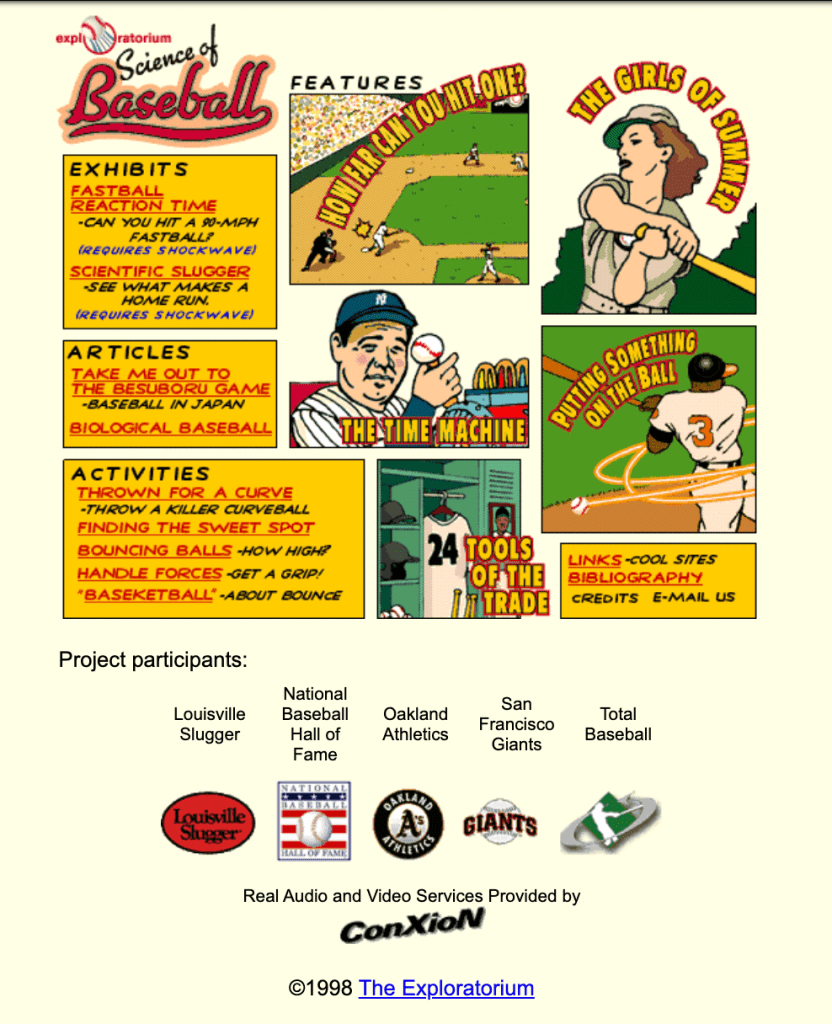
“Science of Baseball.” Exploratorium, February 4, 1999. https://web.archive.org/web/19990204012917/http://www.exploratorium.edu/baseball/. Accessed December 5, 2023.
Representation
As mentioned above, the website does a great job of representing many different identities through various ways of mediums. The examples above illustrate identities that are represented through articles such as Japanese culture and women in sports. Exploratorium at its heart is, of course, a museum centered around science which can be found sprinkled around the activities and articles. In one the article “Thrown for a Curve”, talks about spin rates and pressure the ball encounters from the wind and the hand. The article breaks down various types of pitches like the curveball and how this particular pitch spins differently from the normal fastball. In addition, this article provides details of how the hitter must predict the spin and swing before the pitch and curve in order to maintain being on time for the pitch. Other parts of the websites include interactive games to play such as the reaction time in order to hit a 90 mile per hour fastball. Other activities include what makes a homerun and the science behind that. Paul Doherty, who was a senior staff advisor and scientist at the Exploratorium, discussed home runs. Alan Boyle reported in MSNBC.com, “The really good batters are using lighter and lighter bats these days, Doherty said. There’s a slight loss in the ability to give the ball a ride, but a significant gain in the ability to get the bat around quickly”Boyle (2004). Doherty represented the scientific identity in many of the articles and exhibits on this website, including this site.
The overall website design at the time represented a style similar to a magazine, with a clear cut body and additional information on the side of the website. This style could be dated to the 1950’s, but also represents the easy access to various things for children to explore on the site. While a lot of the articles include science aspects, they are not written in the way that would be overwhelming to a child as well as many of those facts and provided in a simple manner. This allows the identity of the child to be represented as they are able to grasp the information provided. Many baseball fans’ identities are represented as well on the website through the ways listed above, but also through experiments. Experiments such as finding the sweet spot, or the center of pressure in scientific terms, is an example provided in which two people need a bat and a ball and measure the amount of distance the ball travels from hitting a stationary bat in various places along the barrel. This experiment is a representation of the identities of young baseball fans who want to learn what the term “sweet spot” truly means, in ways science can explain.

“Be a Sabermetrician.” Exploratorium, February 19, 1999. https://web.archive.org/web/19990219225243/http://www.exploratorium.edu/baseball/besubaru.html. Accessed December 5, 2023.
Production
The producer of the museum, as mentioned above, was Oppenhiemer, however the producer of individual articles was a team of workers at this museum. The museum itself had to be built from materials, financed by the government, and opened in 1969. The website however opened in 1993, and was developed by coders to produce a website that allowed the museum to keep some of its exhibits up forever. In addition, each individual article had a tremendous amount of different people working on it. Specifically, there had to be scientists to produce the experiments and capture the data to display to consumers in a new way. These scientists played a role in production of the website as they produced the content, while others wrote and transcribed the data, and others coded that data onto a website. Doherty was one of the main producers, as he produced various science experiments to explain common aspects of life through physics. Doherty received his PhD from MIT in 1974, and started teaching at a university before he made the jump to exploratorium. Oppenhiemer’s vision, as discussed in the paragraphs above, was to produce a new and unique learning environment for people to learn about science through everyday life. Many of the identities that are represented though production, are those of the scientist who envisioned the experiment and calculated the results. David Barker on the other hand was a writer and a designer for the museum. While he did not necessarily have the vision for the science, he was the next part of the supply or production chain in this website.
Ultimately to get a final product of the website, the supply chain was quite extensive. Firstly, Oppenhiemer creating the museum allowed for a website of the museum to be started. After the website was started, individual exhibits were put on it. However to firstly have the exhibits, scientists like Dohety had to create and capture results for display. Baker would then write about the data, in a way that a twelve year old would understand, and then plug it into the website. Overall the production of this website is the vision and execution of many different working individuals coming together to produce one thing.
Consumption
While there is no data regarding which demographic visits the website, consumers of the website and the museum are most likely very similar. Although the website is designed for children to learn, many adults come to the museum as well. Over 600,000 people come to visit the museum each year with about 100,000 of them being students on field trips and another 100,000 being teachers attending professional programs (Gaugy 1999.) This demographic of people coming to the museum in 1999, shows how many of the consumers are the predicted ones, while others come for fun. Exploratorium offers teaching programs as well to help K-12 teachers develop their skills as educators. Sara Heredia and Julie Yu wrote about the results of these programs in 2015 in the, “Science Learning in the Informal Environment.” Heredia and Yu reported that teachers who completed these programs, “81% have taken on leadership roles in their schools, 73% have mentored other teachers, and 61% have provided professional development for their colleagues”(Heredia 2015).This finding highlights the consumers of one particular aspect of the museum and therefore the website.
Overall the website is visited around 20 million times per year, and can reach a wide variety of different people from across the globe. Students can visit and learn about science online, and have access to the museum outside of San Francisco. The overall goal while creating the website was to reach a various number of groups of people from students, teachers, young adults, and even science enthusiasts of all ages. Specifically the science of baseball, is directed at the people who love baseball and want to learn how and why certain aspects of the game happen in a way. Overall anyone can consume this product, however it can be speculated that students who wanted to learn more about baseball came to this website to understand the nuances of the game.

Heredia, Sara, and Julie Yu. “Science Learning in the Informal Environment.” Exploratorium, accessed November 16, 2023. https://www.exploratorium.edu/sites/default/files/pdfs/Exploratorium-TIP-Report_0.pdf.
Regulation
Exploratorium does not have many regulations regarding its website. Some regulations regarding the website now include not using any of the content for commercial purposes, and not using any inappropriate language in the comments of an article while asking questions. In the science of baseball section, there are little to no regulations as one could not pose a question on the website in 1999. The content on the website however can be considered a restriction as all the content are museum exhibits which are created by staff. If one does not work at Exploratorium, then that consumer is restricted to what they can post on the website in 1999. In addition another regulation would be the general access of the website, as in 1999 if you did not have any internet or a computer, then you could not access the information provided on the website. Through the lens of a consumer, the regulation was not being able to post and actually being able to access the website via the internet. Overall the museum is a non profit, and therefore does not have any ulterior motives in regards to the production of the exhibits.
The Exploratorium website section Science of Baseball is a part of a community of other exhibits, both online and in person, which demonstrate the five parts of the circuit of culture. Through looking at the museum itself, the history, and how the section is designed the five pillars of the circuit of culture were analysed in the paragraphs above.
References
Boyle, Alan. “The science behind bats and balls”. MSNBC.com. May 20, 2004 Thursday. https://advance.lexis.com/api/document?collection=news&id=urn:contentItem:4JKW-RXF0-TXCJ-G256-00000-00&context=1516831.
Francisco, San, Daniel Livingstone, and Jeremy Kemp. 2006. https://files.eric.ed.gov/fulltext/ED493670.pdf#page=28.
Gaugy, P. 1999. “The Exploratorium.” Electronic Resources Review 3 (3): 32-32. https://doi.org/10.1108/err.1999.3.3.32.30.
Heredia, Sara, and Julie Yu. “Science Learning in the Informal Environment.” Exploratorium, accessed November 16, 2023. https://www.exploratorium.edu/sites/default/files/pdfs/Exploratorium-TIP-Report_0.pdf.
Kutnick, Esther. n.d. “The Evolving Exploratorium: Looking Back, Moving Forward | SFO Museum.” http://Www.sfomuseum.org. Accessed December 4, 2023. https://www.sfomuseum.org/exhibitions/evolving-exploratorium-looking-back-moving-forward/gallery#6.
Oppenheimer, Frank. 1972. “The Exploratorium: A Playful Museum Combines Perception and Art in Science Education.” American Journal of Physics 40 (7): 978–84. https://doi.org/10.1119/1.1986726.
Oppenheimer, Frank. 1984. “‘“The Sentimental Fruits of Science,”’ Dr. Frank Oppenheimer’s Acceptance Speech for the Oersted Medal Awarded by the American Association of Physics Teachers, San Antonio, Texas, 31 January 1984.” American Journal of Physics 52 (8): 685–89. https://doi.org/10.1119/1.13570.
Peterson, Anne. “Web site explores baseball science”. The Associated Press State & Local Wire. August 29, 1998, Saturday, AM cycle. https://advance.lexis.com/api/document?collection=news&id=urn:contentItem:3THG-5SH0-00HV-647Y-00000-00&context=1516831.
Smith, Foster. “Miscellaneous: Discovery”. National Post (Canada). April 29, 2000 Saturday. https://advance.lexis.com/api/document?collection=news&id=urn:contentItem:4078-0430-002N-P0K3-00000-00&context=1516831.
“Website at a Glance.” Exploratorium, https://www.exploratorium.edu/press-office/press-releases/website-glance. Accessed 27 Nov. 2023.
 Cultural History of the Internet