
 Posted by
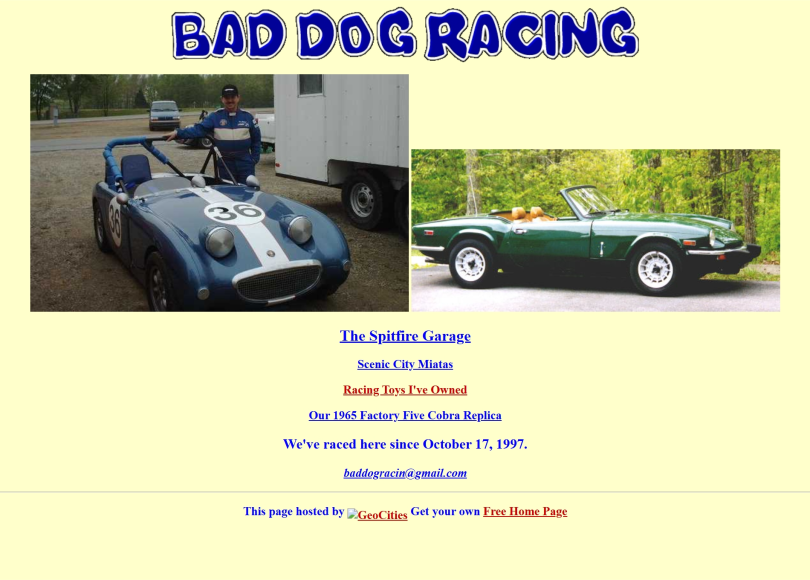
 The “Bad Dog Racing” website, a modestly designed GeoCities page, exemplifies the culture of early internet spaces where personal interests were shared through basic, often self-made web design. By examining this website through the circuit of culture, focusing on production, consumption, identity, and representation. We gain insight into its intended purpose, audience, and the broader cultural context that shaped its creation and consumption.
When talking about production, GeoCities was one of the most popular web hosting platforms in the early days of the internet, allowing people with little to no web design experience to create and host personal websites for free. This site’s production context is immediately recognizable through its simplicity: a plain, static structure, minimalistic visuals, and large, playful fonts that give it an amateur, homegrown feel. The creator of the “Bad Dog Racing” website was probably a hobbyist with a passion for vintage car racing, working within the limited digital tools available at the time. Although they probably didn’t have much experience, they were still able to share their love of cars without the formal skills of a web designer. This production style reflects the do-it-yourself idea of the early internet, where ordinary users could freely express personal interests and build niche communities.
In terms of consumption, this website is aimed at a rather specific audience: car enthusiasts, particularly those interested in vintage racing and classic car restoration. The homepage invites viewers to explore different sections, including “The Spitfire Garage,” “Scenic City Miatas,” and “Racing Toys I’ve Owned.” Such titles suggest this site was created to appeal to people who share an interest in specific car models, racing history, or personal stories about car ownership and modifications. The email link attached encourages all viewers to reach out, hinting that the creator envisioned a small, tightly knit community of like-minded people who might connect through their shared passion rather than broad commercial interest.
The identity aspect of this website can be seen in the name; “Bad Dog Racing” itself signals an identity made up of fun, rebellion, and individuality. The informal, playful tone seen throughout the site suggests that this is not a formal racing team or brand but rather an individual—or a small group—passionately engaged in a hobby that they want to share with others. The choice of name, as well as the inclusion of vintage car models like the “1965 Factory Five Cobra Replica,” creates an identity that merges nostalgia with an embrace of unconventional, do-it-yourself culture. This site serves as a form of digital self-expression, allowing the creator to develop a specific connection with others who appreciate the same era of racing culture. The relaxed language and layout evoke a sense of camaraderie, showing that the creator values connection and shared enthusiasm as opposed to polish and professionalism.
The “Bad Dog Racing” website is visually representative of a culture that celebrates nostalgia and classic cars. The imagery, featuring cars like the Austin-Healey Sprite race car and a Triumph Spitfire convertible, pays much respect to automotive history and suggests that the creator has an appreciation for not only racing heritage but also the aesthetic appeal of vintage cars. The layout and color scheme—simple, with a pale-yellow background and blue, bubble-lettered banner—project a retro style that aligns with the old-school racing vibe. This visual representation highlights a culture focused on vintage authenticity and the preservation of classic car models, inviting the viewer into a space that values these vehicles as both historical artifacts and personal achievements. The aesthetic is purposefully created, mirroring the rugged, hands-on nature of car restoration and racing.
Though the “Bad Dog Racing” website lacks interactive features in the modern sense, such as social media integration or live comment sections, it likely included some forms of engagement common to the GeoCities era. The presence of an email address suggests that the creator valued engagement with visitors, opening a direct line for those interested in discussing cars, sharing stories, or perhaps even meeting in person. By providing a space for visitors to share their appreciation, contact links allowed hobbyists to create interactive communities around shared passions, long before the rise of social media.
The “Bad Dog Racing” website is a sort of a time capsule of early internet culture, showcasing the unique ways in which individuals used limited tools to create spaces dedicated to their personal interests and hobbies. Through a simple, DIY aesthetic, the site represents the culture of vintage car appreciation while fostering a community of enthusiasts who could connect over shared interests. Analyzing the site through the circuit of culture highlights how production, consumption, identity, and representation intertwine to create an online space that reflects both individual identity and collective passion. This website, with its amateur design and nostalgic appeal, reminds us of a time when the internet served as a raw and largely unregulated space for personal expression and smaller communities. The “Bad Dog Racing” site captures an era when people could build their digital identities through creativity and connection, paving the way for the more complex, interconnected web we know today.

