

 Posted by
 Numismatics in the Digital Age: The Internet’s Impact on Coin Collecting Through the Lens of the Circuit of Culture
Introduction
Numismatics, the study and collection of coins, has existed for centuries. This hobby spread mainly through the word of mouth and the passing down of family coin collections, but the creation of the Internet caused a sharp increase in the number of numismatists. With the onset of the digital age, coin collecting transformed from a scholarly niche into a widespread hobby, largely due to the American Numismatic Society’s web presence. The following analysis uncovers the Internet’s transformative impact on numismatics through the lens of the Circuit of Culture’s five factors: production, consumption, representation, identity, and regulation.
The American Numismatic Society (ANS) was created in 1858. At that time, the art of coin collecting was seen as a scholarly pursuit, and the opportunity for an individual to produce a coin collection of his own was largely limited by familial wealth, education, and previous collections passed down through one’s bloodline. Additionally, the very act of coin collecting required a level of societal status that the common man could not reach. Why would the working man spend his limited income on a piece of metal when he serves as his family’s singular breadwinner? This question exposes how exclusive the numismatic sphere was, but all of this changed in 1999. The earliest capture of the American Numismatic Society’s website was recorded through the Wayback Machine on November 27, 1999, even though the site was officially created in 1996. On this day, at twelve thirty-nine in the afternoon, the ANS website was merely black and white text with attached hyperlinks that would take the visitor to one of the ten subsections ranging from “Study Opportunities” to “ANS Departments.”[1] While their initial website had practically no aesthetic appeal, the mere production and publication of it on the Internet would result in a drastic increase in the amount of coin collectors across the globe.
Production

In a 2001 piece for The New York Times, Michael Pollack discusses how the creation of websites has allowed for hobbyists to share their interests with those who are searching for new hobby. One hobbyist stated, “The Web is not about location, it’s about community,” and later on in the article, the American Numismatic Society website is linked.[2] When viewed through the lens of numismatics, the ANS website produced a gateway into coin collecting, and it allowed for curious individuals to open up the door into a possible interest, subsequently breaking down the societal stratification that riddled numismatics in its earlier years. Regarding the production of the American Numismatic Society’s website itself, it “created a database of its entire cabinet holdings and offers more than 500,000 records.”[3] Additionally, “its library sample has about 2200 records available.”[4] This compilation of records streamlined numismatic information and allowed its website visitors to learn about various types of coins in an efficient manner, regardless of their physical locations. Another database, MONETA, created a “virtual numismatic museum, with various levels of access to information and images, for students, researchers and connoisseurs.”[5] Compared to the confines of a library or school, the Internet has no physical barriers to entry, and the opening of the digital space resulted in numismatics reaching a broader audience. Richard Basset, a researcher at Pace University, studied this phenomenon and stated, “the Internet and the global economy have greatly contributed to the explosion in terms of the number of dealers and collectors that have become actively involved in the collectibles domains.”[6] Production of various numismatic sources on the Internet heightened the likelihood that an Internet user would stumble across one of these sites, whether it was by accident or on purpose. As a result, the number of people consuming numismatic information off of the Internet increased, and coin collecting experienced a boom in popularity.
Consumption
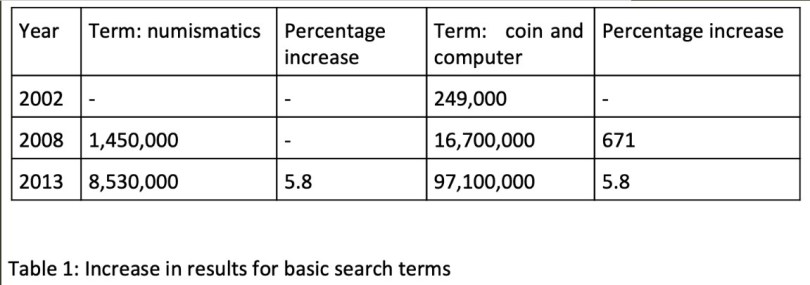
Wigg-Wolf, David. “Numismatics, Computers and the Internet.” A Survey of Numismatic Research 2007 (2002): 720-26. 
r/mildlyinteresting. “For Everyone Who Never Got to Finish Their State Quarter Map (First 50 Only).” Reddit. Accessed December 1, 2024. https://www.reddit.com/r/mildlyinteresting/comments/q4v1f1/for_everyone_who_never_got_to_finish_their_state/.
The practice of coin collecting before the Internet was mainly a physical experience based around a niche audience. Interest in numismatics was relatively stable, but its major supporting organizations wanted to catalyze the excitement around this hobby. A 1997 CBS News Transcript tells the story of New York City treasury officials and American Numismatic Society Executives coming together to spread rare coins throughout local businesses. This effort was done to “encourage coin collecting and drum up more interest in it,” and “if you get one of them in your small change, it’s finder’s keepers. But, of course, you’re going to have to really look at your coins to find one, and that is the whole point. It’s a stunt to promote coin collecting as a hobby.”[7] The mere fact that officials had to pull a coin collecting stunt to catalyze numismatic interest exposes how the hobby was staid, but luckily, numismatics in the digital sphere was greatly aiding the consumption of coin collecting via search. In his 2002 piece, A Survey of Numismatic Research, David Wigg-Wolf studied the search quantities for the words coin and computer. His initial hit quantity in 2002 was “249,000,” but six years later, “16,700,000” keyword hits were recorded in 2008.[8] While this drastic increase takes most of the attention, the nearly 250,000 hit quantity in 2002 shows that people on the Internet were actively seeking out information on numismatics.
A demand for online numismatic information had been born, and this thirst for knowledge was also being personified in parallel with the rise in popularity for the U.S. Treasury’s release of the 50 state quarters. In 1997, The Associated Press released a poll gaging the interest in the state quarter program, and “75 percent of those polled said they’d likely save some of the new quarters.”[9] The Treasury Department created the 50-state quarter program two years later, and by 2002, “139 million Americans [were] collecting the new quarters featuring different states.”[10] Compared to the lack of excitement surrounding numismatics in 1997, the digital landscape of 2002 serves as a prime example of the power that the Internet had in exposing web users to numismatics. David Wigg-Wolf stated, “As web technology has progressed, and the trend accelerates towards consumption of Internet resources via the use of mobile devices (tablets, telephones, digital assistants etc.), it has become imperative to make resources available in a consumable format.”[11] With the rise of search engines and numismatic databases, the representation of coin collecting found itself having to adapt to a wider audience, and the practice of coin trading was forever changed.
Representation
“We knew that when eBay became a monster trading platform, shows were doomed.”
Legend Numismatics 2017 Mid September Report
In the pre-Internet age, coin dealers main form of representation came through coin shows. This practice is grounded in physicality and strengthened through the presence of both the seller and the buyer, but problems with this system arose. Potential dealers and up-and-coming collectors were faced with a high barrier to entry due to costs associated with traveling around the country with no guarantee of making a profit at a show. However, numismatics in the late 1990s experienced a rapid shift toward online trading since “the Internet [had] contributed to the increased number of collectors.”[12] With this newfound collector base, the landscape of coin shows were no longer exclusively between “dealers and auction houses as collectors are also able sell their duplicates or extra collectibles items by reaching large numbers of other collectors through the Internet.”[13] In person trading was rivaled by online trading, and sites such as eBay and collector run trading platforms experienced increased traffic. Coin Community Family, a coin collecting forum recounts this moment in one of their posts: “eBay came along and made the world aware of coins. They blew past the 100,000 potential buyers mark probably the day they had the first coin posted. No one really stopped to look at the sheer numbers of people who were suddenly buying coins. If there ever was a hobby ripe for the web, coins had it all because of 3rd party grading.”[14] While online coin trading catered to the larger numismatic audience, its presence began to overshadow in person coin shows. Legend Numismatics 2017 report stated “Now that millennials are looking at coins, they will probably never attend a live show-after all these are people who prefer to text someone in a house vs ring their door bell (we were floored when we heard that). For us, shows are not even a place to buy and sell any more.”[15] The 2020 Pandemic proved to be the final blow to in person coin shows, despite American Numismatic Association membership quantities spiking “nearly 20% over the last year to almost 30,000. Any rare coin company with a web presence is seeing greatly increased sales and traffic.”[16] Numismatics morphed itself to fit inside the digital sphere, and while this increased overall sales, it greatly impacted the identity of coin collectors.
Identity
With a heightened web presence and a broader audience, the identity of numismatists was bound to change. Tech-savvy young adults began to pursue coin collecting, causing the projected median age of numismatists to drop “29 percent in the near future with most of the demographic switch going to collectors the age of 18-34.”[17] Additionally, coin collecting became increasingly global due to the continent connecting power of the Internet. Rosa Lanteri, author of “Numismatics and the Database” found that “a scholar in New York can now easily interact with a collector in Perth, Australia in real time conversations using technology such as Skype or Google Hangouts with access to rich and varied resources including high definition imagery, 3D models and video.”[18] The older and highly educated stereotype of numismatic demographics dwindled, and coin collectors were now individuals from all ages, countries, and educational levels. Additionally, traders have increased their social media usage as a means to conduct business. The following blog post from the Numismatic Guaranty Corporation provides a crucial view into the impact of social media on the identity of coin collectors: “[I] created an Instagram page for my collection, and I am having a blast! Who would have thought that I, of all people, would enjoy social media? Most of my friends are shocked, and my wife thinks the whole endeavor is rather comical. I have been posting a coin from my collection with a brief, often historical write-up almost every day, and the community seems to be very supportive. To make things even better, I get to check out some truly amazing coins that others share from their collections. It’s almost like the “post your newest additions” thread but much more active. I see at least a dozen coins a day that I never even knew existed, and I find myself more tempted than ever to expand my collecting interests. In that regard, I suppose Instagram may be a bit of a bad influence.”[19] The connectivity provided by Instagram allowed this user to show off his collection with ease, despite his initial lack of familiarity with the platform. Social media and website usage has also allowed for more cohesion in the numismatic community through the regulation of pricing.
Regulation
With a seemingly endless amount of numismatic information available to the Internet user, there has been an increase in the regulation of price gauging surrounding coin trading. Doug Winter, a professional numismatist and blog owner, discussed this regulation in his blog: “In the past, a dealer could buy a coin from an auction, mark it up (or upgrade it) and offer it for sale, often with the potential buyer having no idea where it was from. Now, most coins in dealer’s inventories can be easily traced to auctions. If a dealer offers a coin for $8,000 that just sold at a Heritage sale for $5,000, it might greatly offend a potential client. Margins, for internet-savvy buyers, tend to be smaller as a result.”[20] Coin collectors used the internet to their advantage as a means of comparing prices and informing themselves on what comprises a truthful offer. An example of this can be seen through the Professional Coin Grading Service’s online price guide pictured below. Winter later states, “This access to information has put the collector on much more level playing field than ever before. Even a new collector can see what coins bring at auction and now have a degree of comfort knowing that there is (hopefully) a legitimate under-bidder at 5-10% less than what they just paid.”[21] While the connotation of regulation often proves to be negative, numismatics’ experience with regulation proved to stabilize seller-buyer relations.

Closing
The premise of numismatics has not changed because of the Internet, but its practice has adapted to fit into the digital age. Through the production of websites, increased online source consumption, shifts in numismatic representation, diversifying identities of coin collectors, and stiffening regulations surrounding trading, the world of coin trading was forever altered. With the creation of the American Numismatic Society’s website, this hobby became accessible to the masses, and the power of the Internet allowed for coin collecting to occur constantly, at a global scale. While the shift towards online trading was not perfect, it opened up the door for new individuals to join the numismatic community. As a result, the once dwindling hobby of the 1990s morphed into the booming numismatic industry of the 2000s. Coin trading will never be the same because of the Internet’s constant presence, but when viewed through the Circuit of Culture, the frozen past is where numismatics found its adaptive future.
Footnotes
[1] Internet Archive, “American Numismatic Society,” Wayback Machine, November 27, 1999, accessed November 28, 2024, https://web.archive.org/web/19991127123907/http://www.amnumsoc.org/.
[2] Michael Pollack, “PASTIMES; Pick a Hobby, And There’s A Web Site”, The New York Times, June 13, 2001, Wednesday, https://advance.lexis.com/api/document?collection=news&id=urn%3acontentItem%3a4389-F930-0109-T0TF-00000-00&context=1519360&identityprofileid=QW3CVQ54612.
[3] “Research coins on Internet”, Sunday Mail (Queensland, Australia), September 21, 1997, Sunday, https://advance.lexis.com/api/document?collection=news&id=urn%3acontentItem%3a4585-F220-0197-F3D8-00000-00&context=1519360&identityprofileid=QW3CVQ54612.
[4] “Research coins on Internet,” Sunday Mail.[1] Rosa Lanteri, “Numismatics and the Database: The Misurata (Libya) Treasure Experience,” ICT and Communicating Cultures (2005): 69.
[5] Rosa Lanteri, “Numismatics and the Database: The Misurata (Libya) Treasure Experience,” ICT and Communicating Cultures (2005): 69.
[6] Richard A. Basset, “Computer-Based Objective Interactive Numismatic System,” Order No. 3106821, Pace University, 2003, https://proxy1.library.jhu.edu/login?url=https://www.proquest.com/dissertations-theses/computer-based-objective-interactive-numismatic/docview/305266419/se-2.
[7] “RARE COINS TO BE DISTRIBUTED AT NEW YORK CITY BUSINESSES TO PROMOTE COIN COLLECTING”, CBS News Transcripts, July 24, 1997, Thursday, https://advance.lexis.com/api/document?collection=news&id=urn%3acontentItem%3a3SH4-T660-009C-B41D-00000-00&context=1519360&identityprofileid=QW3CVQ54612.
[8] David Wigg-Wolf, “Numismatics, Computers and the Internet,” A Survey of Numismatic Research 2007 (2002): 720-26.
[9] “Collectors’ dream: 50 different quarters, one for each state”, The Associated Press, June 17, 1997, Tuesday, PM cycle, https://advance.lexis.com/api/document?collection=news&id=urn%3acontentItem%3a3T8G-7SH0-000Y-K35P-00000-00&context=1519360&identityprofileid=QW3CVQ54612.
[10] “COINS TUCKED AWAY IN U.S. HOMES — $7.7 BILLION”, Pittsburgh Post-Gazette (Pennsylvania). February 24, 2002, Sunday, https://advance.lexis.com/api/document?collection=news&id=urn%3acontentItem%3a457B-86R0-0094-52K4-00000-00&context=1519360&identityprofileid=QW3CVQ54612.
[11] Wigg-Wolf, “Numismatics, Computers and the Internet.”
[12] Basset, “Computer-Based Objective Interactive Numismatic System,” 10.
[13] Basset, “Computer-Based Objective Interactive Numismatic System,” 2.
[14] Coin Community Family, “Legend Numismatics Reports Coin Shows Are Dying off Due to the Internet – Coin Community Forum,” September 9, 2017, Accessed November 14, 2024. https://www.coincommunity.com/forum/topic.asp?topic_id=296600.
[15] Coin Community Family, “Legend Numismatics Reports.”
[16] NGC Coin Collectors Chat Boards, “Numismatics and Social Media Platforms,” November 25, 2021, Accessed November 14, 2024, https://boards.ngccoin.com/blogs/entry/11695-numismatics-and-social-media-platforms/.
[17] “More Americans Collecting Coins Than Ever Before; U.S. Mint Celebrates Start of National Coin Week With Demand for its Coins at an All Time High”, PR Newswire. April 18, 2000, Tuesday, https://advance.lexis.com/api/document?collection=news&id=urn%3acontentItem%3a402R-01P0-00KH-73S9-00000-00&context=1519360&identityprofileid=QW3CVQ54612.[1]
[18] Rosa Lanteri, “Numismatics and the Database: The Misurata (Libya) Treasure Experience,” ICT and Communicating Cultures (2005): 69.
[19] NGC, “Numismatics and Social Media Platforms.”[1]
[20] Doug Winter, “How The Internet Changed Rare Coin Auctions | Douglas Winter Numismatics | Rare Gold Coins – Douglas Winter Numismatics,” Douglas Winter Numismatics, March 28, 2011, Accessed November 13, 2024, https://raregoldcoins.com/blog/market-blog/how-the-internet-has-changed-rare-coin-auctions.
[21] Winter, “How The Internet Changed Rare Coin Auctions.”
Bibliography
Bassett, Richard A. “Computer-Based Objective Interactive Numismatic System.” Order No. 3106821, Pace University, 2003. https://proxy1.library.jhu.edu/login?url=https://www.proquest.com/dissertations-theses/computer-based-objective-interactive-numismatic/docview/305266419/se-2.
Coin Community Family. “Legend Numismatics Reports Coin Shows Are Dying off Due to the Internet – Coin Community Forum,” September 9, 2017. Accessed November 14, 2024. https://www.coincommunity.com/forum/topic.asp?topic_id=296600.
“COINS TUCKED AWAY IN U.S. HOMES — $7.7 BILLION”. Pittsburgh Post-Gazette (Pennsylvania). February 24, 2002, Sunday. https://advance.lexis.com/api/document?collection=news&id=urn%3acontentItem%3a457B-86R0-0094-52K4-00000-00&context=1519360&identityprofileid=QW3CVQ54612.
“Collectors’ dream: 50 different quarters, one for each state”. The Associated Press. June 17, 1997, Tuesday, PM cycle. https://advance.lexis.com/api/document?collection=news&id=urn%3acontentItem%3a3T8G-7SH0-000Y-K35P-00000-00&context=1519360&identityprofileid=QW3CVQ54612.
Internet Archive. “American Numismatic Society.” Wayback Machine, November 27, 1999. Accessed November 28, 2024. https://web.archive.org/web/19991127123907/http://www.amnumsoc.org/.
Lanteri, Rosa. “Numismatics and the Database: The Misurata (Libya) Treasure Experience.” ICT and Communicating Cultures (2005): 69.
“More Americans Collecting Coins Than Ever Before; U.S. Mint Celebrates Start of National Coin Week With Demand for its Coins at an All Time High”. PR Newswire. April 18, 2000, Tuesday. https://advance.lexis.com/api/document?collection=news&id=urn%3acontentItem%3a402R-01P0-00KH-73S9-00000-00&context=1519360&identityprofileid=QW3CVQ54612.
NGC Coin Collectors Chat Boards. “Numismatics and Social Media Platforms,” November 25, 2021. Accessed November 14, 2024. https://boards.ngccoin.com/blogs/entry/11695-numismatics-and-social-media-platforms/.
Pollack, Michael. “PASTIMES; Pick a Hobby, And There’s A Web Site”. The New York Times. June 13, 2001, Wednesday. https://advance.lexis.com/api/document?collection=news&id=urn%3acontentItem%3a4389-F930-0109-T0TF-00000-00&context=1519360&identityprofileid=QW3CVQ54612.
“RARE COINS TO BE DISTRIBUTED AT NEW YORK CITY BUSINESSES TO PROMOTE COIN COLLECTING”. CBS News Transcripts. July 24, 1997, Thursday. https://advance.lexis.com/api/document?collection=news&id=urn%3acontentItem%3a3SH4-T660-009C-B41D-00000-00&context=1519360&identityprofileid=QW3CVQ54612.
“Research coins on Internet”. Sunday Mail (Queensland, Australia). September 21, 1997, Sunday. https://advance.lexis.com/api/document?collection=news&id=urn%3acontentItem%3a4585-F220-0197-F3D8-00000-00&context=1519360&identityprofileid=QW3CVQ54612.
Wigg-Wolf, David. “Numismatics, Computers and the Internet.” A Survey of Numismatic Research 2007 (2002): 720-26.
Winter, Doug. “How The Internet Changed Rare Coin Auctions | Douglas Winter Numismatics | Rare Gold Coins – Douglas Winter Numismatics.” Douglas Winter Numismatics, March 28, 2011. Accessed November 13, 2024. https://raregoldcoins.com/blog/market-blog/how-the-internet-has-changed-rare-coin-auctions.
 Cultural History of the Internet