

 Posted by
 In 1999, Derek “Lanzer” Liu was a Network Engineer who was a fan of Anime, Manga, and Video Games. An active member of Usenet, he met his close friend John Kim four years prior on alt.binary.anime. John convinced Lanzer to come to Anime Expo with him, where he would meet Josh” L0cke” Gainsbrugh, Long Vo, and Charles “CP” Park. Soon joined by Kidkoum “Saka” Visarutvanit, the initial core of what would soon be Gaia Online’s team had formed.

Each of the artists had unique specialties that helped them work together as a team. VO was great at sketching, and could quickly lay out the panels of a comic. L0cke was good at creating backgrounds such as skyscrapers. Saka focused on character design, while CP focused on rendering effects and color.
Gaia’s creators were all fans of Anime, Video Games, and Comics. Before Gaia, they all moved into the same house and started a comic book group called Studio XD – named after the emoji. Lanzer was the only non-artist in the group, developing the niche of providing financial support.
One of the comics they worked on included “Last Shot” from Image Comics, following a Bounty Hunter named “Revolver” and his quest to survive in a world run by mercenaries. Another was Echo, a military action drama following the Echo team as they defend the world from a hidden threat. Other things they worked on include Robotech, a science fiction mecha series, as well as the short-lived X-Men: Evolution Comic Run.


Since the group could make their own schedule, they spent a lot of time playing the MMORPG Ragnarok Online. As the group played through the game, they realized their fondest memories weren’t the gameplay – it was about the social interactions through the internet. After this epiphany, they sought to create something like an RPG, but with far more focus on forging bonds. Other inspirations for the site included the likes of Final Fantasy and other RPGs – the group did extensive research on the video games they liked in order to capture what personally drew them in.

February 18th, 2003 was the unveiling of Gaia Online – then Go-Gaia.. Use of the website required an account, tied to a username, email, and password. In addition to the forums, it had a few games, artwork collections, and avatar customization features, an anime link list. Advertisement for the site was surprisingly minimal – the founders handed out a few postcards at Anime conventions such as Fanime, but the rest was handled through the playerbase’s word-of-mouth.
The quick growth of the website quickly caused financial strain – ads were run, but it wasn’t enough to pay for the necessary server upgrades. This led to the group setting up a means for players to donate. The group wanted to give something back to the donors to show gratitude, but L0cke felt uncomfortable about that idea – he didn’t want an item only some users could obtain. A compromise was met where an item would be created, but it would be a small and simple thing.
When Users donated, they received a thank you letter, and contained inside was an item known as the Angelic Halo. The description read that the selfless and giving could be likened to Angels.

When they gifted an exclusive item to donors, they saw a heavy rise in donations – revealing a new revenue strategy. Gaia would begin to create items available upon providing real-world money to the site. They were initially called “Donation Items”, but they were renamed into “Monthly Collectables” to make it clearer that Gaia Online wasn’t a non-profit.
The Gaia Playerbase – or “Gaians” – have a strong affinity for customization. Lanzer stated that the ability to self-express was one of the main draws of Gaia Online. A lot of revenue was generated by selling accessories to people.
The site’s marketplace regularly had people sell the Monthly Collectables that were no longer offered in exchange for Gaia Gold – a currency used by the website. The prices of these quickly rose with item exclusivity, leading to a working internal economy. Occasionally, people would sell these off-site for real money, but this was against the Terms of Service and discouraged.
Additionally, Gaians had far more engagement with their website than most other websites did during its earlier years. They were spending far more time on the site than the average internet user was expected to spend on a site, with some spending up to eight hours on it. Moderation was somewhat hands-off at this point due to the rapid increase in users. This led to the creation of the Chatterbox thread, which allowed spamming – this helped talk some strain off of the moderators.
In the most popular time of the site, the userbase was known for its roleplay community. Users would make threads with specific fantasy scenarios, and pretend to be certain characters within them. Scenarios could vary from a mansion or school to a diner or tavern.
While many Gaia Online users were adults, the site obtained the reputation of having a generally younger userbase. Several of the pages were written to talk to the parents of users who were younger. Notably, it’s written in a style that’s slightly less formal than the usual expectation of a corporation. While there’s no slang used, it does half-joking advise parents to “Consider asking to see your kid’s Gaia member profile page… tomorrow” in order to make sure the kid is keeping themself safe.
This trend continues to other pages of Gaia Online. For example, the “About Us” page describes the site as being founded by “a few comic book fans in a garage”. Many of the Fun Facts also make heavy use of Humor, such as illustrating the amount of posts on the forums by stating how many times they could coat the Empire State Building in Pudding if there was a conversion rate of one post to a teaspoon.

Ultimately, this is most likely to build rapport between the admins and users of the site. With a combination of video game fans, Anime fans, and general “creative types”, it can be reasonably said that the Founders and Administrations are essentially just older versions of the types of people who would be drawn to the site. In an older interview, Lanzer once stated that he viewed a social life on the internet with equal importance to one outside it. He stated that the community aspect created by Gaia is something he grew up with.
The general agreement amongst the users and creators of the site is that Gaia Online’s primary function is as a conduit to making connections. It serves to connect young people who hold a shared interest in things such as Anime, Video Games, Comics, and other things in that vein. People who use this site believe that the connections and time spent talking to others holds worth – even if they never consciously came to state it.
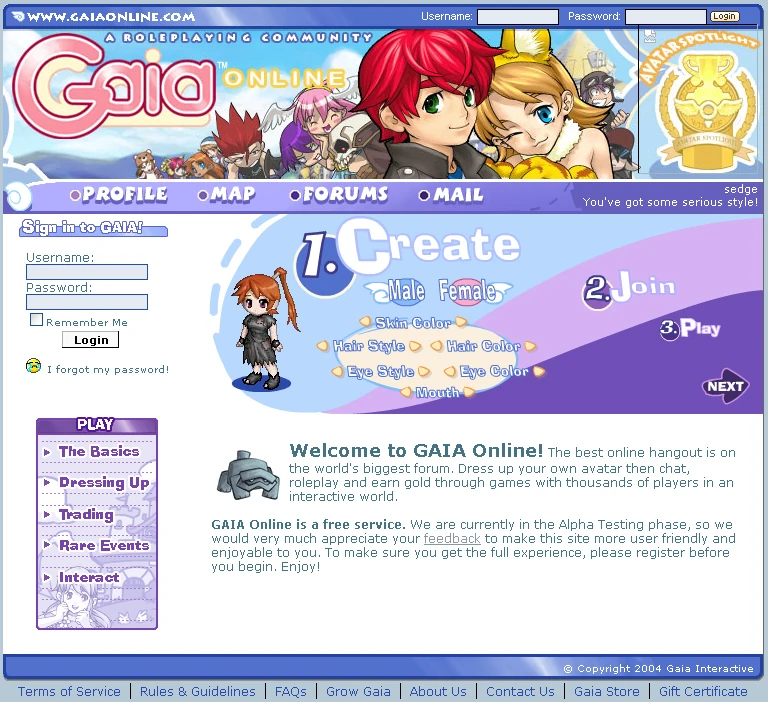
AniHQ, Gaia Online. “Gaia Online, Archived.” Gaia Online, March 31, 2003. https://web.archive.org/web/20040331102505/http://gaiaonline.com/.
Liu, Derek. Interview: Derek Liu, Gaia Online Anime Community, 2003. https://web.archive.org/web/20031202155043/http://www.big-boards.com/int.php?n=60.
Liu, Derek. “Gaia Online – Lanzer’s Journal.” Archive Listing – Lanzer’s Journal, 2024. https://www.gaiaonline.com/journal/?mode=archive&u=3.
Krotoski, Aleks. “Virtual Worlds Forum 2008: Gaia Online.” The Guardian, October 8, 2008. https://www.theguardian.com/technology/gamesblog/2008/oct/08/games.events.
Au, Wagner James. “Move over Myspace, Gaia Online Is Here.” Old GigaOm, April 22, 2007. https://web.archive.org/web/20230219151734/https://old.gigaom.com/2007/04/22/move-over-myspace-gaia-online-is-here/
Worthen, Ben. “A Small Step for Snoop, a Hipper Hop for Virtual Worlds.” The Wall Street Journal, September 11, 2008. https://www.wsj.com/articles/BL-BB-1162. (https://web.archive.org/web/20080913185853/http://blogs.wsj.com/biztech/2008/09/11/a-small-step-for-snoop-a-hipper-hop-for-virtual-worlds/)
Chan, Nicole. “The Gold Rush: A Look into the Rise and Fall of Gaia Online .” Academia.edu, April 30, 2015. https://www.academia.edu/36307772/A_Look_into_the_Rise_and_Fall_of_Gaia_Online.
Johnson, Barbara Zebe. “Virtual Economies as Financial Literacy Sandboxes: Case Study in Gaia Online.” University Digital Conservancy Home, June 2012. https://conservancy.umn.edu/handle/11299/137558.
 Cultural History of the Internet