
 Posted by
 Introduction
The internet today thrives on user-created content, especially for already existing media. For many, liking a book, movie, or show is not the end of a journey, but the beginning. Fans not only consume content, but transform; exploring wildly different media, styles, and perspectives. These fan-creations can sometimes even overshadow the original work in terms of popularity. True, these sorts of derived creations have existed for as long as creations have existed, such as Virgil’s The Aeneid (30-19BC) which took the titular character Aeneas from Homer’s Iliad, written about 7 centuries earlier (DuPont, 2023). The internet didn’t create fan-content, but what it did was introduce a social and collaborative aspect to media consumption, one that in real-time transcends physical and linguistic barriers to create content.
A cornerstone of online fanworks is fanfiction, or derived literary works. These span a variety of genres: choose-your-adventures, raunchy romances, or action-packed epics. In fact, the longest English work, spanning an incredible 35 million words, is The Loud House: Revamped by “Jamesdean5842”, a fanfiction of the Disney cartoon sitcom, The Loud House. This behemoth is hosted on fanfiction.net (FFN), the oldest currently operating fanfiction site on the internet. Created in 1998 by Xing Li as a school project, the site rapidly grew until today, where it has 12 million users (DuPont, 2023).
Production & Consumption
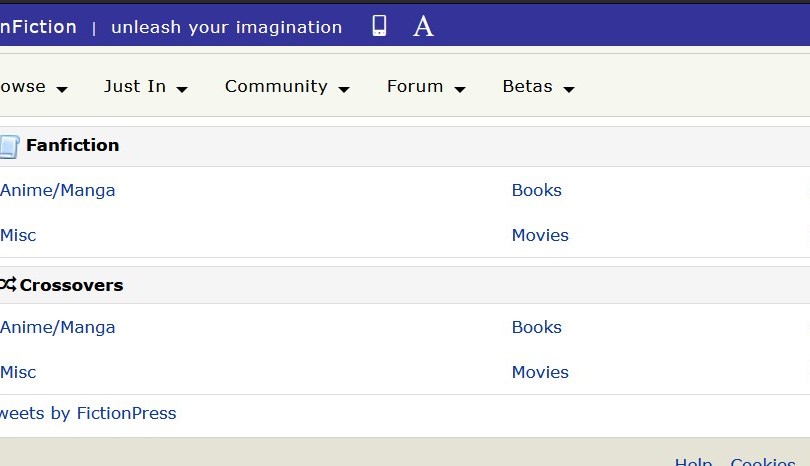
Let’s consider FFN through the lens of production. During the site’s early years, circa 2002, the site offered only written works and instant messaging. These were further subdivided into “fandoms”. FFN itself is rather limited with what can even be published: The works are exclusively text, lacking any multimedia functionality. The fanfics simply have user-provided ratings and genres, and are partitioned into chapters. As far as fanfiction sites go, this is as rudimentary as it gets. FFN adds some community aspects with reviews, wherein readers can leave a comment on chapter, and follow/favorite lists.

Fanfiction.net on July 19, 2002, Courtesy of WaybackMachine
Although the instant messenger is available for download via the WaybackMachine, at that point was only available to then popular operating systems, and so can no longer be run. On December 15th, 2005, the developers have the following update:
Members that have been with the site since the beginning can reminisce about this forum thing we used to have. Long ago, the site had an official forum per category and the feature was canned simply for the fact there were not enough moderators to tackle the flood of topics and debates.
Forums, although functionally dead today, succeeded by social media sites, were, in 2002, the life blood of fandom. It provided spaces for fans to share “their admiration as well as criticism on a specific performance”, exchange ideas, discuss fandoms, seek writing advice, and build relationships, enhancing the participatory nature of the platform. (Munawer et al. 2024). Forums became, as much as fanfiction, a part of what is produced in a fandom. That is to say, more broadly, that FFN facilitated an ouroboros of fan-created works begetting fan-created works, and although it can argued whether or not that model succeeded, it cannot be denied that what is produced is more than just stories.
For fanfiction, production and consumption are two sides of the same coin. Readers on FFN can easily navigate to their favorite fandoms and related forum boards. As they explore different stories and characters, readers often become contributors themselves, writing their own fanfiction or engaging in discussions within the forums. This creates a dynamic, cyclical relationship between producers and consumers. The forums on FFN, for example, serve as a space where readers can offer feedback, share interpretations, and critique stories, often leading to revisions and improvements in the works themselves. Here, the lines between author and audience blur.
Importantly, fanfiction necessitates an active consumption of media, one that doesn’t require enjoyment. The desire to read fanfiction “typically involves not simply fascination or adoration but also frustration and antagonism”, where the “combination of the two responses … motivates their active engagement with the media.” (Jenkins 1992, 24). While Jenkins focuses on the production of fanfiction from original media, this can be easily extended to the production of fanfiction that is derived, inspired by, and even a fanfiction of, other fanfiction. As Dye notes, many movies and books begin as fanfiction: Fifty Shades of a Grey is a Twilight fanfiction, which might itself be a My Chemical Romance fanfic, The Idea of You and After are One Direction fanfics, and Love Hypothesis is a Star Wars fanfiction, some of which have been posted on FFN (Dye 2024). That is to say that fanfiction not only inspires other fanfiction, but these works can transcend the internet and hit the big-screen, or even transform what happens in the original source. Dye posits that 9-1-1‘s Evan Buckley would not have come out as bisexual without fan efforts inspired, at least in part, by fanfiction. Fanfiction itself serves as a training ground for up-and-coming writers, especially those from marginalized backgrounds, such as women, “a supportive environment within which women writers could establish and polish their skills” (Jenkins 1992, 47).
On FFN, writers are readers and readers are writers, and the two thrive on each other. There is a community of collaboration on all levels: readers will often leave reviews, discuss fics in forum posts and act as betas (unpaid editors and proof-readers). This close knit relationship fosters a strong sense of community and often gives birth to rituals, slang, and community specific behaviors (Munawer et al. 2024). For example, one behavior that authors often engage in is “gifting” a fanfic, sometimes in organised events. These events span themes, can last between a day and a month, can have specific submission requirements, and are often hosted and run off-site, such as on LiveJournal.

Pages Containing Gift-fics, some organized off-site.
Representation & Identity
Representation and identity is an important cornerstone of FFN’s impact on online culture. There are two necessary groups to feature when discussing FFN: Women and LGBTQ+ individuals. Historical information on FFN’s demographics is unavailable, but a recent survey of fanfiction readers suggests that 79% of FFN users are women, with 70% between the ages of 13 and 29 (Davis 2019). That is to say that users of FFN skew female and skew young. It’s no wonder then that fanfiction in the public psyche is identified largely with the teen girl.


Age and Gender Distribution of Fanfiction Readers (Davis, 2019)
Women have long been embedded in fandom culture. Although some may present early fandom, especially for science fiction, as nerdy men, as early as the 1980s there were descriptions of women being heavily invested in male-targeted media. As Jenkins describes, “if the comic fan and the psychotic fan are usually portrayed as masculine … the eroticized fan is almost always female (the shrieking woman on the cover of the Vermorels’ book)” which suggests a historical devaluation of female interest in media (Jenkins 1992, 15). In fact, in pop-culture the popular depiction of a woman is one of being “unable to maintain critical distance from the image” wanting to obtain “total intimacy” with a piece of media (Jenkins 1992, 15). But it’s important to note one thing: it is wholly expected for women to consume content directed for the male audience, but men are rarely if at all allowed to consume media for women. Women and girls are thereby trained, taught, and encouraged to “make sense of male-centered narratives”, such as superhero stories, science-fiction, but boys are taught to “devalue female-centered stories” (Jenkins 1992, 116). Women are primed then, to dig deeper into works to identify with the stories and characters, allowing them somewhat of an advantage when it comes to “making inter-textual connections across a broad range of media texts” as women are used to identifying with characters that otherwise do not share many characteristics with themselves (Jenkins 1992, 37). As Jenkins argues, early fandom can be seen, “as an effort to create a fan culture more open to women, within which female fans could make a contribution without encountering the entrenched power of longtime male fans” (Jenkins 1992, 49). Forums allow women and other FFN to further identify with different characters in media, increasing not only their knowledge but also level of interest (Munawer et al. 2024). This becomes a ritual in and of itself, where users seek out forums specifically to become further entrenched in not only the media, but the community. As described early, there is a deep desire to take and integrate a media into oneself.
But Xing Ji, the creator of FFN, by all accounts is a man, so doesn’t that mean that this hypothesis is incorrect? To be clear, fanfiction is practiced by all genders and ages, and even the study from earlier shows that 4% of users are men (Davis, 2019). This analysis is not to say that men and boys do not consume fanfiction, it’s not to say that they don’t write it: It is to say that women are uniquely primed to be heavily involved in the creation and consumption of derived works. FFN, as a largely anonymous fanfiction site, although created by Xing Ji to share his interest in X-Files (Fanlore), quickly gained a largely female audience.
We can also explore how queerness exists on FFN, both in terms of content made and users. Queer individuals turn to fanfiction in response to traditional media, which “can often express inaccurate and harmful tropes” about marginalized communities (Floegel 2020). Slash fiction, however, uniquely emerges not only out of the queer community, but notably from straight women. Slash fanfiction centers on re-imagining same-sex relationships between fictional characters. As Henry Jenkins explains, “The colorful term, ‘slash,’ refers to the convention of employing a stroke or ‘slash’ to signify a same-sex relationship between two characters (Kirk/Spock or K/S) and specifies a genre of fan stories positing homoerotic affairs between series protagonists” (Jenkins 1992, 192). Emerging within Star Trek fandom during the early 1970s, it was born as a response to fans’ desire to deepen the connections between beloved series protagonists (Jenkins 1992, 192). These stories, often subversive in nature, reframe character dynamics to emphasize emotional intimacy and romantic or sexual undertones that were absent or understated in the original work.

A scene of Spock’s death in Star Trek: The Motion Picture (1979), frequently used as “evidence” of the canonical nature of K/S
For the queer community, slash fiction offers a platform to “express queer possibilities that transform past, present, and future cis/heteronormative trends,” such as reimagining queer-baiting relationships as fully realized queer partnerships (Floegel 2020). This creative process is deeply tied to the lived experiences of queer writers, who “engage in [emancipatory media] creation to compensate for and reclaim cis/heteronormative narratives” (Floegel 2020). Individuals on FFN frequently use fanfiction to transform “past, present, and future cis/heteronormative trends”, such as transforming a queer-baiting relationship into a real queer relationship (Floegel 2020). This allows readers and writers to take the narrative of their lives under their own control but replacing stories that may have been directly harmful. Of course, not all fanfiction is created or consumed with the explicit purpose of rewriting harmful stereotypes, it is often used as a “primarily joyful and cathartic” tool (Floegel 2020).
As Jenkins observes, slash fanfiction often “confronts the most repressive forms of sexual identity and provides utopian alternatives to current configurations of gender,” offering a space where queer individuals can envision more inclusive and empowering possibilities (Jenkins 1992). For many marginalized communities, FFN presents a safe space, not only for them to explore and express challenging topics, but on the other side of the coin, to construct worlds where forms of discrimination, like sexism, racism, homophobia, transphobia etc are non-existent. Fanfiction resists restrictive norms and envisions a more inclusive world.
Floegel notes that “participants claim that slash fanfiction content often opposes cis/heteronormative values and problematic depictions of queerness found in canonical EM [entertainment media].” Sites such as FFN allow users to criticise mainstream portrayals and “find themes in slash fanfiction that allow them to explore and develop their identities” (Floegel 2020). Beyond exploring sexuality, slash reexamines traditional masculinity, while lesbian slash disperses traditionally masculine and feminine traits, fostering a more fluid understanding of gender (Jenkins 1992, 196 & 203). Slash “invites us to imagine something akin to the liberating transgression of gender hierarchy … a refusal of predetermined gender characteristics in favor of a play with androgynous possibility” (Jenkins 1992, 194).
Over time, slash fanfiction has become “a significant genre within fan publishing and may be fandom’s most original contribution to the field of popular literature” (Jenkins 1992, 193). Its impact on fan communities and the broader landscape of creative storytelling underscores the power of fans to reinterpret and reshape narratives in ways that resonate with their desires and perspectives. But, throughout its history, it has not been without struggle. Early on, resistance to slash relationships were often homophobic in nature. Fans often criticized slash for “[questioning] the masculinity of the protagonists and [challenging] their heroic stature,” sparking concerns about preserving the original characters’ integrity (Jenkins 1992, 193). One fan, Kendra Hunter, viewed slash as “character rape,” (strong words!) arguing that it violates the intent of the original source material and disregards the fans’ desire to remain faithful to the canonical program (Jenkins 1992, 193). These critiques are common on FFN review and forum boards.
Of course, criticism of slash fiction is not only discriminatory in nature. Slash has been critiqued for perpetuating structural inequities, as fan communities themselves are often “structured by normative whiteness and heteronormativity” and demand significant labor from participants (Floegel 2020). Additionally, female authors of slash sometimes fail to create compelling female characters, instead projecting their desires and ambitions onto traditionally masculine protagonists—a reflection of the limitations imposed by patriarchal literary traditions (Jenkins 1992, 200). Women, rather than creating female narratives, instead transform male narratives to reflect their experiences. Critics also argue that slash “celebrates gay male experience … at the expense of developing alternative feminine identities,” raising concerns about its inclusivity (Jenkins 1992, 195).
Some conventions during FFN creation restricted the public distribution of homoerotic fanfiction to avoid offending actor guests and alienating fans who were “violently offended by the very idea of slash” (Jenkins 1992, 193). It’s interesting to note then that FFN since its inception has allowed queer content on the platform, in opposition to a landscape that resisted it. But, on FFN, there often reviewers would leave homophobic comments in response to slash fiction. Some writers even displayed in their description that they were against slash fiction. FFN itself is not without criticism, early purges of content on the site often targeted queer content. In 2002, FFN purged all NC-17 content on the site in response to several complaints. Today, only a small proportion of fanfictions on the site are queer.

Distribution of fanfiction across multiple platforms.
Regulation – Copyright and Censorship
Fanfiction and its hosting sites, such as FFN operate on a thin line. Fanworks cannot be distributed for profit in order to fall under fair use, and although there may be some that can be commissioned to write fanfiction, popular sites can prohibit this sale. Some can try to commercialise their works by removing recognizable aspects of the work to make it available for publishing (Williams 2022). In the case of Cassandra Clare, author of the wildly popular Shadowhunter universe, she got her start writing fanfiction (Williams 2022). In fact, City of Bones contains an almost verbatim paragraph from her fanfiction.
Although generally fanfiction does not reproduce the original creation, thereby violating the reproduction right under Copyright Law, the law is blurred by direct quotes and the use of original characters (Williams 2022). The more “canon-compliant”, meaning the more reliant and accurate the fanfiction is to the original text, the more likely the fanfiction is infringing on Copyright Law. Fanfictions, on the other hand, are not considered to violate the distribution right, as the law specifically emphasizes physical distribution in its entirety (Williams 2022). A potential violation may be “fic-binding”, where a fic is printed, bound, and sold (Williams 2022). This can be an infringement on copyright laws, but FFN does not engage with or enable this.
You may guess that fanfiction can be defended as a parody, it can fall under fair use because “fanfiction may be unlikely to be confused with the original work for multiple reasons” (Williams 2022). On the other hand, although one can consider fanfiction as transformative, the reality is that similarities and reputational harm that fanfiction can bring on the original work can mean that fanfiction is unlikely to fall under fair use (Williams 2022).
Furthermore, although some fanfiction writers have gone on to publish their works, for many, fanfiction is just “a permanent outlet for their creative expression” (Jenkins 1992, 49). It takes a certain level of dedication to write and edit hundreds of thousands if not millions of words for no monetary benefit and simply online recognition. Additionally, just because one fanfiction is popular, does not immediately lend itself to a huge following: although writers on FFN can be followed, it is not as if a high following count somehow boosts their posts.
Fanfiction has also historically been placed under regulations. The website has a list of “undesirables,” aka authors and works that should not be submitted due to the creators staunch anti-fanfiction stance. One particular author, Anne Rice, the creator of The Vampire Chronicles, was infamous in the fanfiction community for her hard stance and inclination to sue fanfic authors. She has stated “it upsets me terribly to even think about fan fiction with my characters.” In 2020, Archive Of Our Own (Ao3) became inaccessible in response to mass reporting of the site by fans of Xiao Zhan (Li 2024). Fans were angered by fanfiction depicting the actor as a trans man and in a relationship with his co-star, Wang Yibo. This event intensified regulation of gay/queer fanfiction, affecting many other sites, including FFN (Li, 2024).
Citations:
DuPont, Ember. “Fanfiction: What is it and How it Impacts You”. The Skyline Post, June 1, 2023. LexisNexis Academic
Dye, Cassie. “Sassy Cassie: Fanfiction influences modern media”. The Post: Ohio University. April 9, 2024. LexisNexis Academic
Fanlore. Accessed Dec 10, 2024. https://fanlore.org/wiki/Xing_Li
Floegel, Diana. “‘Write the Story You Want to Read’: World-Queering through Slash Fanfiction Creation.” Journal of Documentation 76 (4): 785–805, 2020.
Internet Archives. Accessed Dec 10, 2024. https://web.archive.org/web/20161129180957/http://www.annerice.com/ReaderInteraction-MessagesToFans.html
Internet Archives. Accessed Dec 10, 2024. https://web.archive.org/web/20060511035119/http://www.fanfiction.net/
Jenkins, H. Textual poachers: Television fans and participatory culture. Routledge, 1992.
Li, Xiaomeng. “‘I Feel like a “Cyber‐gypsy”’: BL Fanfiction Writers in China’s Changing Landscape of Fandom Culture.” Journal of Popular Culture, August, 1 2024.
Munawer, Saddam, Abdul Shakoor, Usman Idrees, and Muhammad Tariq. 2024. “Fandom and Fanfiction in Entertainment.” International Journal of Social Science Archives (IJSSA) 7 (1): 416–24.
Williams, Ellen. 2022. “I’ll Take It from Here: The Psychology of Fanfiction and Its Relationship with Copyright Law.” Law & Psychology Review 47 (March): 225–47. Lexisnexis Academic

