
 Posted by
 Introduction: For this assignment, my prompt was, “Write a commencement address to the last generation of human-only doctors, as they prepare to work alongside advanced AI in medicine”. I chose this prompt because I am very curious about the future of healthcare, where human knowledge and artificial intelligence must find a way to collaborate with one another. My expectation was that the AI will provide a speech that shows both the pride in human medical achievements and the expectation of what AI can bring to the field. I am also curious to see how AI would address the potential challenges that come with this collaboration of AI and humans.
Prompt: “Write a commencement address to the last generation of human-only doctors, as they prepare to work alongside advanced AI in medicine.”
Output:
Commencement Address to the Class of 2050: The Last Generation of Human-Only Doctors
Dear Graduates,
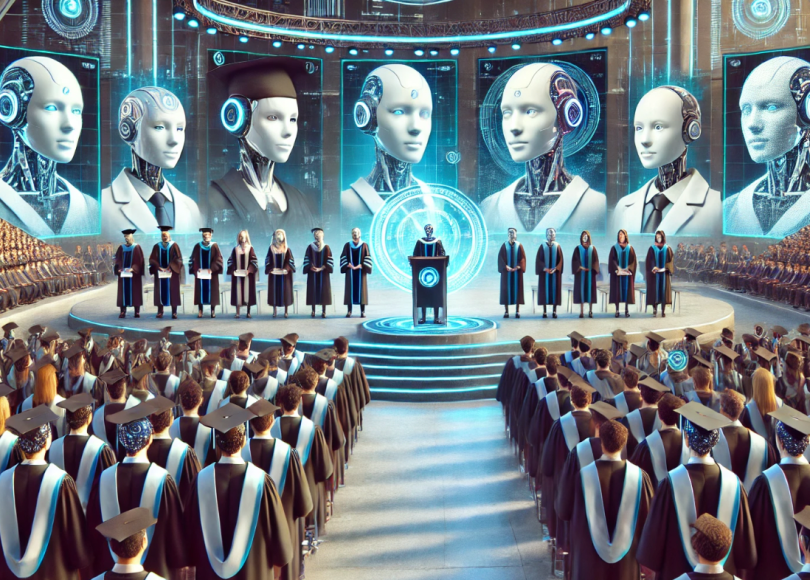
Today, we stand on the threshold of a new era in medicine, and you, the Class of 2050, are at the forefront of this transformation. You are the last generation of doctors who have trained, learned, and practiced without the direct assistance of advanced artificial intelligence. This fact alone makes your journey unique, and your achievements are nothing short of extraordinary.
You have spent years mastering the intricacies of human biology, diagnosing ailments, and developing treatment plans—all relying on your knowledge, intuition, and experience. You have been the custodians of human health, the healers who have listened to patients’ stories, and the hands that have performed life-saving surgeries. You are the embodiment of centuries of medical tradition, wisdom passed down from one generation to the next.
But now, as you step into the next phase of your careers, you will no longer walk this path alone. Advanced AI systems, capable of analyzing vast amounts of data in seconds, will be your partners in the pursuit of health and wellness. These machines, with their ability to predict, diagnose, and even treat with unparalleled precision, will challenge and complement your skills. Together, you will achieve feats that were once thought impossible.
Yet, as with all great advancements, this partnership comes with its own set of challenges. You will need to navigate the ethical dilemmas that arise when machines make decisions that once rested solely in human hands. You will face the question of what it means to be a doctor in a world where AI can outperform humans in certain tasks. And you will be tasked with ensuring that the human touch—the empathy, compassion, and understanding that define medicine—remains at the heart of your practice.
It is important to remember that AI, for all its capabilities, lacks one crucial element: the ability to care. It cannot feel the pulse of a patient’s anxiety, the warmth of a reassuring smile, or the pain of loss. These are the qualities that make you irreplaceable. Your role as doctors will evolve, but your humanity will always be your greatest asset.
As you prepare to work alongside these intelligent systems, I urge you to embrace this change with an open mind and a courageous heart. Do not fear the future, for it is one that you have the power to shape. Use the tools at your disposal to enhance your practice, to reach new heights in patient care, and to ensure that every decision, no matter how data-driven, is made with the patient’s well-being at the center.
You are not just the last generation of human-only doctors; you are the bridge between the old and the new, the stewards of a legacy that will continue to evolve long after you have retired your stethoscopes. The future of medicine is in your hands, and I have no doubt that you will lead us into this new era with the same dedication, wisdom, and compassion that brought you here today.
Congratulations, Class of 2050. The world of medicine awaits your leadership. Go forth, and make history.
- Chat GPT https://chatgpt.com/
Reflection:
The commencement speech shows the important ideas about identity and representation, as well as helping us think about how medicine is changing while technology becomes more advanced.
Let’s start with identity. The speech is directed to the last group of graduating human doctors. It describes who they are, which are humans that are about to become doctors who have spent years studying and developing the skills that will help them become elite human doctors. However, their role is about to change completely. They now have to work alongside AI, which can and will handle many of the things they once did. This is because the AI machines/robots will be much faster and more accurate, but they can’t connect with people. The speech also highlights that these graduates will still play a crucial role because they offer things AI can’t, which is human compassion and care. There is a clear difference: one side, humans who understand emotions and can build trust with patients, and the other, AI can get all the data and precision, but no empathy.
In terms of representation, the speech shows how medicine is at a very big turning point. Doctors, AI, and patients are all portrayed in ways that show larger cultural concerns about the change. The doctors are shown as the final generation of workers before AI completely takes over. On the other hand, the AI robots are being seen as powerful but also lacking the empathy that humans have. This sums up how a lot of people feel about technology today. We are amazed by the potential and its capabilities, but also concerned about what can be lost. The speech also states that doctors will use AI to increase accuracy while making sure that the human touch and interactions remain the same, implying that the future will be a balance between humans and AI.
The main message of the speech is about embracing change while still holding onto what matters most to humans. It reminds the graduates that even though AI will change the way medicine is practiced almost completely, their human touch will always be important. This reflects a much greater shift in how we think about the future and the use of AI. AI may take over some tasks, but the personal qualities that define us such as empathy and human connection will still be essential, especially in the medicine field.

